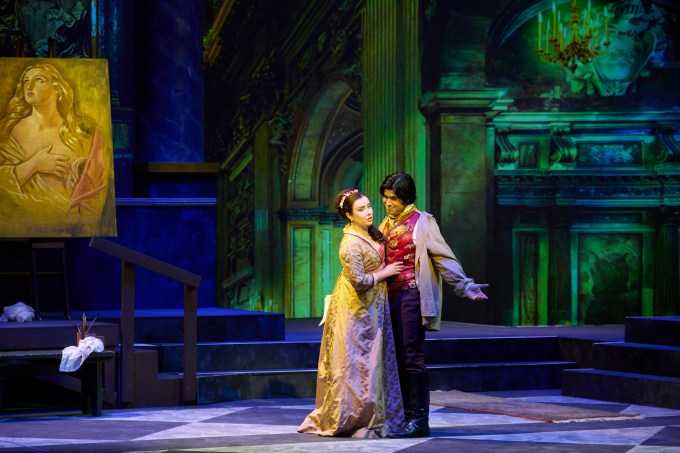
Giacomo Puccini is renowned for soaring lyricism and accessibility in his operas. What many aficionados do not realize is that with the exception of his failed first full-length opera, Edgar, the title character of each of his seven three-act operas is female – a testament to his love for the female voice. While most of his heroines – Mimi, Cio-Cio San, Manon, and Magda – are designed for lighter voices, Tosca is the most demanding of his female roles and one of the challenges in all of opera. It is long and mostly dramatic, with shrieking and demanding range, yet requiring lyric beauty.
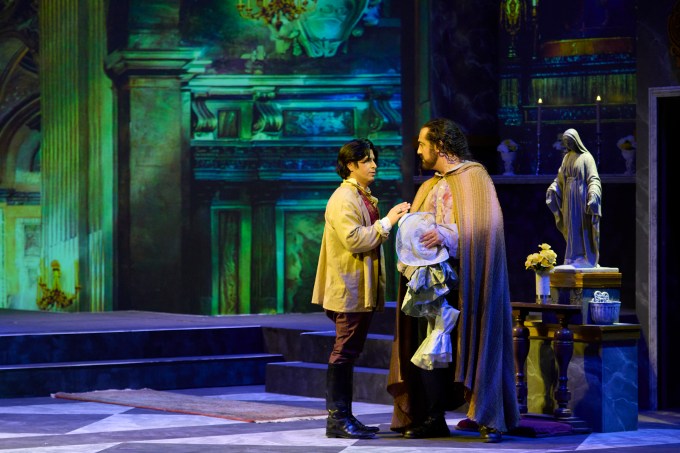
Although some find Tosca dark and overwrought, its libretto by Luigi Illica and Giuseppe Giacosa offers the proper complement of characters with a protagonist, a love interest, and a venal antagonist. One might question whether Tosca is the protagonist and Cavaradossi the love interest or vice versa, but undoubtedly, Scarpia is among the most craven villains in opera.
The highly dramatic plotline also embraces complexity with conflict, betrayal, retribution, misdirection, and the deaths of all major principals by different means. The music meets the demands of the libretto at every turn, including some of Puccini’s most memorable arias as well as the powerful and ominous Scarpia leitmotif.
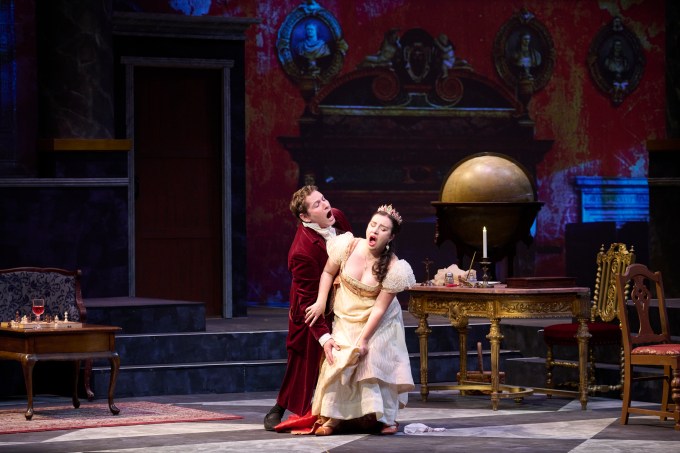
For those not familiar, singer Floria Tosca is in love with painter Mario Cavaradossi who, having hidden an escaped political prisoner, crosses swords with Chief of Police Scarpia. The lascivious Scarpia promises that if Tosca submits to him sexually, he will save Cavaradossi from execution. Any opera lover knows that a bloodbath driven by bad faith, relentless pursuit, and broken promises ensues.
West Bay Opera offers a traditional staging of Tosca to fine effect with a trio of strong-voiced principals to lead the way. Julia Behbudov returns to West Bay having starred as Desdemona in Otello last year. Although adept in spinto roles, her dramatic vocal skills are very much in evidence in this eponymous part. Indeed, Tosca’s signature aria “Vissi d’arte,” provides a broad swath for interpretation as she pleas with Scarpia that she “lives for art” and doesn’t indulge in political intrigue. While it can be caressed and the dynamics varied considerably, Behbudov goes from forte to fortissimo in a high energy delivery. What is remarkable is that she has the voice to sing the aria after the demandingly harsh prelude of her confrontations with Scarpia earlier in Act 2.
Xavier Prado is Cavaradossi, and corresponding to Behbudov, he possesses a high range that is generally lyrical but with the additional asset of capacity for big sound. Happily, the voices of the two lovers are very compatible in their high-volume duets. Cavaradossi is twice blessed in the firmament of most loved arias. In the beautiful Act 1 “Recondita armonia,” (“Hidden harmony”), he caresses the sounds of reconciling his appreciation of the beauty of another woman yet thinking only of Tosca.
His highlights are bookended with his passionate and ominous “E lucevan le stelle” (“And the stars were shining”), in which he regrets losing the love of his life as he anticipates death, even though he’s been told that the execution will be a sham. The stunningly romantic aria is introduced by a mourning clarinet solo, and instrumentally-led melody. Perhaps if it weren’t for Pavarotti’s popularizing Puccini’s “Nessun dorma,” (“Nobody is sleeping”), it might be opera’s most popular tenor crossover hit.
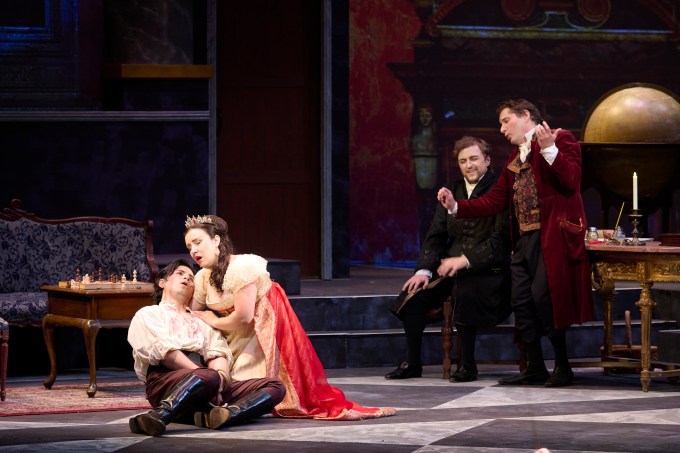
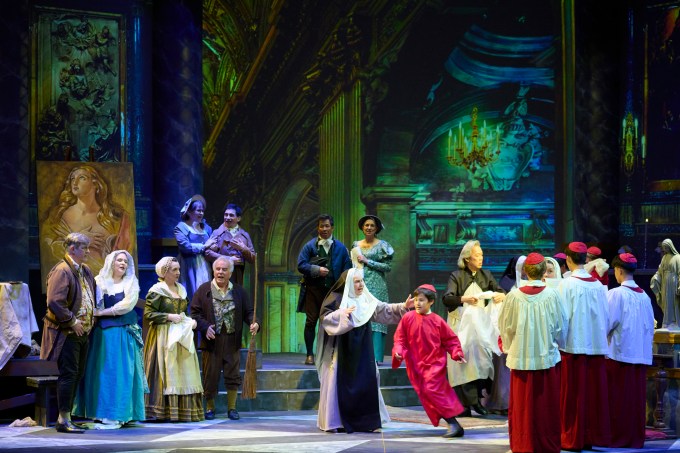
Robust baritone Robert Balonek portrays the evil Scarpia, most fitting as he played opera’s other most famous villain, Iago, in WBO’s production of Otello last year. Balonek’s always deep and powerful voice suits the seething, hypocritical Scarpia. His teeth-bearing rendition of the compelling “Tosca/Te Deum,” chills. While the choir sings praises of the Lord, Scarpia overlays the religious rapture with his lust for Tosca and how he will have Cavaradossi executed and delusionally, how he will win Tosca for his own.
Tosca will always be one of opera’s most thrilling pieces. Even if some smaller character parts and orchestra performance is a bit uneven, as was the case here, the production offers more than should be expected, and there is much to love. Congrats to General Director Jose Luis Moscovich and West Bay Opera.
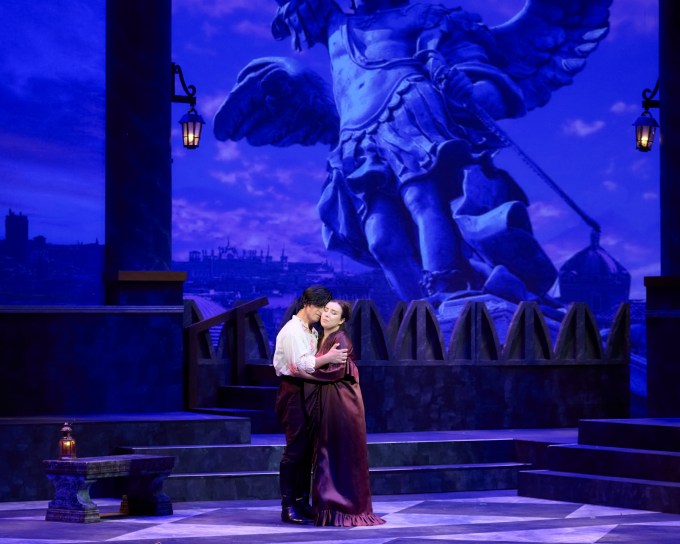
Tosca composed by Giacomo Puccini with libretto by Luigi Illica and Giuseppe Giacosa is produced by West Bay Opera and plays at Lucie Stern Theatre, 1305 Middlefield Road, Palo Alto, CA through May 31, 2026.

