(center in pink) Adia Evans as Ariadne, (surrounding in blues) Nymphs – Abigail Raiford as Echo, Jennifer Robinson as Nyade, Katherine Dobbs as Dryade. All photos by Kristen Loken.
Richard Strauss established his excellence and diversity as an opera composer from the very start. With Solome and Elektra, both from Greek classic theater, he elicited powerful emotions from the harrowing story lines accompanied by his harsh music. Following was his first collaboration with librettist Hugo von Hofmannsthal, Der Rosenkavalier, a romantic comedy with delicate, ethereal music placed in Vienna in the 18th century.
Strauss continued his relationship with von Hofmannsthal, composing his fourth opera, Ariadne auf Naxos. Structurally unique, this highly convoluted opera-within-an-opera, contains an envelope in modern times of two troupes preparing for private performances and as the enclosure an opera which returns to the Greek classics. It also uncommonly and successfully embraces both opera seria and commedia dell’arte in the form of opera buffa.
Enes Pektaş as The Music Maker, Theo Claveles as The Composer, Emilie Kealani as Zerbinetta, Ryan Bryce Johnson as The Choreographer.
Merola Opera offers a spectacular take on this piece. Strauss loved the female voice. His first two operas had female title characters, and in each of his next two, the cast is headed by two sopranos and a mezzo in a trousers role. In this production, the trio is absolutely stunning. It may be added that the three female nymphs are stellar as well, along with the whole cast ensemble. Simple but effective gray-and-green-hued staging by Alexander V. Nichols provides a subtle backdrop for the bright costumery from Cynthia Savage. Accomplished Director Omer Ben Seadia brings it all together in brilliant fashion.
Ariadne auf Naxos is not the easiest opera to understand. First comes The Prologue in which an opera company and a comedy troupe are both to perform in the house of a wealthy patron. They clash upon finding that given time constraints, they must perform simultaneously!?!? “Act 2” is referred to as The Opera, but the dramatic story of mournful Ariadne awaiting death on a barren island is interrupted by five comic actors led by the flighty Zerbinetta.
A prelude precedes all else, offering the opportunity for Conductor Ann-Katrin Stöcker and her unusually specified orchestra with doubled woodwinds to display its lush sound in its amalgam of melodious passages. The prologue itself introduces a cacophony of characters as the two teams skirmish on how to manage the unmanageable task of combining their two performances into one. This light-hearted and chaotic act contains all manner of variety including clashing musical styles to represent the two troupes and much spoken word.
Theo Harrah as The Waiter, Claire Choquette as The Chief of Staff, Logan Wagner as Scaramuccio, Emilie Kealani as Zerbinetta, Ryan Bryce Johnson as The Choreographer.
Despite the involvement of a raft of performers, The Prologue is owned by the conflicted Composer who suffers angst as he must make changes to the opera score. Theo Claveles, with a silken, yet powerful mezzo in the trousers role excels, reaching Wagnerian proportions in the duet with Zerbinetta. The other intriguing performer is Ryan Bryce Johnson who stands out as The Choreographer, both for the rich timbre of his tenor voice and his comedic acting.
But the serious, sustained vocal excellence comes at the beginning of “Act 2”, The Opera. Ariadne lies on a rock in front of a cave awaiting Hermes to take her out of the world of the living as the nymphs stand by consoling.
The wonderful Adia Evans broods with sumptuous vocal beauty in the aria “Wo war ich?” (“Where was I?”), convinced that real life as she knew it is no more. Then, after a brief respite to catch her breath while the nymphs interject, she follows with the aria “Es gibt ein reich,” (“There is a realm”) in which she continues, anticipating death. Evans amazes with a honey-tinged soprano – round and powerful – while commanding the dynamics and range with great facility.
John Mburu as Truffaldino, Emilie Kealani as Zerbinetta, Cole McIlquham as Brighella, Paul Jang as Harlequin, Logan Wagner as Scaramuccio.
Yet, the signature aria from the opera, considered one of the most demanding in the coloratura repertoire is yet to come. That task is assigned to Zerbinetta, delightfully portrayed by Emilie Kealani. In “Grossmächtige Prinzessin“ (“High and mighty princess”), she rebukes Ariadne by noting that her love and her pain is no different than any other woman. They all have trembling, beating hearts.
Vocally lighter than Evans or Claveles, but extremely agile, Kealani rounds out the distaff threesome of delightfully memorable singers and performers. She delivers joyously and is able to navigate the treacherous leaps and trills of the demanding aria with abandon.
Ariadne auf Naxos is not generally considered among the very best of Richard Strauss’s operas, but nonetheless, it is a worthy masterpiece firmly in the repertory. The music is beautiful and the structure and story are engaging.
Adia Evans as Ariadne, Matthew Sink as Bacchus.
Because of the large ensemble with highlights for many performers, Ariadne gives opportunities to many Merolini. Thematically, its being a metaopera, it fits the very real trials that artists have to deal with like collaboration and compromise. Merola has mastered its challenges and produced a rendition of this opera that leaves the audience stunned and in awe.
One bone to pick is with the supertitles in this production. I was totally at sea early on as to who the characters were, and I’m certain that I was not alone. Particularly in an opera with many characters introduced at once and/or in which characters are not immediately introduced by name, it would be very helpful to identify characters in the supertitles minimally as they first sing. It is not clear to me why most opera companies are deficient in this matter, and not enough room on the supertitles or any shifting of responsibility to the audience is simply unacceptable.
Cast.
For those unaware, Merola is a summer opera training program for young artists financially independent of but having close artistic collaboration with San Francisco Opera. It is one of the most esteemed programs of its kind in the world.
Ariadne auf Naxos, composed by Richard Strauss with libretto by Hugo von Hofmannsthal, is produced by Merola Opera and plays at San Francisco Conservatory of Music, 50 Oak Street, San Francisco, CA through August 1, 2026.
Kevin Singer as Niccolo Machiavelli. All photos by Robbie Sweeny.
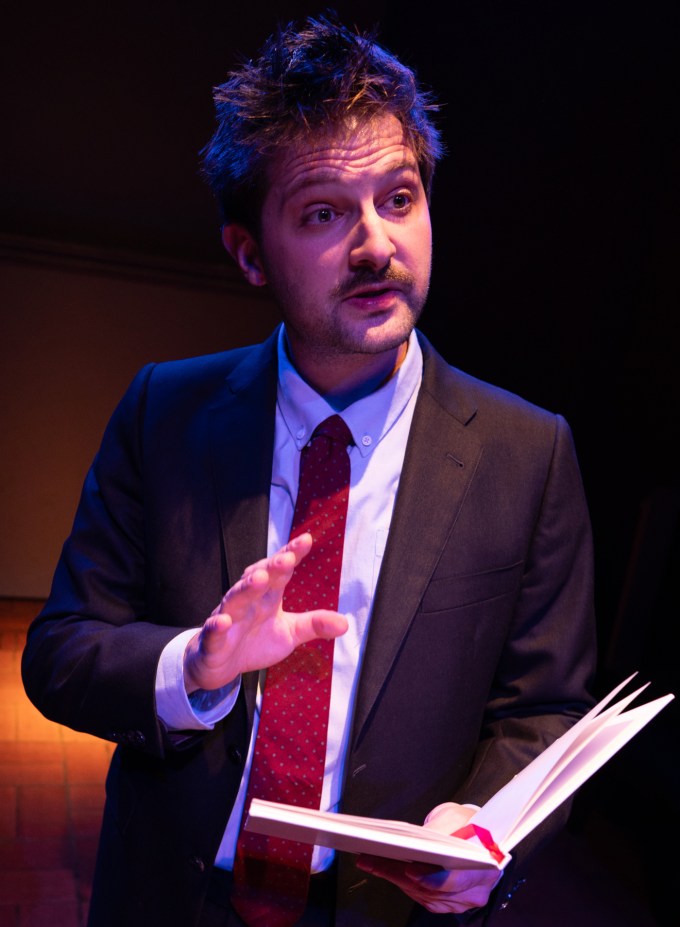
Berkeley-based theater company Central Works will be closing its doors after three decades of producing original works and delighting audiences in its intimate space at Berkeley City Club. Playwriter-Director Gary Graves, who has co-helmed the company for most of that time along with Co-Founder Jan Zvaifler, offers as his swan song six hours worth of history amplified by imputed relationships. The Prince Part 1 & Part 2, reflect on the life and times of Niccolo Machiavelli, a figure who has been the focus in several of Graves’ plays. Though freestanding and interesting on its own, Part 1 acts as a prelude and relates to Machiavelli’s early dealing with ham-fisted leaders. Indeed, it is his counterparts who really drive the action, while Part 2 reveals his evolution as a political strategist.
The Prince Part 2 involves five actors in seven roles, whereas, Part 1 acts fundamentally as a two-hander. While the cast is comprised of three actors, the two-actor first act imagines the relationship between Machiavelli and the radical ascetic priest Jerome Savonarola, who, now under arrest, was the main architect of the Republic of Florence and its de facto leader from 1494-1498. Also, with only two characters played by one actor each, the last two acts could be a separate play, as they ascribe the association between Machiavelli and Cesare Borgia following Savonarola’s downfall.
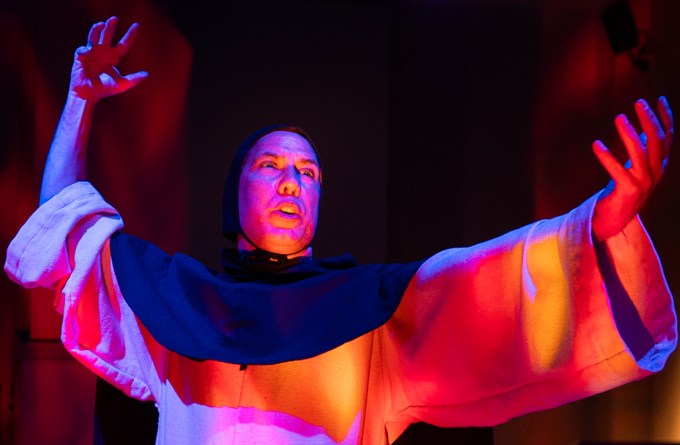
Mark Farrell as Jerome Savonarola.
With the exception of a physical threat by Cesare on Machiavelli, the work contains virtually no dramatic action like sword fights or scaling walls, but it is driven by intense exchanges between the principal character and the two figures who left their marks on the history of northern Italy. Although three-hours long on a bare stage save for occasional props, the play grabs the attention through outstanding acting; interest in the historical moment; and literate writing with taut dialog and diversion with occasional declamation. The complex intrigue among seen and unseen historical figures tantalizes.
That said, Savonarola’s theocratic demands, control, and terror are not depicted as clearly as they could be. For instance, despite his call for destruction of all things ungodly and which inspire pride be destroyed, the consequences of the bonfire of the vanities are not developed. The vertical morality exercised by Savonarola in the name of republicanism differs little from Christian nationalism and its slavish acceptance of the current administration in this country.
At the time of the narrative around the turn of the 16th century, the principal character was about 30 years of age and was a senior bureaucrat, who in the play acts merely as a messenger for political leaders of Florence. Thus, the notion that he should be a stronger adversary to Savonarola and Cesare Borgia in this play would be mistaken. As a political philosopher, Machiavelli would later author The Prince, whose prescription that good outcomes warrant bad deeds became known as Machiavellian. However, that work which is an arid handbook for rulers was not published until 1532, five years after his death and decades after the events of this play. It can also be noted that most who are driven to write are introverts and not people of action.
Kevin Singer is outstanding as Niccolo Machiavelli, capturing the nuance of a character who is underpowered but involved in weighty matters as an intermediary representing the governing council of Florence. Although forceful at times, he more often seems curious, uncertain, and even intimidated by Savonarola, played with sanctimony and fiery religious conviction by Mark Farrell.
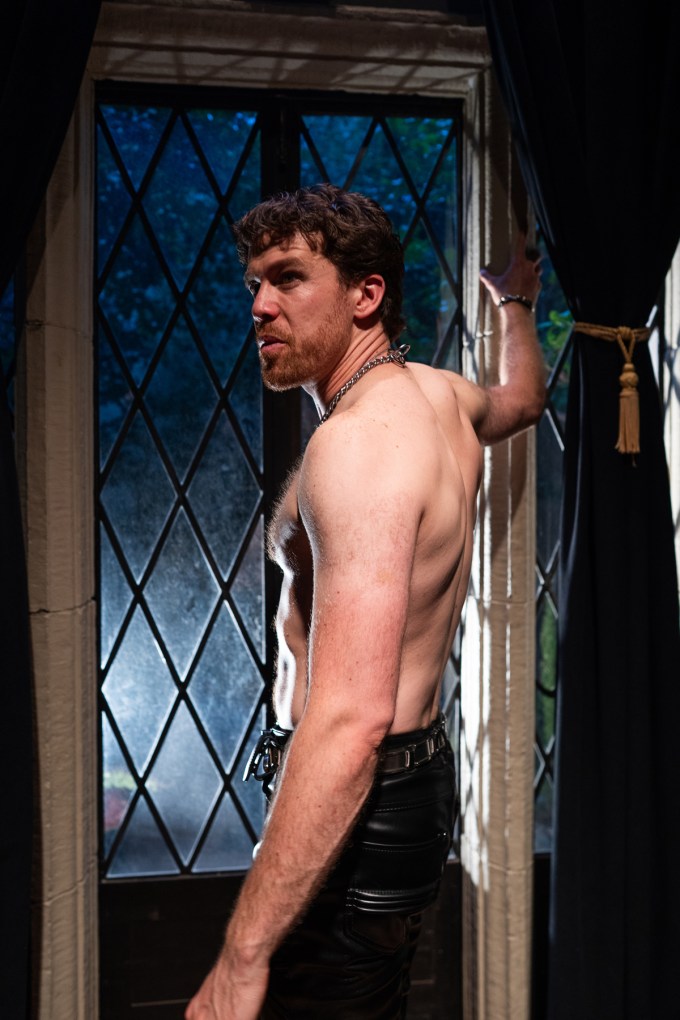
Brennan Pickman-Thoon as Cesare Borgia.
As the priest, Farrell acts with confident authority as one who always has a spiritual counterpoint to anything that contests his actions. But he is under threat as he has been excommunicated by Pope Alexander VI, whose authority he disputes, in part because the pope acknowledges fathering children by mistresses. So Savonarola remains a cleric and effectively the leader of Florence. But those who Machiavelli represents wish to see Savonarola gone, and the emissary offers the escape.
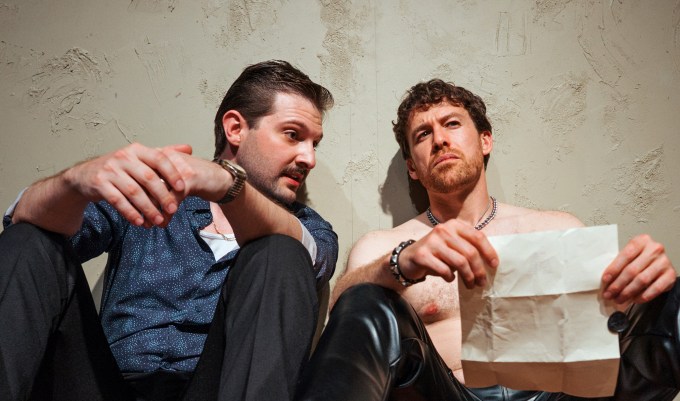
The connection between Machiavelli’s two counterparties in the play is that Cesare Borgia is the son of the pope who has expelled the priest. A feverishly intense Brennan Pickman-Thoon as Cesare dominates Machiavelli by dint of personality, humiliating the weaker man by forcing him to dress as a prostitute for a ball. Cesare also commands military power, but the bureaucrat enters negotiations with a key card noting that Cesare’s power relies on his relationship with the Vatican, which could alter should his father be deposed or die.
The Central Works production is simple as most talkathons are, though a detailed soundtrack by Gregory Scharpen enhances the play. The one controversial element concerns the strategic decision on Tammy Berlin’s costuming. Savonarola’s hooded robe appears to be of the period, but Machiavelli is almost always in a contemporary business suit. Cesare also wears modern dress, but his costumes include black latex pants and a flowery shirt that look straight out of a gay leather bar; shirtless (ditto); and a Soviet army tunic. Why all this? I don’t know.
Kevin Singer as Niccolo Machiavelli, Brennan Pickman-Thoon as Cesare Borgia.
In any event, The Prince Part 1 provides an enticing glimpse into Florentine history from the perspective of a young Machiavelli. It serves as a stimulating prelude to the more expansive Part 2, in which the central figure is more accomplished and interacts with other notables of the period – Lorenzo de Medici, da Vinci, and Michelangelo.
The Prince Part 1 – the life and times of Niccolo Machiavelli, written and directed by Gary Graves is produced by Central Works and plays on its stage at Berkeley City Club, 2315 Durant, Berkeley, CA through September 6, 2026.
AmaWaterways has pioneered this cruise as the first non-Amazonian river cruise in South America to be served by an international cruise line. It plies between the least touristy of the major Colombian cities and the most, with each pole having much to offer. The river itself is the most important waterway of Colombia, the home to old colonial cities; Afro-Caribbean settlements; vast bird populations; the largest wetlands in Colombia; and the classic folk dance, the cumbia. Kudos to AMA, not only for opening up the route but for sponsoring activities for their passengers in the small towns that have added employment and new dimensions to the local economies. Although this commentary is not intended to be an AmaWaterways promotion, the fact is that the cruise is both enjoyable and the only practical way to visit this region.
My wife Karin and I travel extensively, and this is an itinerary that targets the seasoned traveler or the adventurer looking to do something out of the ordinary. And because this market is newly developed, some allowances should be made. Hosting only 80 or so passengers, the AmaMagdalena experience is intimate in a setting that offers the functionality of larger river ships but less glitz and a little less activity than its European sister ships. Because many of the excursion sites are otherwise underdeveloped, it is particularly important to visit this region on a cruise that has the contacts to ensure that you experience the best.
Just your average sunset on the river.
Dining on AMA offers a mix of international and Colombian cuisines, with pretty comparable breakfasts but other meals that don’t quite meet AMA’s high standards in Europe. Variety of fruits given Colombia’s vaunted biodiversity is a plus, while chronic overcooking of meat, and limited snack offerings during off-meal hours are minuses. The one dining room venue is all-purpose except for the once-a-week chef’s tasting dinner, which is a step above the regular fare, and an outdoor barbeque which is tasty and fun.
Excursions and most alcoholic drinks are included. Staff attitude and personal attentiveness is excellent, but there is a laxness on keeping various inventories refreshed. We did have itinerary changes that were necessary because of uncontrollable conditions but were sometimes not well communicated, and talks about the locale and coming activities were uneven. Still, all of the passengers we talked to were happy with the experience, as were we.
Colombia is a land of great variation from snowcapped mountains to deserts, a primary source of metals, cocaine, emeralds, coffee, and cut flowers. Karin and I had been in Bogota, Medellin, and Cartagena but were most pleased to add this experience to our memory banks.
Barranquilla
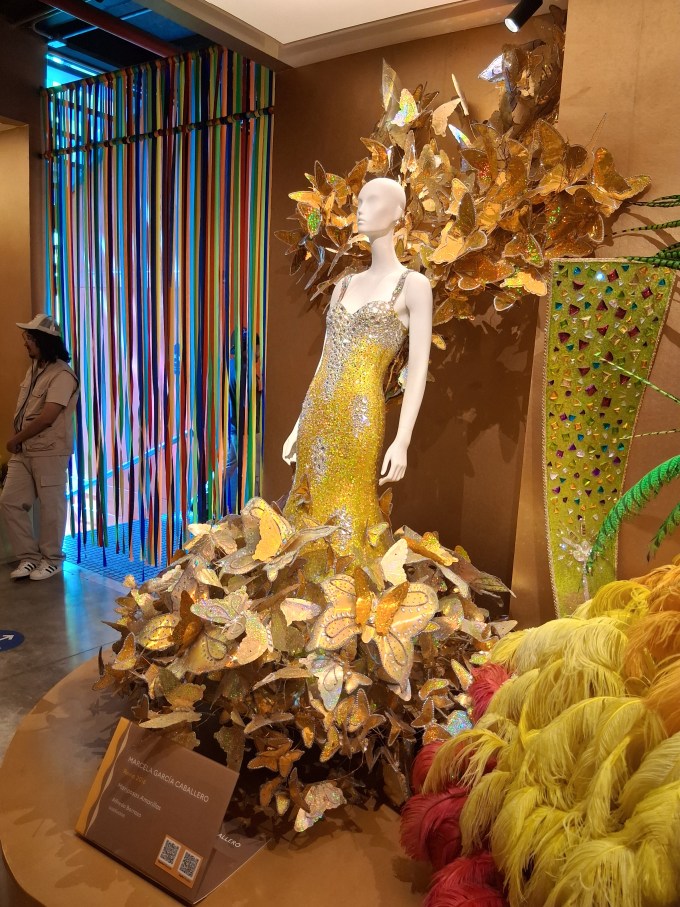
One of many elaborate Carnaval Queen’s gowns at the Carnaval Museum. The yellow butterflies honor Gabriel Garcia Marquez who employed them in his fiction to represent the fragility of love, renewal, and optimism.
The fourth largest city in the country, its success in trade and industry has not been accompanied by tourism, but that is changing with a newfound focus. Unlike other Colombian cities, there is no colonial area as it was destroyed by the Spanish in revenge for the revolution which freed Colombia, Venezuela, and Ecuador. The new part of town where the international hotels are found is a vast area of high-rise apartments on well-kept streets which is extremely safe. Numerous appealing malls house famous international retail shops, many restaurants, and a buzz of activity of locals. The city is famed for having the world’s second largest Carnaval to Rio’s and hosting the nation’s soccer team. We were there during the 2026 World Cup, and the whole country was fanatic for their team. The yellow national jerseys were in abundance on days when the team tied the highly ranked Portugal in group play and defeated Ghana in the first knock out round but then lost to Switzerland on penalty kicks.
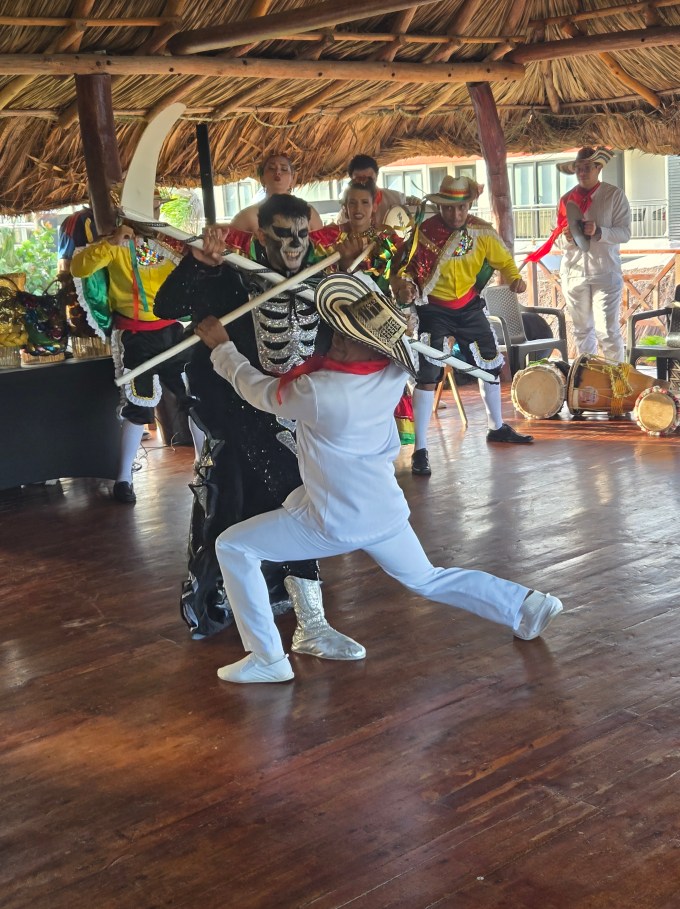
Performance of a Carnaval skit.
After embarkation and a Carnaval-like performance, our first cruise day stayed in the city, and the local tour was very engaging. The star is the Carnaval Museum, which is terrific, with large displays of the stunning costumes of Carnaval queens; an honor display of the queens and their tiaras; memorabilia associated with the event; and ten video stations of Carnaval around the world from New Orleans to Cochin, India.
The Gran Malecon is a 3-mile-long parkland along the river with many places to play and eat. Two sculptures of Barranquilla’s most famous and prized citizens can be found there, Shakira and Sofia Vergara! A third honored daughter is Paulina Vega, 2014 Miss Universe and the Godmother to the AmaMagdalena. Also noted with somewhat more dignity is Nobel Prize for Literature winner Gabriel Garcia Marquez (100 Years of Solitude and Love in the Time of Cholera) who spent formative years here as a child and later as an adult establishing his journalistic and literary credentials.
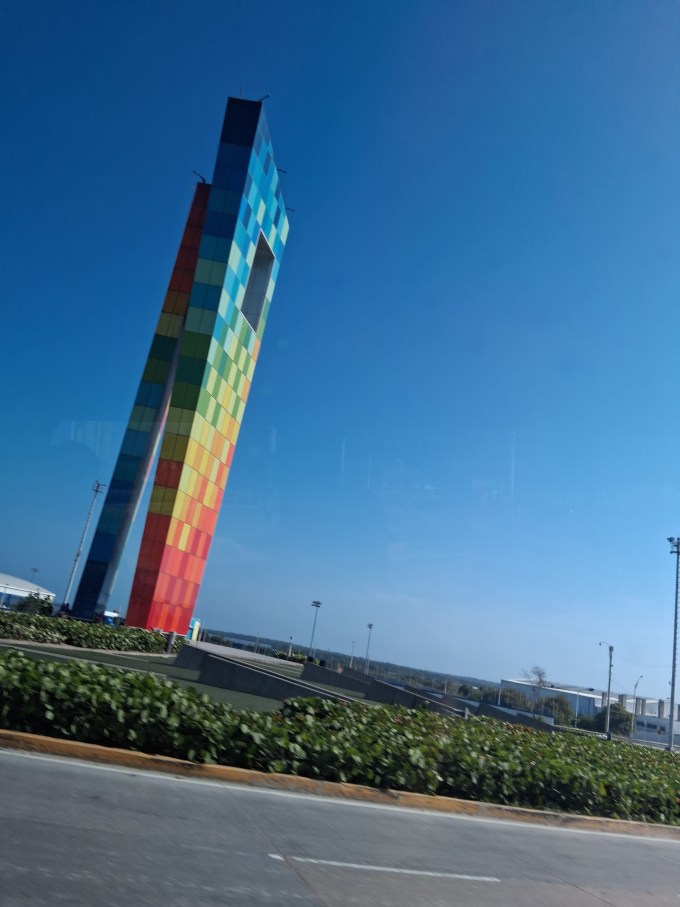
Ventana al Mundo (Window on the World).
Other highlights include the historic Hotel El Prado, which holds a number of significant firsts as the first Latin American tourist hotel and the first in Colombia with private baths and in-room telephones. Adjacent is the Barrio El Prado, a preserved Art Deco era community with an abundance of mansions from the era including some with fanciful architecture such as Moorish. Two monuments were sponsored by Technoglass owner Christian Daes, the most important of which is the modernistic Ventana al Mundo (Window on the World) from 2018 which is comprised of two linked arches of large glass panels in many bright colors.
Cruising the Rio Magdalena
Though the river runs 1,000 miles from the southwest of the country, this itinerary is in the northeast sector. The surrounding land is mostly flat, and banks are mostly lush having considerable agriculture of bananas, palms, and root starches as well as cattle. In these reaches, the Magdalena is typically around a quarter of a mile wide, but it is subject to low water conditions. On our cruise, the section closest to Mompox was deemed too shallow for the cruise ship, so speedboat launches were used to deliver passengers to the town – one hour and a quarter each way. A different wetlands than scheduled was visited, but it was convenient by speedboats and perfectly suitable.
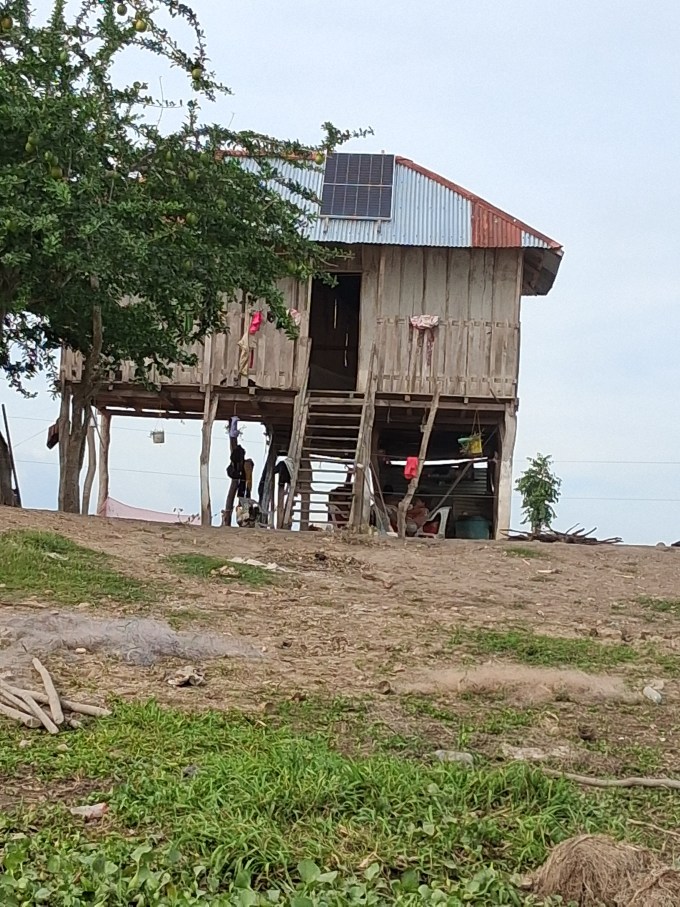
Typical Rio Magdalena peasant house on stilts because of flooding and with solar panels because of being off the grid.
The 80 miles closest to Cartagena is actually on the narrow Canal del Dique, rebuilt by the Spanish in its current form in the mid-17th century to provide easier access to the Magdalena.
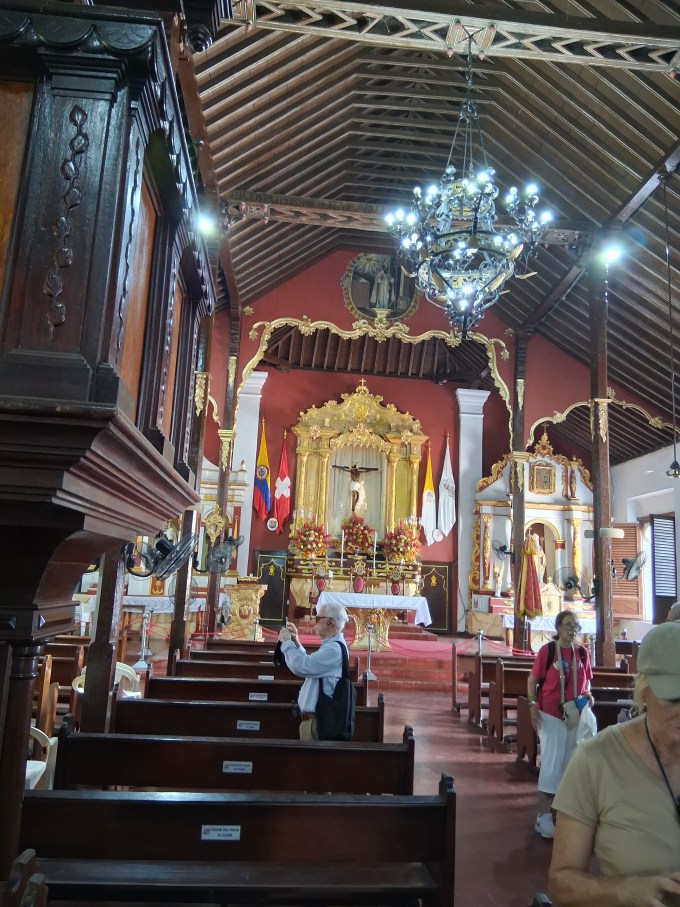
Inside Mompox Basilica from 1603.
Fishing is a major industry and bird life is profuse, so birdwatching is a recurring event on the cruise with formal nature sessions along with incidental observation at any time. Of the 8,000 species of birds on the planet, over a quarter are in Colombia, many of them indigenous to the country. Some are variants of species common the United States like egrets (they are so frequent, it’s hard to imagine you would see more anywhere else), cormorants, and kingfisher, while others are more exotic like wattled jacana, brown throated parakeet, and smooth billed ani.
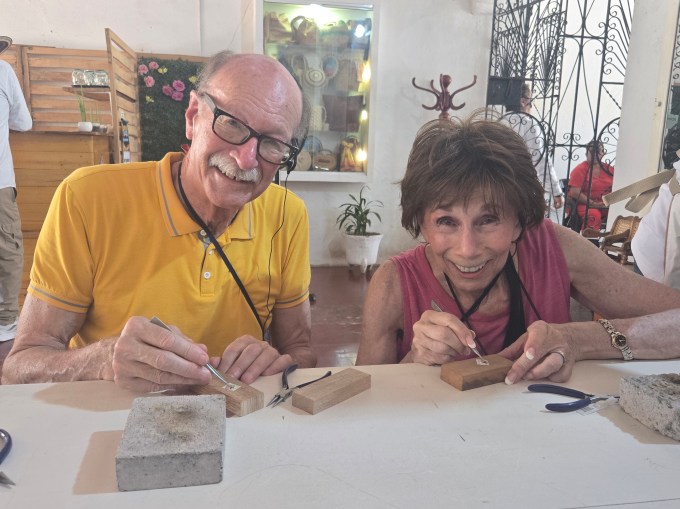
Vic and Karin try their hands at making silver filagree jewelry.
This is a region in which going on an organized tour is mandatory, as the events of interest are not obvious and most are only available to prearranged groups. And as compensation for the limits of sightseeing at the destinations, a number of activities arranged by AMA invigorate the experience. Probably the most involving participation was participating in the artisan process of making silver filigree, which proved to require great focus and patience. We rolled cigars, threw fishing nets, danced the cumbia with professionals, and more. Among viewings, we also observed fishing and much other folk and Latin dancing and music with a particular emphasis on percussion.
Fishing is a key enterprise for locals.
Two towns are of note. First is Palenque which has the historical significance of being the first town in the Americas founded by escaped (African) slaves, in 1603, before the first English forays into what would become the United States. It is still an all-black town with African accents in its dress and artifacts. Together, these characteristics have led to a UNESCO global heritage designation.
Karin holding a cigar hand-rolled by Vic.
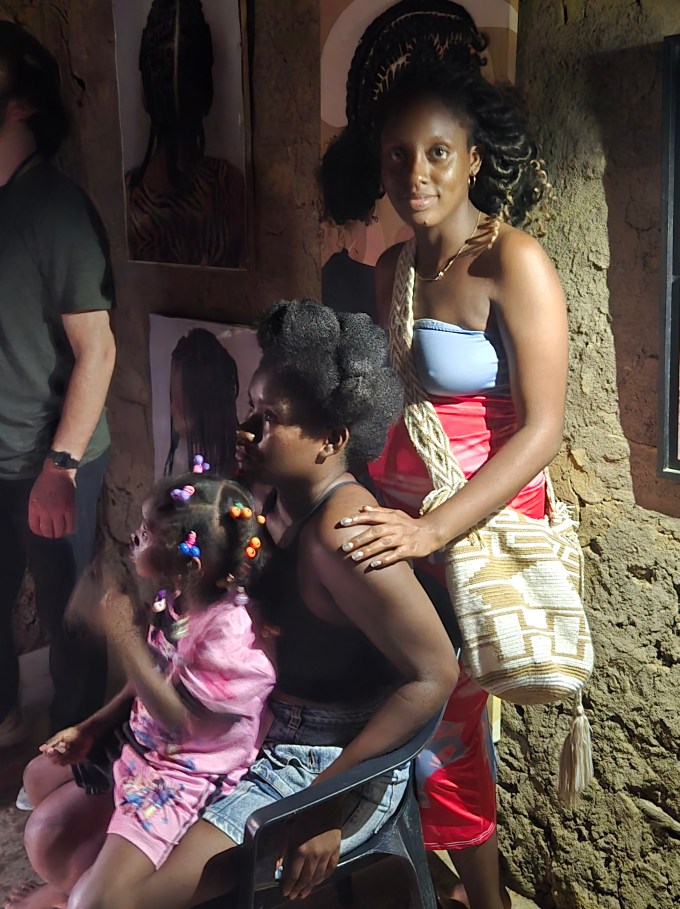
An interesting stop, it offered learning about the local dialect, which adds Bantu vocabulary to Spanish. We also visited a doctor of local holistic medicine, a hair braiding salon, a historic home, and the police station. Although Palenque rests in a heat zone, we fortuitously had a cooling downpour of rain that included hail. The Palenque skirt, a circle skirt in yellow, red, and blue, the colors of the Colombian flag, is lifted to sashay in dancing and is popular elsewhere, particularly in Cartagena.
A hair salon in Palenque.
As a charming town with colonial character and several nice churches, including one dating to 1603, Mompox is actually on an island in the river and the only noteworthy strollable stop on the trip other than Cartagena. It has a variety of restaurants, shopping for local products that exceed offerings elsewhere, and the largest wetlands in the country nearby. Otherwise, the towns along the Magdalena are pretty interchangeable.
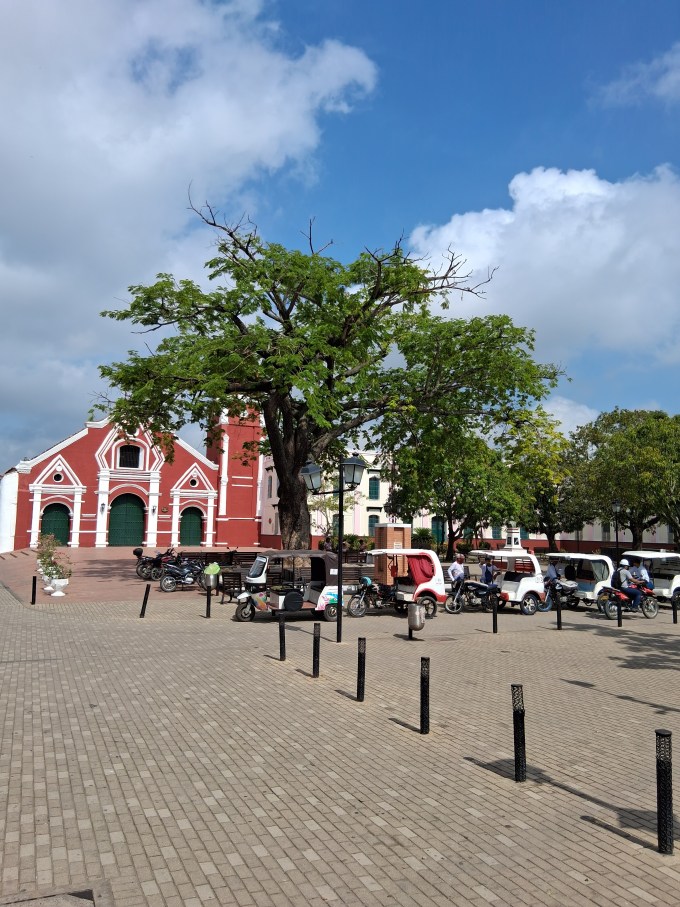
Tuk-tuks awaiting passengers from the cruise.
AMA-arranged transportation for excursions was always prompt, efficient, and appropriate. In addition to the speedboats on water, we moved around by Mercedes minibus, tuk-tuks, pedicabs, and by foot.
Cartagena
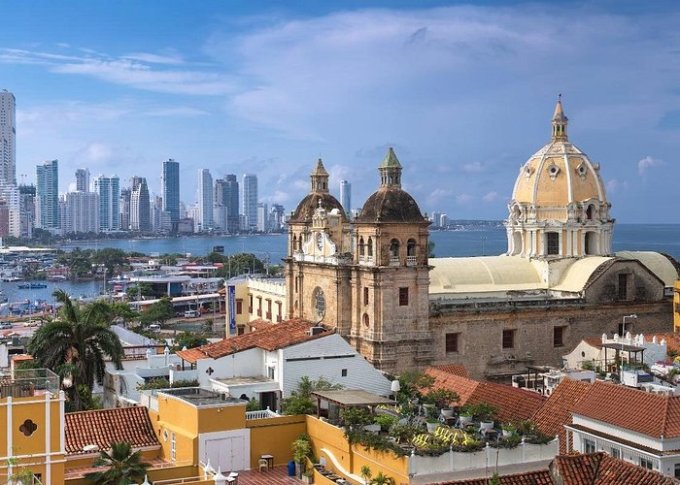
It doesn’t take long to realize why this is the largest tourist destination in Colombia and a very popular stop on ocean cruises. A Caribbean coastal city, it is the Miami of Colombia with a whitewashed look of apartment high-rises in beach areas. But its charm comes first from the old walled city, which is beautiful, formal, well preserved, and neatly kept as should be expected of a UNESCO global heritage site. Attractive colonial architecture from the 17th and 18th centuries exists throughout along with historic churches, small museums, and even the remains of Gabriel Garcia Marquez.
Cartagena – Old Town in foreground, the modern city at rear.
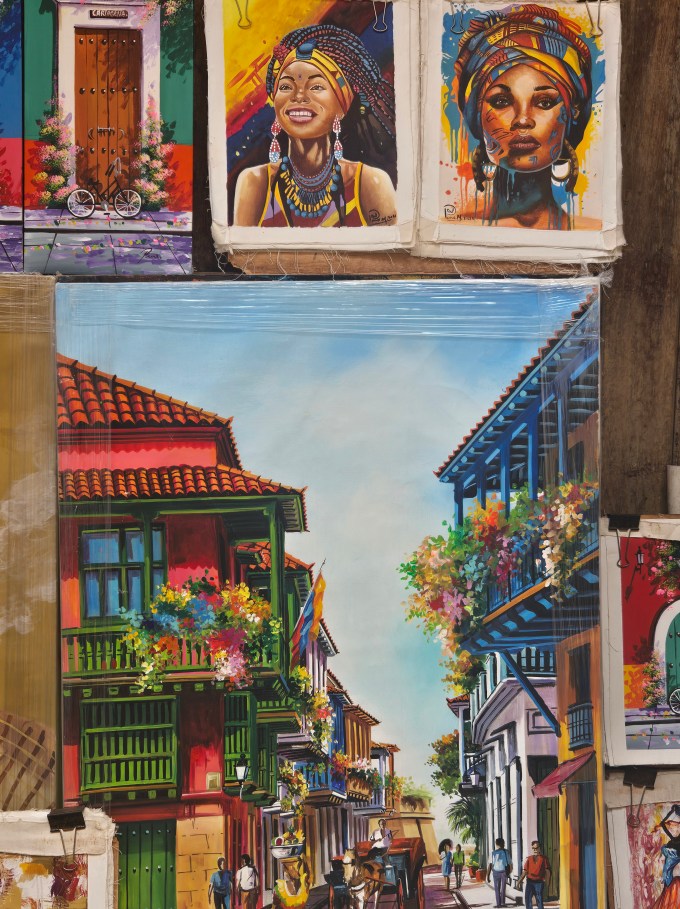
Apart from the obvious wall, the signal that you are there is the endless array of vendors selling souvenirs, drinks, and fruit. Motor traffic is limited within, but electrified hansom cabs offer a fun alternative way to get around. Quality boutiques, coffee shops, and restaurants abound, and what little evidence of multinational intrusion, like Hard Rock Cafe, is very discretely marked. Despite heat that can be brutal, tourists and locals generally maintain sunny dispositions.
Getsemani.
The other appealing tourist neighborhood is the adjacent Getsemani, which was a major source of revolution in the 1830s. More chaotic and spontaneous than Old Town, it also displays period architecture, but streets are narrower, buildings smaller and bursting with gay colors. Banners, flags, and other decorations add to the kaleidoscopic appearance. Street life is lively with many bars and cafes.
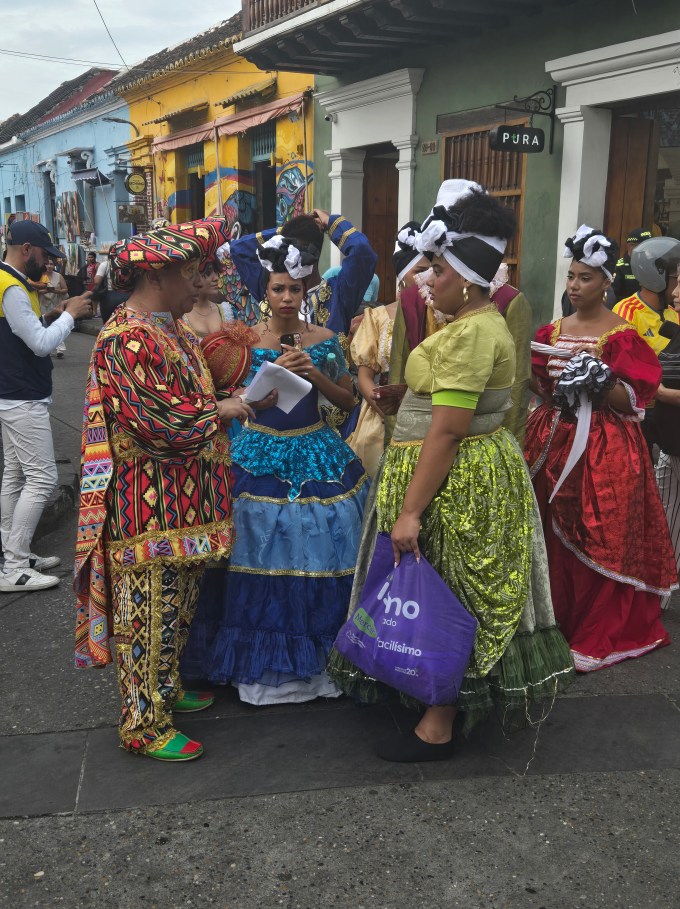
Actors preparing for a historical enactment.
The most iconic single destination is San Felipe Castle. The fortress was built to guard the city from pirates and other invaders, and it offers a panoramic view of Cartagena.
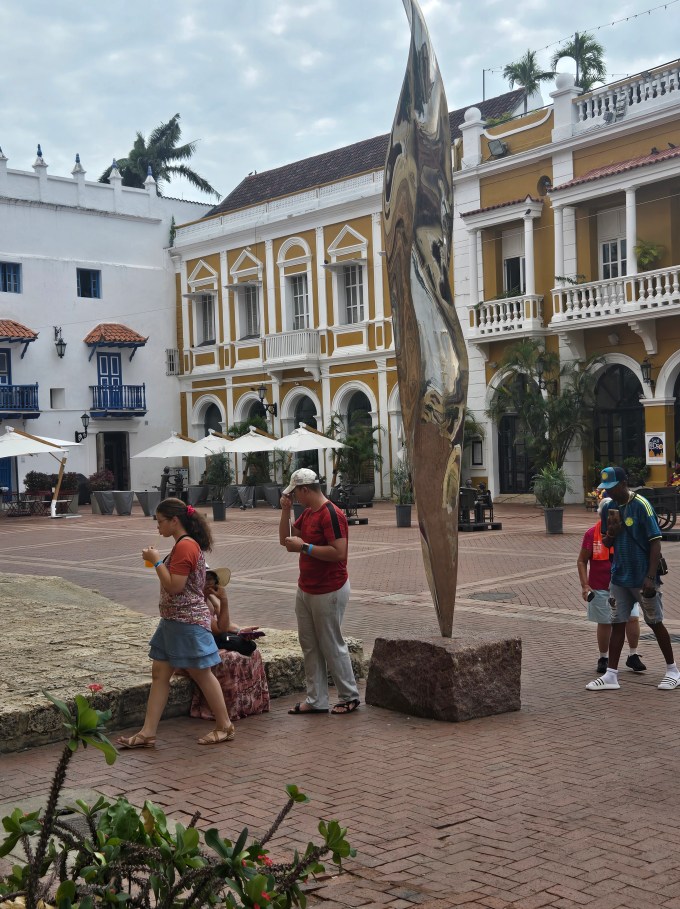
Old Town plaza.
Conclusion
Most Caribbean travelers will find Cartagena to be a distinctive and memorable cruise destination. The remainder of the itinerary on this river cruise targets the more experienced traveler or one with a disposition toward Latin American cultures. Those with appropriate expectations will find much to appreciate from AmaWaterways’ unique cruise.
Michelle Allie Drever as Magda, cast. Photos by Pocket Opera except where otherwise indicated.
Giacomo Puccini was perhaps opera’s greatest master of melody. Chronologically following his three wildly popular pieces (La Boheme, Madama Butterfly, and Tosca), the less frequently performed La Rondine (“The Swallow”), displays a maturity of his craft and combines some unique elements.
Since La Rondine was commissioned in Vienna as an Austrian-styled operetta, it contains light musical idioms as well as the integration of ballroom dance rhythms as tropes that make it special in his canon. Some aficionados consider this opera to be superior to Puccini’s more familiar ones, and Pocket Opera General Director Nicolas A. Garcia even identifies it as his favorite opera altogether. The company takes on this special work and endows it with a strong cadre of voices and a lush if compact production that make for wonderful entertainment.
The plotline could be characterized as La Traviata Light, as it concerns a courtesan who shares a loving relationship with a man whose family is not likely to support marriage. But, unlike Violetta in the Verdi opera, in this one, the central character Magda does not die.
Melissa Sondhi as Lisette, Alex Taite as Prunier.
Contextually, La Rondine holds an unusual place within Puccini’s operatic output. The maestro composed eight full-length operas. Dismissing the unsuccessful first produced, Edgar, which the composer deemed unredeemable, the remaining seven all have females as title characters. All but two are tragedies, with at least a key female principal dying. Tongue-in-cheek, some aficionados will say that if the heroine doesn’t die, it’s a comic opera. In this case, the narrative is legitimately comic in great part, relieving the weightiness that comes with many operas.
Structurally, while his previous operas had traditional pauses after arias and ensembles for applause, this one is through-composed, which in the case of many composers implies little in the way of memorable set pieces. But, after all, this is still Puccini.
So what is La Rondine really about? In the case of both female leads, they will have the opportunity and even the taste of greener grass, a new life that each has aspired to. But there are obstacles, known and unknown, and the question remains whether they can succeed and at what price. Will either fly away, or does the swallow return to its home?
The most satisfying, hauntingly beautiful melody and recurring leitmotif that most embodies La Rondine is about a character who doesn’t exist in the opera. Magda is a Parisian courtesan who holds lively soirees. One of her regulars is the poet Prunier (performed by the talented, bright-voiced tenor Alex Taite) who begins to tell the story of his creation, Doretta who has forgone wealth for true love. Magda, who will face this quandary herself, picks up on the tale as if it were her own and completes it with the magnificent “Chi il Bel Sogno di Doretta,” (“Doretta’s Dream”). Michelle Allie Drever is Magda, and she absolutely owns this lilting and limpid aria with her imposing, exceedingly powerful, darkly colored soprano.
Michael Kuo as Rambaldo.
In an unusual twist, Prunier is not interested in Magda, but in her maid, Lisette. In another unusual twist, Lisette, who is played by delightfully captivating soprano Melissa Sondhi, is saucy, defiant, cigar-smoking, and even borrows Magda’s clothes, hardly the invisible servant.
When Magda crosses paths with her impossible love, Ruggero, played by tenor Maxwell Ary, at the restaurant Chez Bullier, she is disguised to the extent that Ruggero doesn’t recognize her. Yet, he falls in love with Magda again in her guise as Paulette. Prunier and Lisette have also gone to Chez Bullier, and the four will collide by accident, with the lively result being a charming quartet, “Bevo al Tuo Fresco Sorriso” (“I Drink to Your Fresh Smile”), another musical highlight.
The fifth wheel in these proceedings is Rambaldo, a wealthy banker who has been Magda’s protector and sugar daddy. Portrayed with delightful ambiguity by compelling baritone Michael Kuo, it is uncertain whether he will be there for Magna should she return to her previous life if she separates from Ruggero.
Maxwell Ary as Ruggero, Michelle Allie Drever as Magda. Photo by Mike Thompson.
While La Rondine lacks the compendium of memorable arias and ensembles of some other Puccini operas, what it does have is warm, mellifluous music from end to end and characters that connect with the audience. And Pocket Opera always delivers more than should be expected from a company of its size – not to mention that it presently operates with the logistical disadvantage of performing each production at three very different small venues, an hour or more apart from one another.
Nonetheless, staging and costumery capture the period feel. Stage Director Elly Lichenstein creates a lively ambiance when called for, and Music Director Mary Chun leads the small but effective orchestra with conviction.
La Rondine, composed by Giacomo Puccini with libretto by Giuseppe Adami translated to English by Donald Pippin, is produced by Pocket Opera in co-production with Mercury Theater, with remaining performances at Legion of Honor, 100 34th Avenue, Lincoln Park, San Francisco, CA through July 26, 2026.
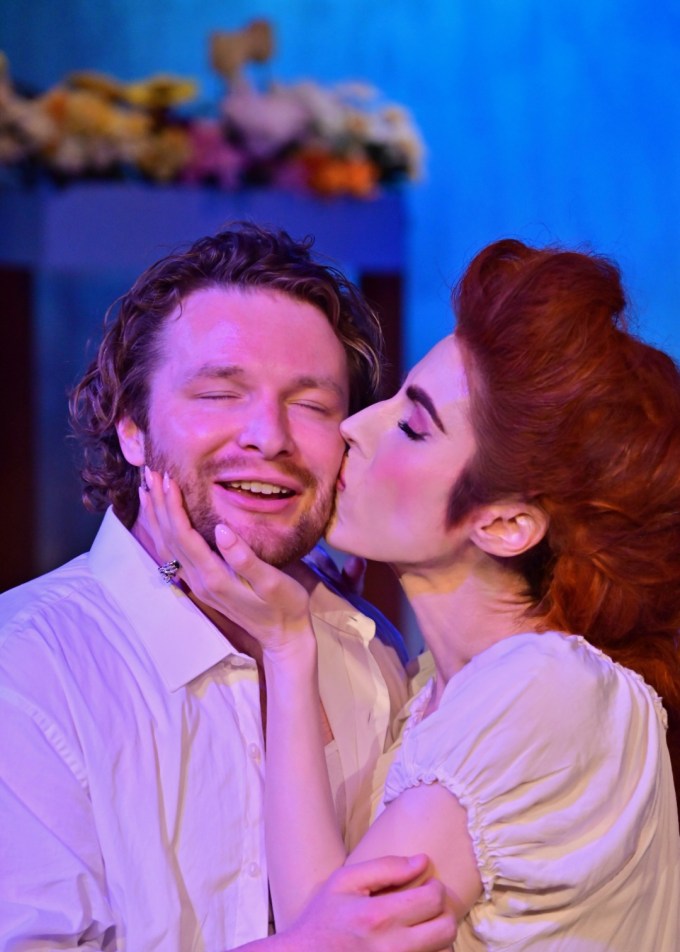
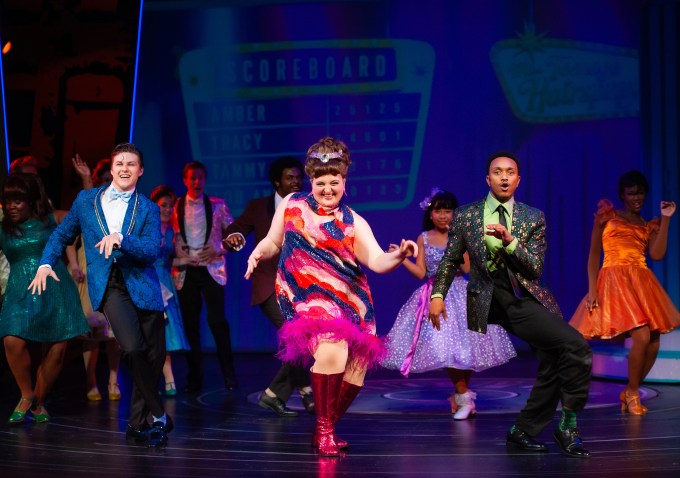
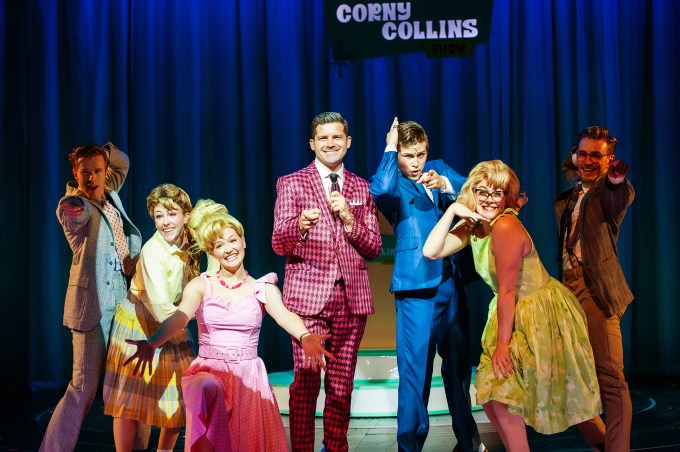
Trevor March as Link, Ella Ruth Francis as Tracy, Jordon Covington as Seaweed. All photos by Jessica Palopoli.
No sooner does Ella Ruth Francis as Tracy Turnblad open the show singing “Good Morning Baltimore” with convincing confidence and competence, than we know that she is going to nail the lead role and that the audience is in for a real treat. Hairspray is a big production for San Francisco Playhouse, one of the premiere Bay Area theater companies, and they hit all of the right notes on every element of the production. The opening night audience was in stitches and wildly supportive throughout.
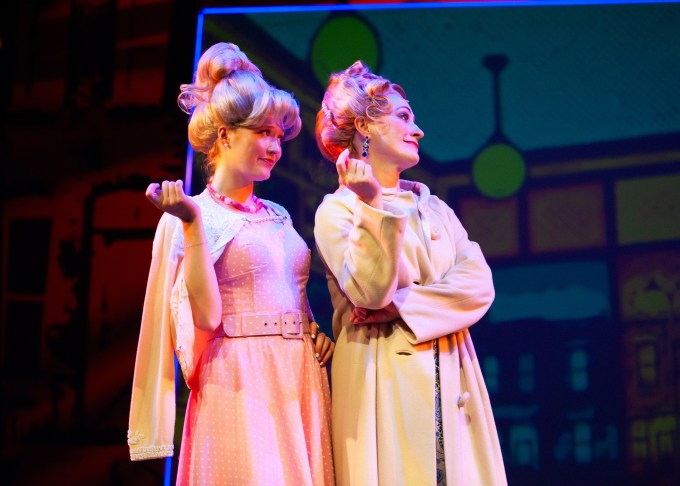
Mackenzie Macdonald as Amber, Alison Ewing as Velma Von Tussle.
For those who don’t know, HairsprayThe Broadway Musical is the descendent of the great Baltimore smut peddler John Waters’s hit 1988 movie, which is both his most accessible work and the most ready for prime time. The musical swept the 2003 Tonys and played Broadway for eight years, so obviously, something wonderful is there. That wonderful includes one toe-tapping pop song after another and brilliantly defined characters that are as archetypical as in a Dudley Do-Right and Snidely Whiplash skit. But if your reaction is that you’ve already seen it, it’s possible you’ve forgotten how lively and engaging it is, and it’s possible you underestimate the exemplary job Playhouse does with it.
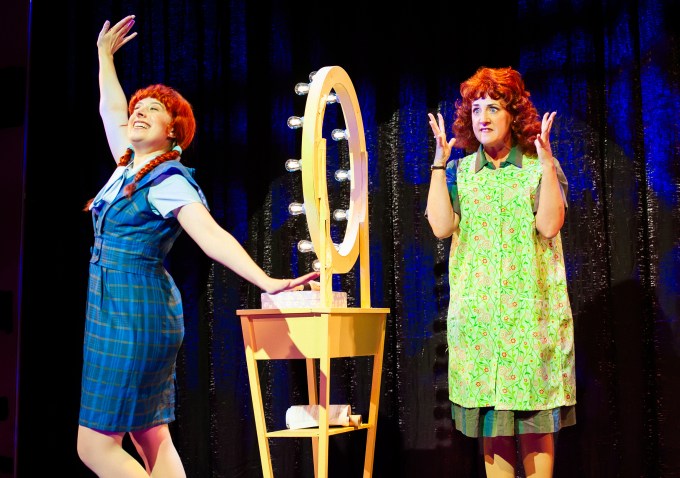
Samantha Rich as Penny, Rebecca Pingree as Prudy Pingleton.
The setting is 1962, and you may feel thrown back to the ‘60s as nostalgia abounds in the script and the staging – the dances, clothes, hairdos, social practices, and more. Tracy is a well overweight, working-class high schooler who dreams of dancing on the Corny Collins Show, a local stand-in for the massively popular American Bandstand and its squeaky-clean host, Dick Clark.
Despite the virulent discrimination of the time against “fat” people, Tracy has a naïve self-assurance. Beyond her belief in her dancing, she also thinks that she can integrate the Corny Collins Show, which to date has offered a monthly “Negro Day” for the black kids to have a televised dance day as a limp appeasement to the minority community. Jeffrey Brian Adams is a lock cinch for the loveable liberal Corny, a man-child who relates to teens as if he were one and who would like the kids on the show to be truly representative of the community. He supports Tracy and the black kids.
(center) Jeffrey Brian Adams as Corny Collins, cast.
Every narrative needs a nemesis, and that would be Corny’s benighted producer Velma Von Tussle (played as suitably arrogant and bigoted by Alison Ewing) aided by her throwback daughter Amber (a vivacious and condescending Mackenzie Macdonald). And while Velma denigrates Tracy by saying that the watermelon doesn’t fall far from the tree (sic), one might say of Amber that poison ivy spawns poison ivy. Not only does Velma block all efforts to include unattractive and minority kids on the show, but she cheats in hopes of Amber becoming Miss Hairspray.
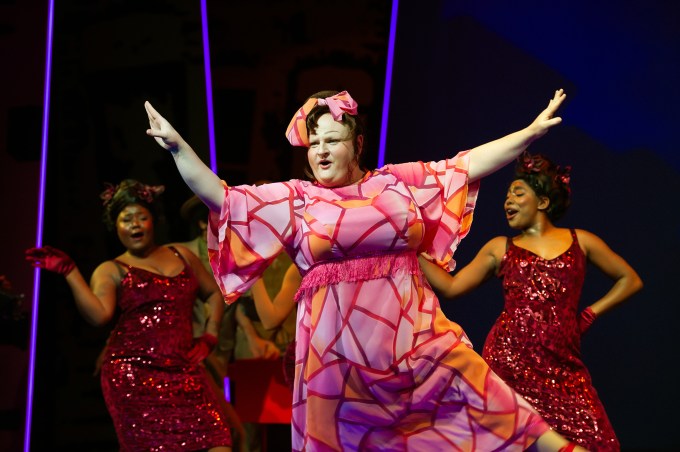
All of the performances are spot-on, and another that deserves recognition is Jonathan Chisolm as Tracy’s loving but discouraging mother, Edna, whose dreams of dress designing have been crushed by the reality of becoming a frumpy laundry lady. Perhaps in honor of John Waters’ muse, the crossdressing Divine who created the role, or to desensitize those who feel threatened by transexuals, Edna seems to always be played by a crossdressing man or non-binary.
Jonathan Chisolm as Edna Turnblad.
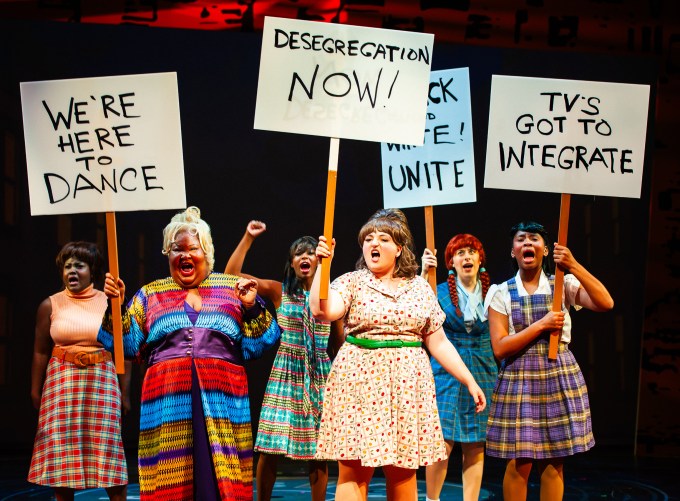
Despite the lively feel and excitement that dominates, social issues drive the story with acceptance and inclusion being the overarching demands, a plea to end discrimination based on race, sex, body type, or any other trait. The story introduces all of these insults to human decency and dignity. The most rousing call to confront them comes from a song performed by an older black woman, Motormouth Maybelle, played by Jeannine Anderson. As she belts her anthem “I Know Where I’ve Been,” every line resonates and stirs the listener, exemplified by the stanza “There’s a dream in the future; There’s a struggle we have yet to win; And there’s a pride in my heart; ‘Cause I know where I’m going; And I know where I’ve been.”
(foreground) Jeannine Anderson as Motormouth Maybelle, Ella Ruth Francis as Tracy Turnblad.
Creative contributions to the production are immense and deserve recognition. The show is full of lively song (musical direction by Dave Dobrusky, sound by James Ard) and dance (choreographed by Phoenyx Rose) numbers on a colorful stage (Heather Kenyon) lit (Michael Oesch designer) with over 800 lighting cues. The variety and number of bright costumes (Bethany Deal) is overwhelming, as are the wigs (Y. Sharon Peng). Finally, the complex production is brought together exquisitely and seamlessly by Director Bill English.
Hairspray The Broadway Musical, composed by Marc Shaiman with lyrics by Scott Whittman & the composer, and a book by Mark O’Donnell & Thomas Meehan from the movie by John Waters is produced by San Francisco Playhouse and appears on their stage at 450 Post Street, San Francisco, CA through September 12, 2026.
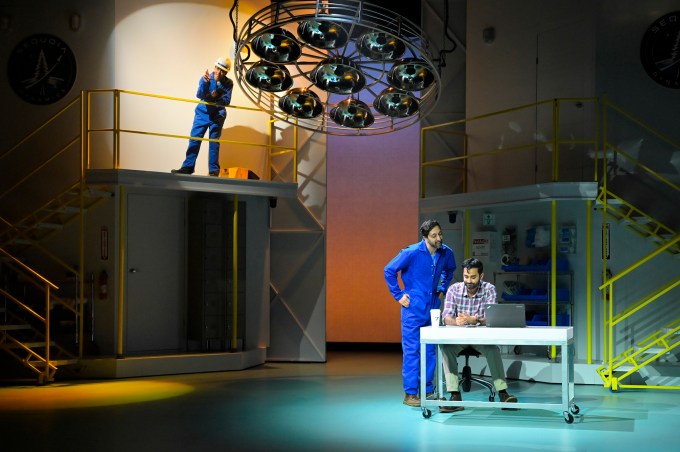
Megan Suri as Leela, Kapil Talwalkar as Krish, Kunal Dudheker as Baasu, Kathryn Smith-McGlynn as Val, Ranjita Chakravarty as C.K. All photos by Kevin Berne.
Just as the United States will forever be stained by the racism of slavery, so will India’s dominant religion, Hinduism, for its caste system. Although the latter has made great strides in providing opportunity for Dalits, formerly known as untouchables, the shadow persists.
American culture increasingly interacts with Indian culture in many ways. As companies use international outsourcing to take advantage of skills and lower costs available outside of the U.S., India has become a prime beneficiary both for call centers and high-tech units. And in addition to educational opportunities and general immigration by Indians, many of them come to the U.S. on H1-B visas, especially for high-tech jobs in Silicon Valley.
Kunal Dudheker as Baasu, Kapil Talwalkar as Krish .
TheatreWorks world premiere of Geetha Reddy’s The Employee Dharma Handbook deftly directed by Snehal Desai, pierces that space with an extremely well-acted, dramatic, yet very humorous look into a social issue that has arisen in this country in contemporary times. The result is a thoughtful skewering of both an ancient code of social hierarchy and capitalism whose only denomination is money.
Most Americans accustomed to what they believe is egalitarianism, give little or no thought to which Hindus they engage with or how they engage with them, even those Americans who know something about the caste system. But what about Hindus in America?
The play’s title appropriately implies that the action occurs in a workplace environment. The inclusion of the complex Hindu word dharma, which can relate to righteousness or social order, clearly signals that this play concerns Hindus.
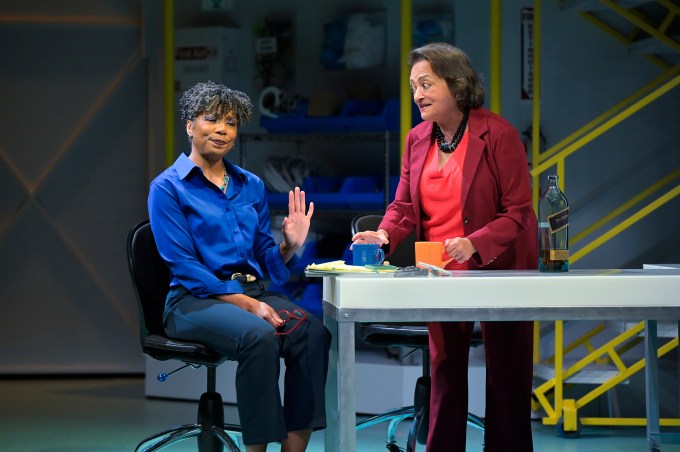
Kathryn Smith-McGlynn as Val, Ranjita Chakravarty as C.K.
Sequoia Dynamics, a fictional Bay Area aerodynamics company, prepares for the launch of a probe to one of Jupiter’s moons, Europa. Mission Manager Krish (male) has just appointed Baasu (male) as a director reporting to him, passing up Leela (female), who was of equal organizational level and slightly more senior to Baasu and had superior evaluations on all critical criteria. Leela wants to file a protest, but not based on the obvious, gender discrimination.
It turns out that Krish, played as dignified and righteous by Kapil Talwalkar, is Brahmin, the highest caste, and he retains many beliefs and practices from the country of his birth. Baasu represents those who abandon their religious heritage. The easy-going Baasu, portrayed by a true comedian Kunal Dedheker who extracts laughter from the most trivial comments, advocates atheism, though he acknowledges that his parents are Brahmin. Thus, it is easy for him to be dismissive of caste, as he will always be known as being from the highest one.
Megan Suri as Leela, Kathryn Smith-McGlynn as Val.
As the central character Leela, Megan Suri captures her assured, well-prepared, and unerring way. The American-born daughter of two physicians, Leela has only recently learned that contrary to the stories she was told as a child, that she is Dalit, and that becomes the central issue. Her workplace complaint is based on religious, or more specifically, caste discrimination.
Thrust into the breech is Val (female). With art imitating life, the play draws from real incidents at Cisco and Google. Val is black and used to suffering bias, but she is burdened with adjudicating discrimination in another culture. Many such cases balance on a knife’s edge, and in this case, since Krish knew that Leela was Dalit, it could come down to “did he touch her?” – not in a sexual way, but anything like shaking hands or a pat on the back.
Kathryn Smith-McGlynn as Val, Kapil Talwalkar as Krish, Kunal Dudheker as Baasu, Megan Suri as Leela, Ranjita Chakravarty as C.K.
Human Resource management is a mine field in the best of circumstances, but dealing with established law and the overlay of the Trump administration’s antipathy toward DEI makes the work of people like the breezy but competent Val, played by a vibrant Kathryn Smith-McGlynn, even harder. Val must keep to protocol and constantly censor herself and others to avoid legal liability. And who does this pseudo-politeness favor? The ones who are already in power – a universal phenomenon.
Added complications occur when Chief Technology Officer C.K. (female), who is more concerned about the consequence to a planned IPO and the launch should Krish be derailed, tries to placate Leela by imposing remedial requirements on Krish that don’t benefit Leela at all. One of the funniest scenes with the whole cast of five on stage is that after we know that only English is to be spoken in the office, C.K., Krish, and Baasu have a heated but funny argument with wild gesticulations in Telegu, an Indian language unknown to Leela and Val (or the audience) who stand by befuddled. Is it odd that the three in a chain of command all speak the same native tongue?
Megan Suri as Leela, Kunal Dudheker as Baasu, Kapil Talwalkar as Krish.
Beyond the exquisite ensemble cast, the final star is the scenic design by Wilson Chin. Not only does a model of engine thrusters from a rocket hover over humanity, but the vertical scale of the sets makes the humans look appropriately small.
Other issues are explored as well, including another with universal resonance. How often does a person not receive a promotion because they are so competent at what they are doing that rewarding them with a higher position might be detrimental to the company?
It’s often difficult to communicate about humor without successfully repeating the humor itself. Sometimes it’s one of those “you had to be there” things. If you have a chance, you want to be there.
The Employees Dharma Handbook, written by Geetha Reddy is produced by TheatreWorks Silicon Valley and plays at Lucie Stern Theater, 1305 Middlefield Road, Palo Alto, CA through August 2, 2026.
ayodele nzinga as May N’Kame, Teressa Foss as Dr. Cora Cage. All photos by TaSin Sabir.
You’re forgiven if your notion of two women sharing tea at a home in a posh Cornish enclave in England evokes matrons of pompous dignity but shallow substance. In Lee Blessing’s brilliant two-hander, we meet two women of eminence – Dr. Cora Gage, an accomplished and renowned ophthalmologist, and May N’Kame, who has led a largely cloistered life as the well-educated, perceptive, and clever mother of the dictator of a small African country that she insists be referred to as an empire. But in this empire, as in the real-life vicinity that it represents, bloodshed is rife. Both her husband and father had been murdered. Suffering from failing vision and chronic headaches, N’Kame seeks optical laser surgery from Dr. Gage.
The Lower Bottom Playaz’s cast of two provides depictions that are decisive and powerful. And guided by the sentient hand of Director Cat Brooks, the company offers a near breathtaking realization of the provocative play. The story is riveting and controversy inducing, but to avoid spoilers, the following discussion will sometimes veer to the obtuse.
N’Kame has been around the block a few times, and one could wonder why she selected a surgeon in Cornwall. Her research into Dr. Gage led her to believe that the surgeon may have an experience-based prejudice against black people, thus N’Kame is concerned lest the laser err from its intended path. But Dr. Gage’s possible bias also plays into the ulterior motive for N’Kame’s engaging her. The African woman will seek an unethical act from the surgeon in return for a favor that the surgeon will value. The question is whether Dr. Gage will take the bait.
ayodele nzinga as May N’Kame.
Among the unexpected aspects of the relationship is the dominance exerted by the patient over the doctor. The compelling ayodele nzinga (who was the founder of Lower Bottom Playaz) is N’Kame, and her imperious condescension is profound. The wide-mouthed precision of her diction is more British than the British, but with a cool tinge of venom. Accustomed to palace intrigue and a strategic thinker, she anticipates how issues will evolve. And cornering her prey on each point of ethics, her impassionate deadpan affect is belied by the expressiveness of her elongated fingers.
On the surface, the also compelling Teressa Foss as Dr. Gage is a typically reserved and uncomplicated Brit, her precise enunciation and tight body movements restrained by centuries of habit. But the disagreeable N’Kame gets under her skin, both as a personality and for the awkward position that Gage finds herself in. Rattled by N’Kame’s unsettling probes into her life’s history; challenges to her ethical beliefs; and by the course of action N’Kame proposes, Foss’s Gage rages repeatedly and utters thoughts that she’d probably like to have back.
Although the plotline hinges on a single act, this many-times nominated and awarded Off-Broadway success reveals many fissures between what the women represent and ponders many social and political issues. Of course, where one stands on these matters often depends on where one sits. The protagonists are descendants in societies that were involved in colonialism, which Europeans often view positively for bringing civilization, Christianity, and administration to societies they regard as having been in need, while the recipients (or victims) focus on its demeaning aspects of external rule and the knock-on negative consequences that continue today.
Teressa Foss as Dr. Cora Gage.
One factor that exists both between and within cultures is the notion of friendship. While friendship is commonly viewed as shared comfort with one another and a desire to be together, what about these two women? Even when emotionally distant from one another, they share a certain intimacy and life-altering experiences, and in the end can understand and empathize with one another. Yet one of them feels this as a bond of friendship and the other not.
A central ethical issue in the narrative is the matter of justified killing. Can murder be excused on the premise that many others have died and will be killed otherwise? Again, the women disagree on what civilization should allow.
A related question is the consequence of one dramatic act that in the cases of these women involves sacrifice. Does such a decision forever change who a person is and all actions that follow from it? Should or will regret or remorse forever dim their horizons or can redemption brighten the skies ahead?
A final matter of interest to voluntary, involuntary, and would-be immigrants is “What is home?” and “Where do I want to be?” Each woman will face this choice for very different reasons.
As a final commendation, not only were the directing and acting superlative, but the scenic design by Stephen Jones is noteworthy. It has become uncommon in small theaters to invest in multiple sets to represent different venues, but the Cat Brooks led production has, and it makes a difference.
Going to St. Ives, written by Lee Blessing is produced by Lower Bottom Playaz, and plays at BAM House, 1540 Broadway, Oakland, CA through July 26, 2026.
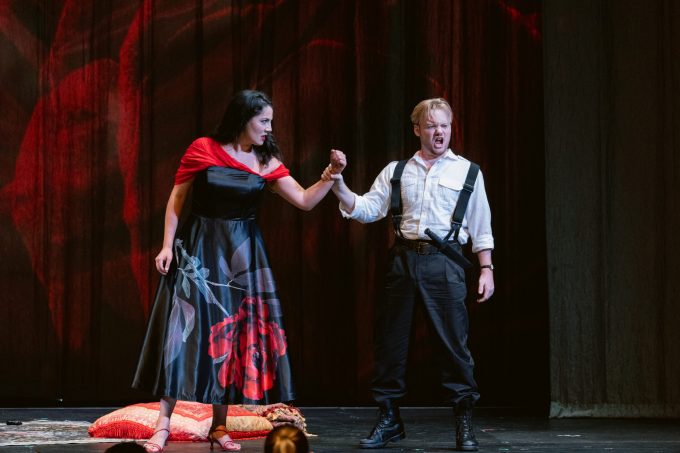
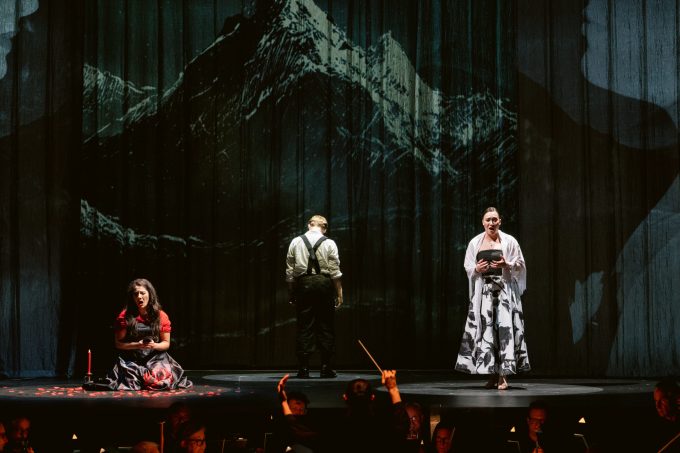
Ariana Maubach as Carmen, Charles Styles as Don José. All photos by Kristen Loken.
Year after year, Georges Bizet’s Carmen ranks as one of the several most produced operas in the world. And why not? Its music, based largely on Spanish folk tunes, is perhaps the most familiar and hummable of any opera. Patrons in many countries, especially throughout Latin America, can relate to the Spanish culture, while the admix of Carmen’s Roma community yields an international exoticism. Its heroine is one of the most dynamic and demonstrative in the idiom. And the triangle created by her suitors, the complex soldier Don José, both hot headed and an infatuated puppy dog, and Escamillo, a renowned and adulated bullfighter, careens inevitably to tragedy.
In 1981, famed minimalist theater and film director Peter Brook engaged composer Marius Constant to abridge the score of Carmen to reduce the storyline to its essence. The resulting 80-minute opera focuses on the intimate and psychological moments of Prosper Mérimée’s source novel. Merola Opera, the highly-vaunted apprenticeship program associated with San Francisco Opera, has produced the adaptation with a highly successful version driven by a cast of fine voices.
Charles Styles as Don José, soprano Anna Thompson as Micaëla.
Unlike Puccini’s heroines from other “Top 10” most popular operas, Mimi, CioCio San, and Tosca, Carmen is independent and unruly, with an imperiousness more like another Puccini heroine, Turandot. Carmen’s freedom from entanglements that she can’t control makes this in a sense a very feminist story, which is one of the draws to Director Mo Zhou who tries to de-sanitize the traditional patriarchal opera scrim.
The shortened opera goes by in no time which appeals to a modern short-attention-span audience. All of the finest music and wonderful arias are a feast for the ears from José’s “La fleur que tu m’avais jetté” and Carmen’s Habañera (“L’amour est un oiseau rebelle”) to Escamillo’s Toreador Song. But they come by in such rapid succession that it is like watching a highlights reel rather than a complete work. Those patrons not already familiar with the story will not realize the richness in the original libretto and may leave with more questions than answers.
Raúl Morales Velazco as Escamillo, Charles Styles as Don José.
Thus, the narrative is bumpy as backstory and motivations are lost and dramatic tension doesn’t build as well as in Bizet’s fully-scripted version. For instance, Carmen’s fiery temperament in her fight with a co-worker at the cigarette factory is missing; the meet-cute between Carmen and José lacks characterizations or setup; and his friend from his home town, Michaela, twice appears and disappears from the story, the second time without sufficient explanation.
Apart from the music, what makes La Tragédie de Carmen engaging is the cast. The captivating Ariana Maubach as Carmen offers a rich mezzo voice with pleasant quaver in the mid and upper ranges and a haughty chestiness in the low end, very fitting for the role. Tenor Charles Styles as José seemed a little underpowered to begin with, especially in the duet with soprano Anna Thompson’s demure Micaela, “Parle-moi de ma mere”, but he impressed as time went on. Carmen is the unusual opera in which the soprano plays second fiddle to the mezzo, but with Thompson’s powerful and mellifluous voice, she is already booked for bigger things. Finally, with a resounding bass voice, Raúl Morales Velazco vocally acquitted himself well as Escamillo.
Ariana Maubach as Carmen, Charles Styles as Don José, Anna Thompson as Micaëla
Conductor Stephanie Rhodes Russell leads the orchestra adeptly. While chamber adaptations to the orchestration that emphasizes soloists works well, the simple piano accompaniment (no reflection on the pianist) sounded empty. The mandated use of canned music for the overture, presumably because it is supposed to come from inside the arena, adds no value as the orchestra sits on its hands.
One question to be asked is what is unique about Carmen for Brook to create this type of adaptation? As a wildly successful opera, it wasn’t desperately in need of a facelift, while other cherished operas that drag on and have smaller audiences could benefit more from a little sculpturing. It should be noted that Brook’s philosophy of theater is from the ancient Greek tradition that all that is needed is actors. Audience members who value expansive scenery, lavish costumery, and a large cast and chorus will not find them here.
Raúl Morales Velazco as Escamillo, Ariana Maubach as Carmen.
Another matter is why this piece was chosen by Merola. One appeal must be that the cost and effort of full staging is not required, as the set is comprised of projections on panels plus a few props. However, the number of principals is reduced from around 16 to 7, meaning that few Merolians perform listed roles. Also, the elimination of group scene action of the soldiers, cigarette girls, and Roman encampment, means no chorus opportunities for other apprentices.
A final issue is whether this production of this adaptation merits attendance. Despite its shortcomings, the answer is yes. Its assets, particularly the music and cast, are compelling and the experience worthwhile.
Ariana Maubach as Carmen, Charles Styles as Don José.
La Tragédie de Carmen is composed by Georges Bizet, with libretto by Henri Meilhac & Ludovic Halévy, as adapted by Peter Brook & Marius Constant, produced by Merola Opera Company, and plays at San Francisco Conservatory of Music, 50 Oak Street, San Francisco, CA through July 11, 2026.