Two Contrasting Plays at NYC’s Public Theater

Starting in 1960, Joseph Papp upended the non-profit theater world with what would become New York’s Public Theater.  The Public would be noteworthy if only for two of its most memorable launches, Hair and A Chorus Line, but it has participated in the creation of scores more while also reviving many noted plays, especially from the Shakespeare canon.

THE CURIOUS CASE OF BENJAMIN BUTTON
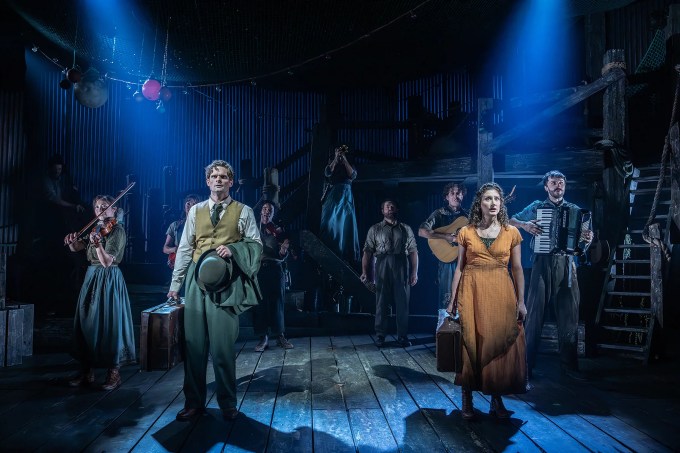
(foreground) Andrew Durand as Benjamin, Kelsee Kimmel as Elowen. All photos by Joan Marcus.

Among the current offerings, The Public is producing a revival of the musical version of The Curious Case of Benjamin Button. For those unfamiliar, the premise is that Benjamin is born an old man who is hidden away by his parents, and who instead of growing older, grows younger.  He would ultimately spring free from his constraints, marry, have children, and share the joys and tragedies of life, while hiding his unique life cycle.

The original source material is from a short story by F. Scott Fitzgerald, who places the initial action in Baltimore, whereas the popular movie from 2008 is based in New Orleans.  British are behind the musical.  The book is composed by Jethro Compton, with music by Darren Clark, and it commences in Cornwall before spreading to other English locales and ultimately to New England.

The joyous and uplifting musical has much to commend it.  The story moves quickly, supported by perky music in the modern English folk vein, and the West End version won three Olivier Awards.

The cast at The Public soars with talent and high energy, led by the accomplished Andrew Durand as Benjamin and Kelsee Kimmel as Elowen, the woman he would marry.  Another standout is Sachiko Mae, who plays multiple roles, starting with Mary, Benjamin’s mother, who would take her own life, distressed by the birth of a son old enough to be her grandfather.
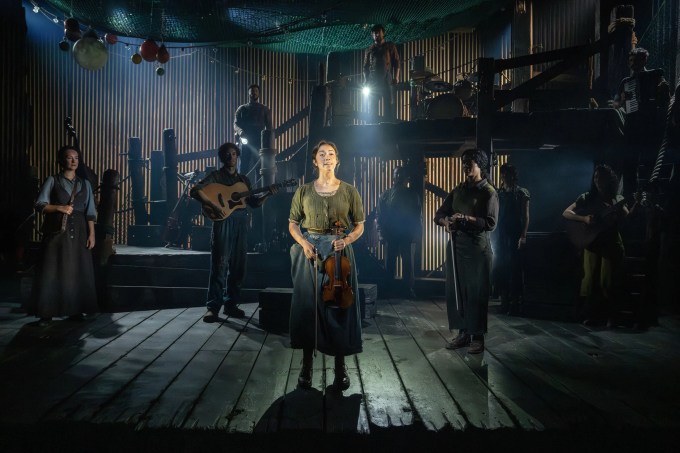
Sachiko Mae as Mary.

The overall feel of the story is uplifting, with many sensitive moments, as Benjamin often faces rejection of the kind that many minorities are accustomed to.  In one instance, Benjamin provided support for an oppressed sailor called Young Jack when the latter was a teen. But when Benjamin meets the same man who against expectation has become a captain, Jack dismisses Benjamin, as he can’t reconcile the empathetic old man he knew before and the younger one he sees before him.

The performance I attended received a standing O.  Together with its unique plotline and accolades, how can one not give a positive recommendation?

Here is where I object to much philosophy of theater criticism, particularly the notion that a critic should be the undisputed arbiter of worthiness, especially when competent critics frequently disagree on evaluation of elements and overall worth.  Many critics express their subjective opinions as if they are objective and unassailable.  Particularly in the New York market, where the Times’ primary critic has been a God absent doubt or humility, a bad review often sinks a production, and along with it, tens of jobs and millions of dollars.  And you know what?  The critic may have just had an argument with their spouse or be having a bad reaction from the dinner that they ate

That said, here are the reasons that Button didn’t work as well for me as for others, some of which you may like or not.  Overall, it is so full of conceits and devices, that it seems formulaic.  Of course, the very premise is a brilliant and unique conceit that is the sine qua non.  In the film, extensive makeup is used to vary Brad Pitt’s appearance of age, but in this case none is used, not even a gray wig to signify age.  To his credit, Durand does a fine job using expression, movement, and gesticulation to distinguish the many ages he reverses through.
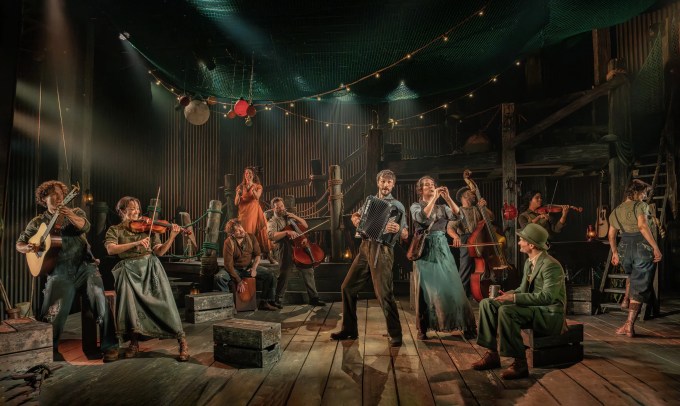
Cast.

Several aspects of the design are so conspicuous that the devices become self-referential.  One is storytelling by committee, in which the monologue baton is passed on every couple of sentences in the frequent orations.  Another is that in virtually every narrative interruption, a date and time stamp is ceremoniously announced right down to the minute.

To show enthusiasm, despite micing, speakers shout at the top of their lungs.  Rather than leaving the stage when they are inactive, the actors always hang around the set, which looks like a dilapidated refuge from The Pirates of Penzance. Good reasons for cast to remain are that each cast member is a musician (another conspicuous device), virtually all multi-instrumental, and they provide the near-continuous ambient music, chorus singing, as well as background to songs.

As noted, The Curious Case of Benjamin Button has received considerable support and will suit the demands of most theatergoers, but you are forewarned of the recurring self-parody devices.  More commentary follows below.

WE’LL SEE

Two decades ago, Oskar Eustice, then new Artistic Director of The Public Theater commissioned Richard Nelson who proposed a series of intimate plays about how people process important events.  We’ll See offers his 13th play centering on domestic life in Rhinebeck, New York, a historic town on the Hudson River, 100 miles north of New York City.

In many ways, We’ll See is the polar opposite of The Curious Case of Benjamin Button.  The former takes place in one room in one evening; the latter in numerous English cities, at sea, and in New Hampshire over 80 years.  We’ll See involves four elderly siblings and a friend played by five actors in a talkathon.  Button has 40 characters from the panoply of life played by 11 actors having multiple roles.  The play is very naturalistic, quiet, and static and performed on a small stage in the round.  The musical is stylistic and raucous with song and heavily coordinated movement on a large proscenium arch stage.
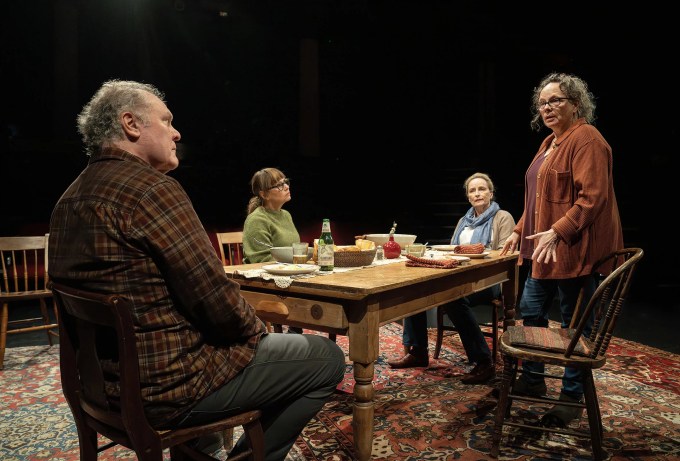
Jay O. Sanders as Richard, Sally Murphy as Jane, Laila Robins as Marian, Maryann Plunkett as Barbara.

Time is significant to Nelson in We’ll See as well, but in a different way.  Each of the 13 plays of the Rhinebeck Panorama has opened on the same day as the action, in this case, November 3, 2026, election day.  We peer into the interactions of the Apples, a politically liberal family.  Richard, the only brother, has actually worked for former Democratic Governor Andrew Cuomo.

The family has gathered for dinner with great trepidation about the elections of the day, and a key feature of the play is that it was written before the outcome was known, so the characters can only speculate on what the audience knows has happened.  While they are concerned and informed politically, one rule the siblings agree to is that no one will mention “his” name, knowing the outsized play it usually gets.

More than politics, most of their discussions concern their daily life as they actually share a meal.  Each of them is put upon in different ways, and each demands respect in different ways.  Richard (Jay O. Sanders) talks of his recent trip to Paris.  Seventy-four-year-old Barbara (Maryann Plunkett) tells that she has been railroaded into accepting retirement from teaching at the end of the semester.  Middle female, Marian, (Laila Robins) tries to keep socially active, while the youngest, Jane (Sally Murphy), is living with her boyfriend in the City and in Rhinebeck.  She and Richard are actively writing a history of their one-traffic-light town and unearthing interesting tidbits, but she also discloses that she hasn’t voted, which causes considerable consternation and discussion.

Richard’s younger girlfriend, the appropriately raspy voiced Yvonne (Yvonne Woods), joins later.  She is an aspiring stage actress, but in an anomalous twist of fate, she is the one who suffers what is known to be a terminal cancer.
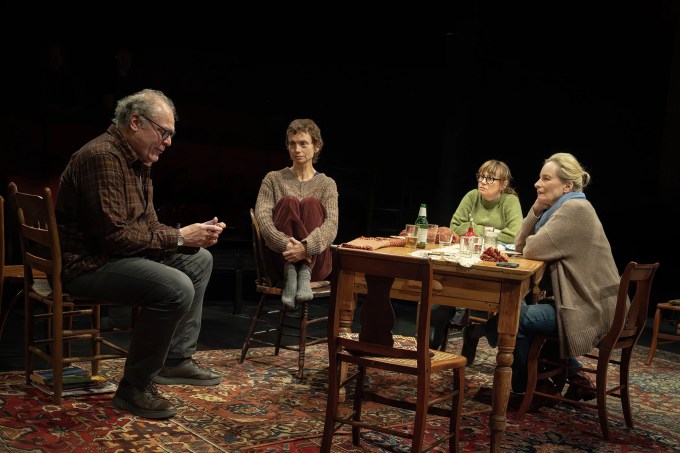
Jay O. Sanders as Richard, Yvonne Woods as Yvonne, Sally Murphy as Jane, Laila Robins as Marian.

We’ll See has little at stake; divulges little of substance; and lacks a conclusive outcome.  Yet, this intimate narrative reveals interactions among people of a certain age at a certain time that has meaning as part of the kaleidoscope of American life.  It is completely convincing, in part due to fine acting from a great ensemble led by husband-and-wife team Jay O. Sanders and Maryann Plunkett who have earned a NY Critics Circle Joint Lifetime Achievement Award.

One housekeeping concern is that acoustics in the theater are tricky, and much dialog can be lost, especially when the speaker is facing away.  For those with any hearing deficiency, avail the listening aids.

The Curious Case of Benjamin Button, with book and lyrics by Jethro Compton and music and lyrics by Darren Clark, plays through December 6, 2026.

We’ll See, written by Richard Nelson, plays through November 29, 2026. Both plays are produced by Public Theater and performed on its stages at 425 Lafayette Street, New York, NY
Erie Mills: A Tribute

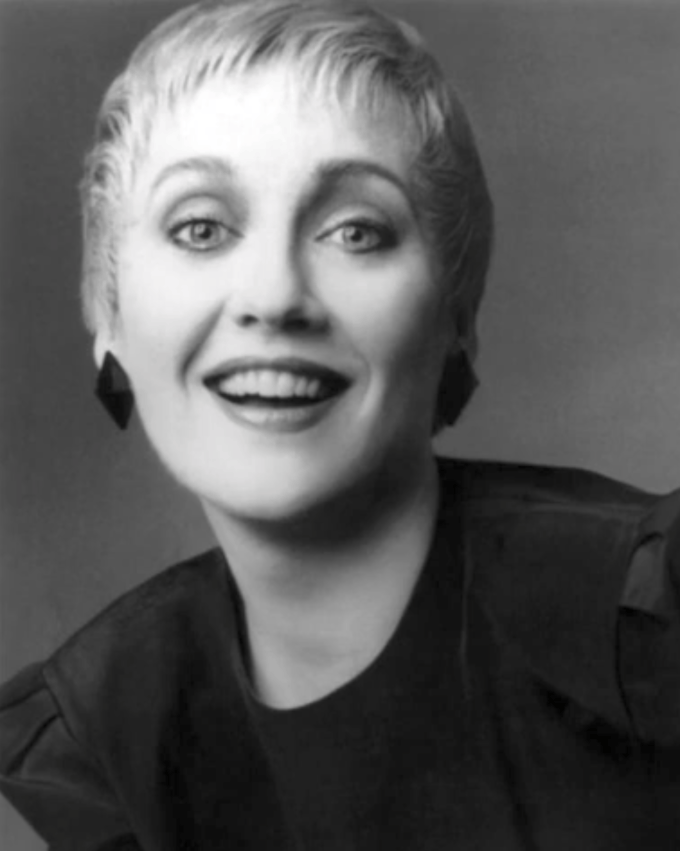
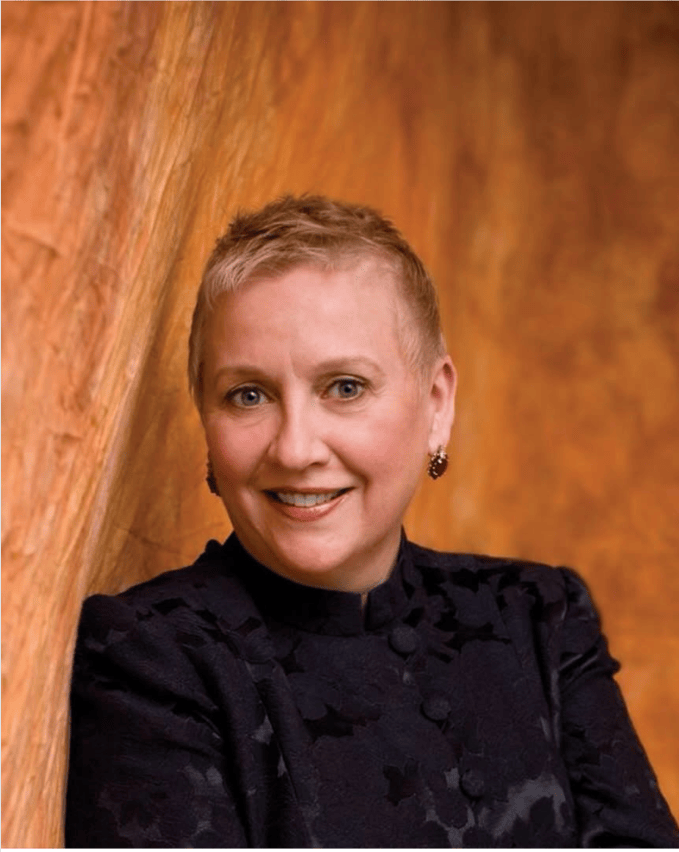
Erie Mills.

Erie Mills, brilliant coloratura soprano, musical and opera star, teacher and mentor, diction coach, and Artistic Director of Livermore Valley Opera for 18 years, died of pulmonary fibrosis at age 73, on June 23, 2026. She is survived by her loving husband Tom Rescigno, physicist and Board Director of LVO.

Many of us are familiar with the notion that children only know their parents as parents, and not as others do. That concept extends to adults who know others only in limited contexts, as did I know Erie only in her final act and only in her professional capacity. So attending her tribute was eye opening.

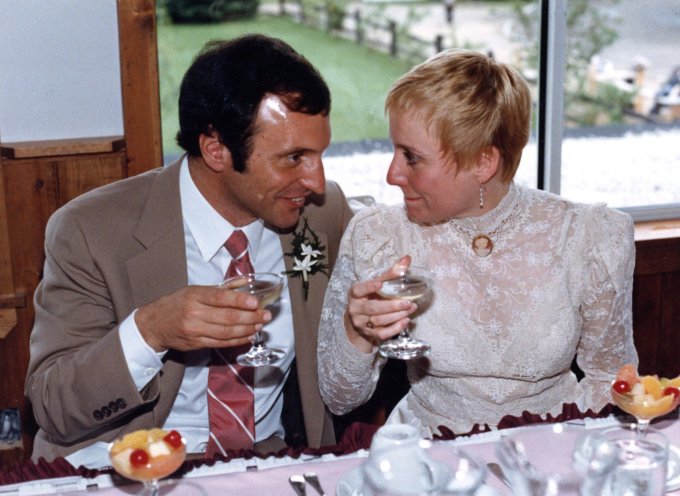
Tom and Erie at their wedding celebration.

At a stunningly well conceived and executed tribute organized on November 11 by her colleagues at LVO, it was fascinating to see Erie from many different perspectives and through the whole of her life. The overarching finding was that her inner and outer beauty and her determination and quest for excellence were with her throughout.

The love and respect for Erie was evident through those who contributed freely to the event. Many volunteers organized and worked tirelessly to make the tribute professional and entertaining. Livermore’s Bankhead Theater, home of LVO, contributed its 500 seat theater free of charge. And seven outstanding opera singers sang without fee.

Erie performing with Wynton Marsalis.

The evening was comprised of several tributes from friends and colleagues who had known Erie for decades; videos and audios of her work; and live performances of arias and ensembles that had meaning to Erie.

Erie sang on all of America’s great stages, including the top four of the Met, San Francisco, Lyric of Chicago, and Houston, as well as most of Europe’s great opera houses from La Scala to Vienna. She developed particularly deep relationships with Opera Theatre of St. Louis, her home town company and the preeminent American producer of opera in English language, and Santa Fe Opera, the finest summer opera company in the country.

What many don’t know is that she transitioned from her first love, which was musical theater. It was delightful to see videos of her as a charismatic and energetic young woman, and particularly her commanding rendition of Gershwin’s Naughty Baby with its high tessitura. Even that early, she revealed a vocal clarity and power with a ringing vibrato that had to find its way into opera.

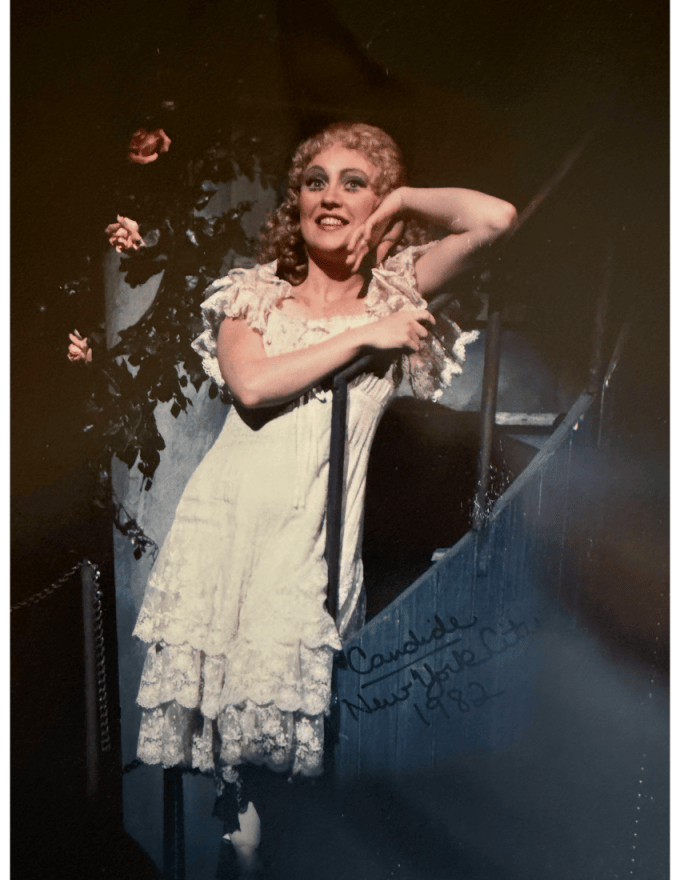
Erie as Cunegonde from Candide.

Growing up in Granite City, Illinois, a suburb of St. Louis, she launched as a teen at St. Louis Muni, which (finally) won the Tony Award as Best Regional Theater in the U.S. this year. As a personal aside and a sharing with Erie, my first musical theater experience was also several shows at St. Louis Muni, and now I vote on the Regional Theater Tony Award, which included the Muni’s win.

In Clark Bason’s tribute, he told of Erie’s early days after moving to New York. She was invited by Hal Prince to be in the all-star cast of the concert version of Steven Sondheim’s Follies and sing a duet with the legendary opera soprano Licia Albanese. But before accepting the gig, she naively asked Bason if she should do it?!?! Happily, she did, and the recorded album won a Grammy.

Bason related Erie’s debut as Cunegonde in Bernstein’s Candide at New York City Opera. The conductor’s name was Joseph Rescigno. Through that link, she met his brother, a guy named Tom, whom she would marry after courtship in San Francisco. Following Bason’s remarks, the audience was treated to Erie’s rendition of “Glitter and be gay,” from the 1982 New York City Opera’s recording of Candide, which also won her a Grammy.

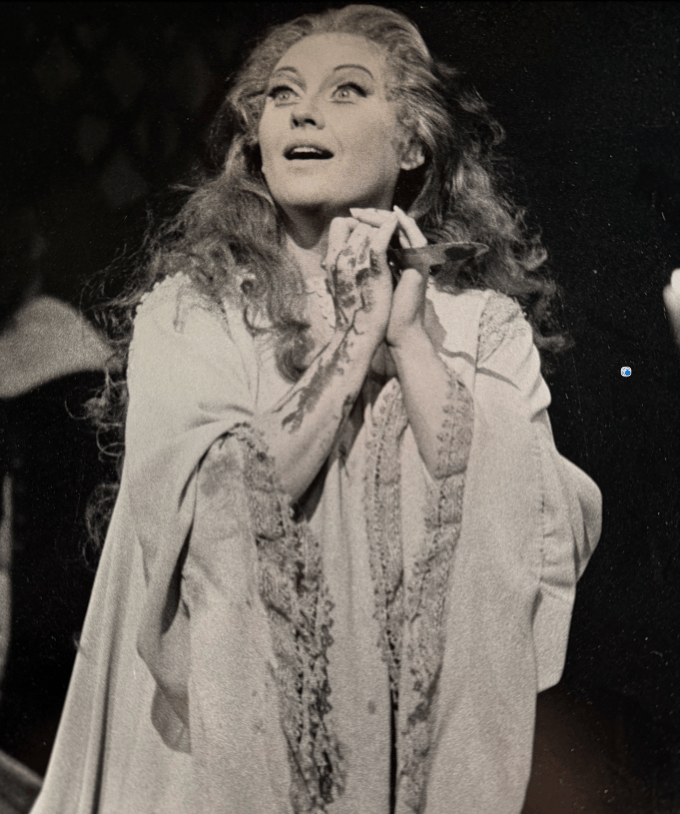
Erie as Lucia di Lammermoor.

President of the LVO board Jonathan Kleid also gave a warm and masterful tribute. It was surprising to learn that they had been dear friends since 1985, when Erie made her San Francisco Opera debut. It seems that Erie rented Jonathan’s apartment while she was performing and he was away. But before hand, they met and had a dinner together. Over Jonathan’s protestations as to who should pay the bill, Erie grabbed it first and intoned, “I’ll pay. I’m a diva!”

Kudos to the talented artists who sang and who are among the Bay Area’s finest – sopranos Avery Boettcher, Christie Conover, and Amy Owens; mezzo Courtney Miller; tenor James Flora; and baritones Eugene Brancoveanu and Robert Mellon. All were in fine voice and gave fantastic performances.

The singers, accompanied by a full orchestra conducted by LVO Music Director Alex Katsman, offered nine arias and ensembles. They were remarkably flawless and of high quality, especially as prepared for a single performance. Personal favorites were “Io son l’unile ancella” from Adriana Lecouvreur (Boettcher), “Donde lieta usci” from La Boheme (Conover), “Ch’ella mi creda libero e lontano” from La Fanciulla del West (Flora), and the trio from Cosi Fan Tutte (Boettcher, Miller, Brancoveanu). Appropriately, the finale was “Make our garden grow” from Candide, sung by all of the artists.

Erie Mills.

The tribute was a fitting farewell to a great friend and great lover of the opera. Rest in peace, Erie.

The Secret Museum

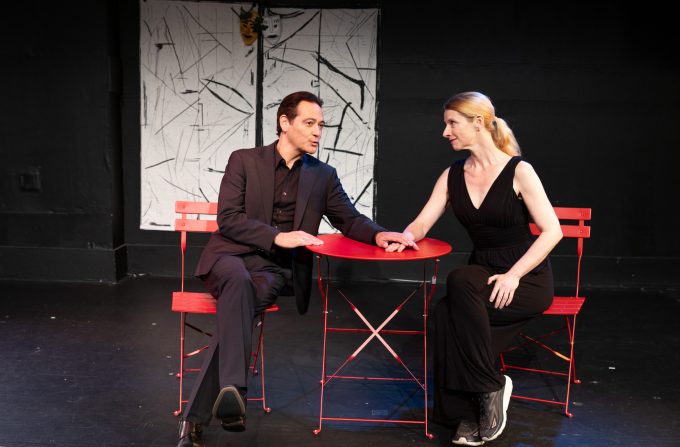
Johnny Moreno, Arwen Anderson. All photos by Cynthia Smalley.

Author Lynne Kaufman has carved an admirable niche creating intimate, dramatic, small cast, biographical plays.  A pre-eminent, but by no means exclusive, producer of those works has been San Francisco’s The Marsh, an esteemed and prolific presenter of new works.  Frequent collaborator Warren David Keith also participates once again as director.

Otherwise consistent with this oeuvre, Kaufman’s script for this engrossing world premiere about erotic exploration, more from an intellectual than a lascivious perspective, is from completely original material.   The cast expands from the usual one or two actors to four, though only two appear at a time, as the vignettes are primarily about relationships.  Making the narrative more compelling, the performers are drawn from among the brightest stars in the Bay Area constellation.

Characters and time stamps of the action yo-yo engrossingly between denizens of Pompeii immediately before the historic eruption of Vesuvius and contemporary contributors to the arts.  The plotline centers on the opening of a museum in Naples that celebrates previously banned art with a sexual focus, especially on the erect phallus, which appears to have been given much artistic attention in (who knew?) sexy old Pompeii.

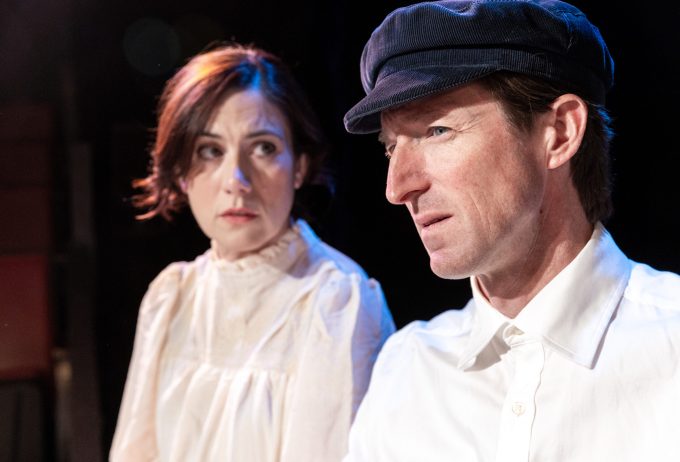
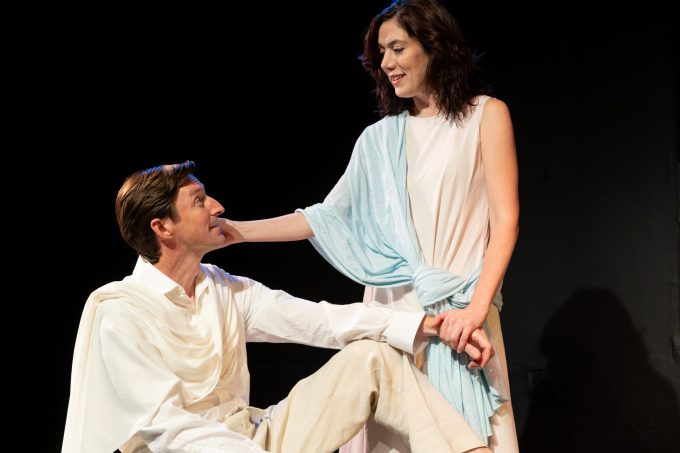
Lyndsy Kail, Joseph O’Malley.

A new fresco has been unearthed from the Pompeii ash, and an American film maker (portrayed by Arven Anderson) with a sexual and feminist bent seeks an exclusive viewing to include in an upcoming documentary film.  It just so happens that the director of the museum (Johnny Moreno) is a former lover of hers.  Thus, she is confident of receiving the favor, but conflict dominates their interaction.

The play’s concept and execution engage throughout, a sequence of dialogues between and a man and a woman.  Some audience members could be a little confused by the frequent scene shifts between characters and times, especially with actors playing multiple roles, though I did not find that a problem.

Kaufman’s intent in The Secret Museum seems clear.  It should be interpreted very much through the lens of sexual stereotyping, rejecting the impositions that men have traditionally placed on women.  The dominant realm is the sexual and its influence on relationships.  In the focal couples and in different ways, the unbridled woman pursues and the man demurs, making for unconventional, but in many ways, refreshing sex roles. 

The other realm is the arts.  In each couple, the woman is the artist, and in different ways, the man objects to the woman’s independence and creativity which he feels should be reserved for men.

Joseph O’Malley, Lyndsy Kail.

Moreno and Anderson are no strangers to Kaufman’s work, as the pair also starred in her play about Anaïs Nin, Shameless Hussy, premiered at The Marsh last year.  It too dealt with a woman breaking free from societal constraints.

What is particularly interesting in The Secret Museum is their very different, yet equally captivating acting styles.  Indeed, they are reminiscent of Marlon Brando and Kim Hunter in the film Streetcar Named Desire.

Moreno is heavily affected with a percussive speaking style, dramatic facial expression, and integrating body movement from neck to knees as if a boxer bobbing and weaving.  Conversely, Anderson seems restrained and naturalistic, as if she were carrying on a conversation guided by a Spencer Tracy dictum of “Don’t act, just speak your lines.”  As her character is American and he is Italian, the contrast of cross-cultural chalk and cheese works. Their clashes over a number of topics rivets and begs the question what attracted them to one another in the past. There is also some surprise when one of them tries to rekindle the flame.

The other couple is a real-life couple, and it’s nice to see them spark when they get an opportunity to share the stage, especially facing off in numerous relationship roles.  In the play’s opening vignette, Joseph O’Malley plays Apollo, the god representing wisdom and order, while Lyndsy Kail plays Dionysus, the god of festivity and fertility.  What may at first seem disconnected to the narrative resolves as we see in each dyad of characters the respective traits that the gods represent.  A minor point is that while a cognate of the name Apollo is used in both Greek and Roman mythology, Dionysus is a Greek god, and it is unclear why his Roman counterpart Bacchus would not be used in the play.

Johnny Moreno, Arwen Anderson.

Kail effectively impacts and exudes composure in each of her manifestations (womanifestations?).  Although she is more ebullient and charming in some of her other characters, I particularly like her as an English painter whose affect belies what she is saying – very English actually.  O’Malley distinguishes himself as he shows the greatest range among the actors from the furious Pompeiian husband who insists that his wife heed his demands to the prudish and mousy English husband who can’t believe what he’s hearing from his wife.

Kudos again to the superb acting ensemble for endowing each character with the distinctiveness intended. The playwright’s exploration of these relationships makes for provocative fare, and the play deserves to be extended to full-length to become more marketable. One specific modification to the script going forward might be to increase or emphasize the stakes and therefore the tension. Inadequate conflict tends to be the Achilles heel of relationship fare that doesn’t quite make it.

The Secret Museum, a world premiere, is written by Lynne Kaufman and plays at The Marsh, 1062 Valencia Street, San Francisco, CA through November 22, 2026.

The Marriage of Figaro

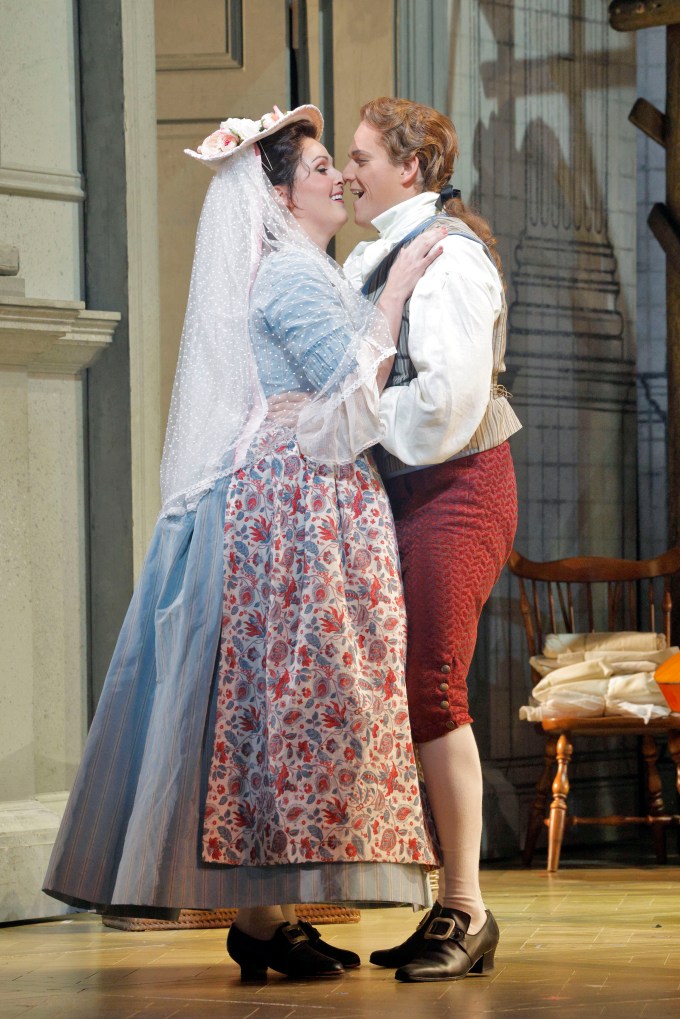
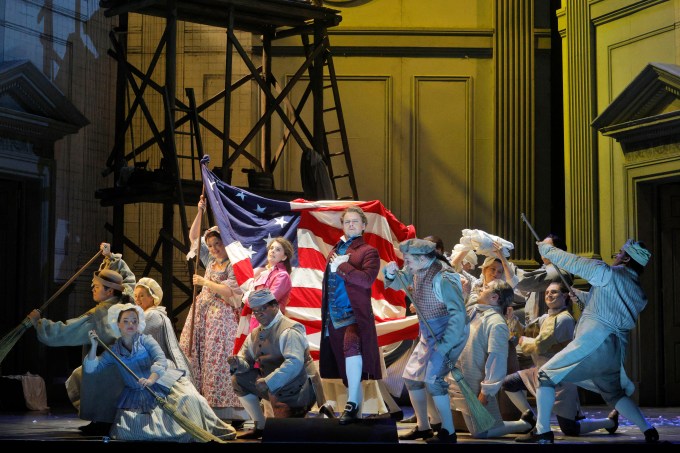
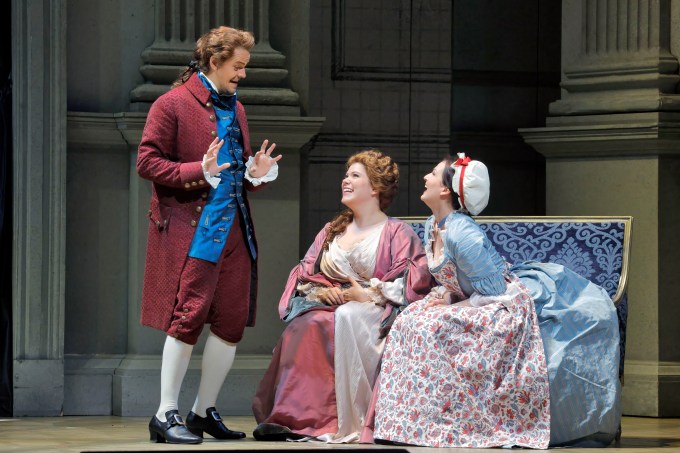
Slávka Zámečniková as Susanna, Peter Kellner as Figaro. All photos by Cory Weaver.

En route to War Memorial Opera House, my wife and editor Karin declared, “I think I’ve had enough of Marriage” (I think she meant “of Figaro,” and not our five decades of connubial bliss!) to which I was silent.  This would be our seventh Marriage, including the same San Francisco Opera production from 2019, and notwithstanding our reluctance, its place as one of the great comedies, if not the finest in all opera, cannot be denied.

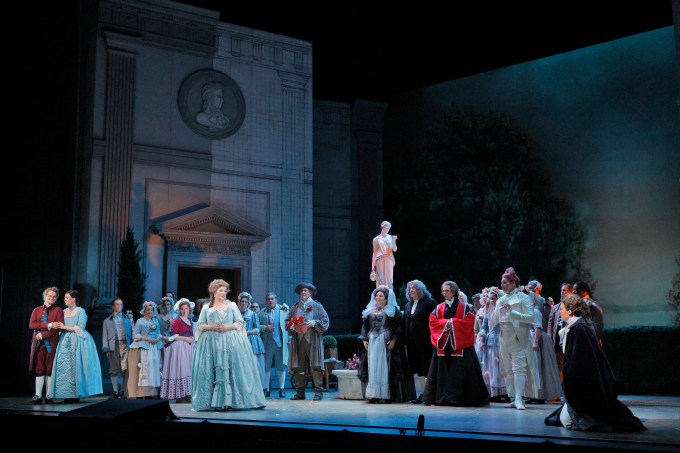
Cast. (Center) Slávka Zámečniková as Susanna, Simone McIntosh as Cherubino, Peter Kellner as Figaro.

On the plus side for the evening, it was Halloween, and it is fun to see kids and many young adults festooned and frolicking in their fanciful costumes, with even some patrons at the opera participating.  Also, since it was the end of Daylight Savings Time, we got an extra hour on our clock which compensated for the late night from an opera approaching four hours in length.  However, most historic was the supertitle flashed to a great ovation just before curtain-up, that the Golden State Valkyries (Hello, Richard Wagner) won the WNBA championship in their second year, the earliest for a major professional sports team in American history.

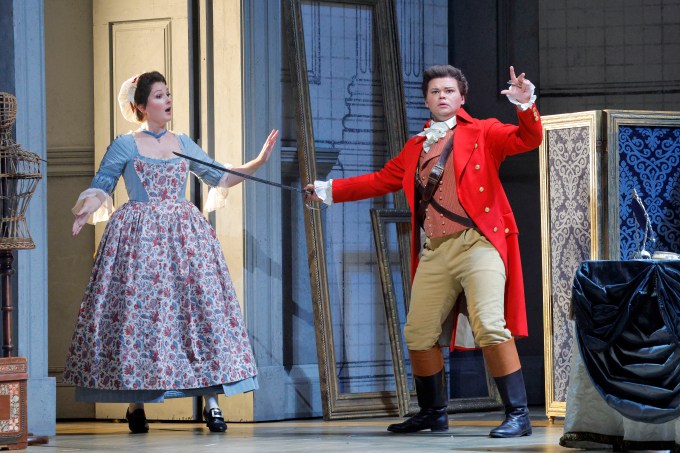
Slávka Zámečniková as Susanna, Thomas Mole as Count Almaviva.

But what made the evening a trifecta-plus is that the production of The Marriage of Figaro was fantastic, and both Karin and I enjoyed it tremendously.  Though the staging, which moves the action to the late 18th century in the United States, is from the 2019 production, the cast is new.  It’s hard to distinguish the quality of the singing among the performers as they are all stellar, without a weak link.  How many times can you say rich vibrato, impressive range, and full sound?

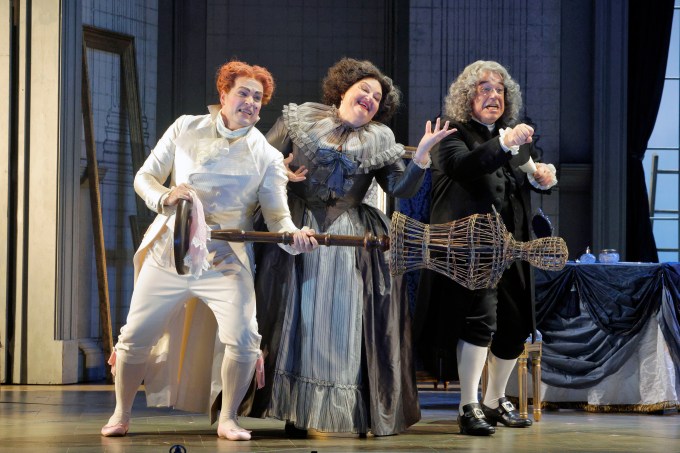
Alek Shrader as Don Basilio, Catherine Cook as Marcellina, Maurizio Muraro as Dr. Bartolo.

Also notable – individually and collectively, the comic delivery excels.  For this we must recognize the guidance of Director Shawna Lucey, whose understanding of movement, timing, and delivery are impeccable.  Though much humor of wit and manners is in the libretto, it requires the physical delivery of faces mugging, arms flailing, jumping out of windows, and hiding under sheets and skirts.  All of this is done with great flair.

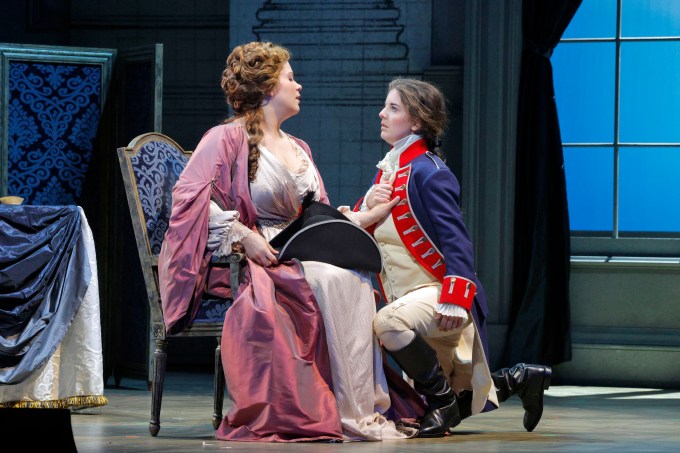
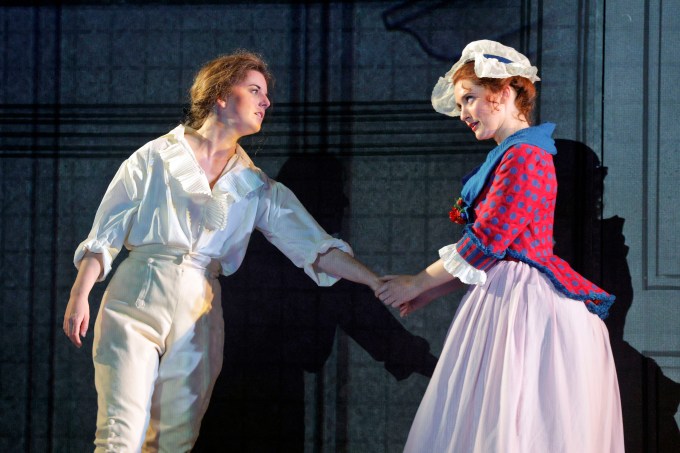
Olivia Smith as the Countess, Simone McIntosh as Cherubino.

Rarely can an opera sustain the level of amusement that this does, and if it does grow stale toward the end, we can blame librettist Lorenzo da Ponte and composer Wolfgang Amadeus Mozart for not recognizing when enough is enough.  Of course, in their day, the audience wanted their money’s worth, and they didn’t have to contend with a 6 a.m. conference call to the East Coast the following morning; the babysitter’s meter ticking on overtime; or the shortened attention span in an electronic age.

The main thread running through the narrative is that the Count’s valet Figaro (an ebullient and magnetic Peter Kellner) is to marry the Countess’s maid Susanna (a clever and determined Slávka Zámečniková, Kellner’s real-life wife!), but Count Almaviva (Thomas Mole, following on another brilliant performance of a lousy character as James in Mary, Queen of Scots) has invoked the droit du seigneur, which allows the lord of the manor to have his way with the female servant before the nuptials.  Needless to say, neither the Countess (Olivia Smith in a compelling breakthrough role) nor the engaged couple is pleased with this prospect, so much ado concerns the strategy to avoid the bedding.  Incidentally, today, we just look at the plot as silly, but the humiliation of nobles by servants was highly controversial in its time, and state censors had to be accommodated.

Peter Kellner as Figaro, Olivia Smith as the Countess, Slávka Zámečniková as Susanna.

Another angle in the story concerns the hormonal odyssey of the page Cherubino (brightly animated Simone McIntosh), most critically, his flirtations with the Countess who feels abandoned by her husband.  The role of the charming but indelicate page is one of the most famous and significant trousers roles in opera, with the boy performed by a female mezzo.  In this opera, the device works particularly well because Cherubino will later appear as a female.

While the action gets complexer and complexer and drags a bit in Acts 3 and 4, the brilliant music carries on.  The ensembles throughout are numerous and striking.  When an older woman, Marcellina (witchy-looking SF Opera legend Catherine Cook) insists that Figaro must marry her to satisfy a debt, the wonderful Act 2 ending sextet ensues with each character commenting on the complicated situation.  Another ensemble highlight is the ethereal “Sull’aria” (“on the breeze”, known as “The Letter Duet”) in which the Countess and Susanna reveal the mistaken identity ruse in which Cherubino will stand in for Susanna in an assignation with the Count.

Simone McIntosh as Cherubino, Sofia Gotch as Barbarina.

As rich as Mozart’s music is, two of his most memorable arias in Marriage build on simple yet elegant phrases, both of which are delivered with great care.  One is “Voi che sapete” (“You who know what love is”) in which the young Cherubino admits to great confusion about falling in love.  Conversely, the Countess’s soliloquy “Dove sono?” (“Where am I?”), is from one who has experience and laments the lost days of her love with the Count.  There are many other set pieces of note, and we shouldn’t forget Figaro’s famously jaunty and totally hummable “Non più andrai” (“No longer will you go”).

There are some other surprises which add to the fun. For those who don’t know, Rossini’s comic opera The Barber of Seville is a prequel, and two other interesting characters carry over from the earlier story, the handkerchief waving music master Don Basilio (clarion tenor Alek Shrader) and the now distrusting and vengeful Dr. Bartolo (fine bass Maurizio Muraro).  And while one could wax on about The Marriage of Figaro, the virtues of the opera and this production should be apparent.

Cast. (foreground) Olivia Smith as the Countess, Thomas Mole as Count Almaviva.

The Marriage of Figaro, composed by Wolfgang Amadeus Mozart, with libretto by Lorenzo da Ponte, and based on the play La Folle Journée, ou Le Mariage de Figaro by Pierre-Augustin Caron de Beaumarchais is produced by San Francisco Opera and appears on its stage at War Memorial Opera House, 301 Van Ness Avenue, San Francisco, CA through November 29, 2026.