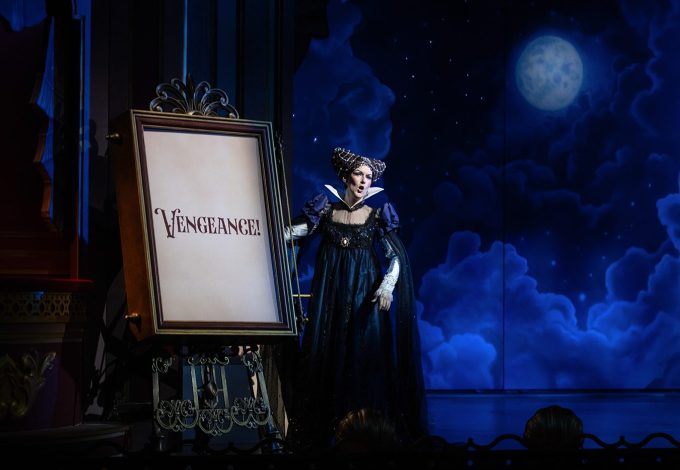
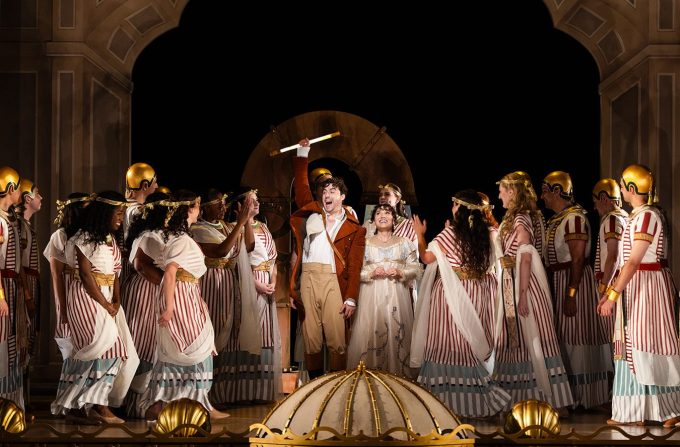
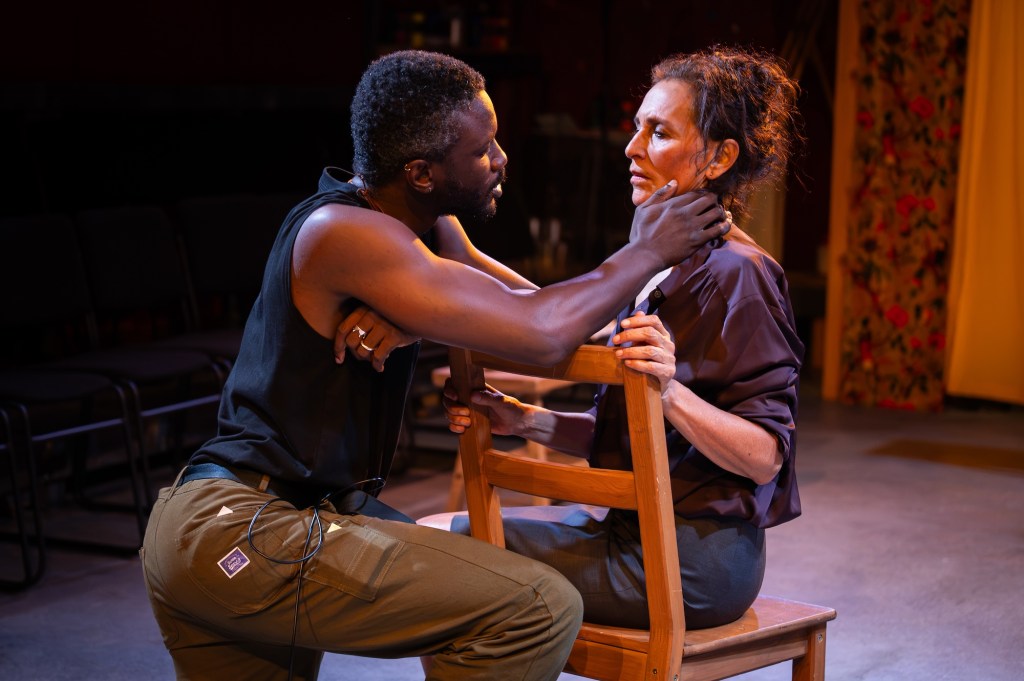
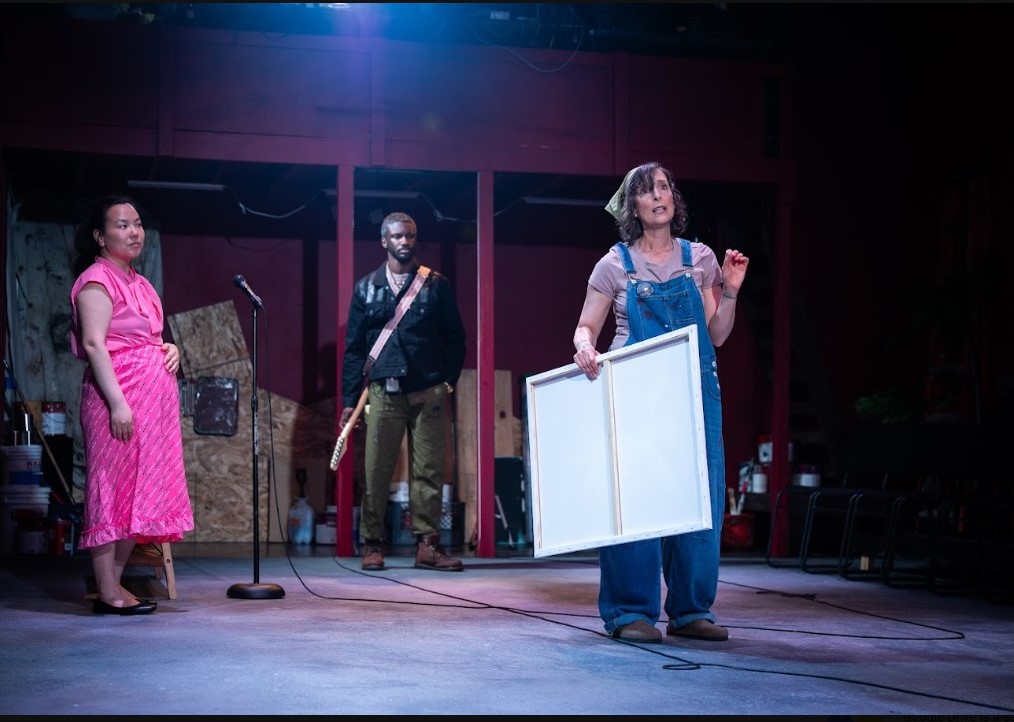
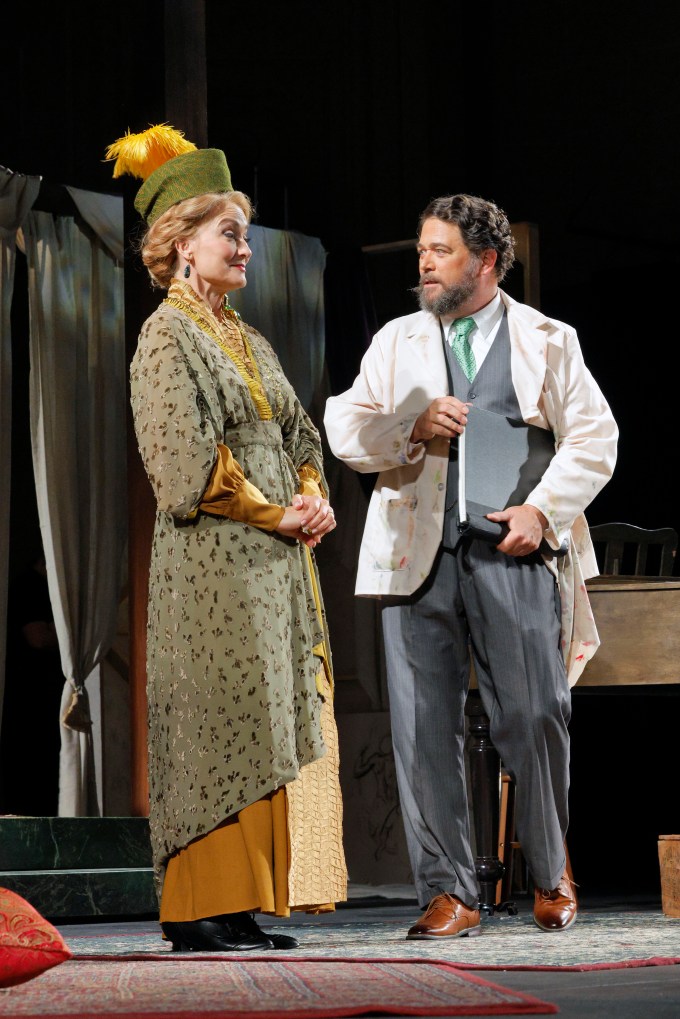
Sheldon (Chris Reber), Spike (Will Livingston), Larry (Erin Gould), Billie (Rebecca Schweitzer*). All photos by Tracy Martin.
Of all sporting activities, what has created more pushback by surrounding neighbors than pickleball because of the constant loud thwacking of solid paddles to hard plastic balls? Playwright (and better known as actor) Jeff Daniels’ play about the ascendent sport opens with an unseen exchange of a mother begging pickleballers to desist for five minutes so that her child can fall asleep. In response to the plea that the play is disturbing the mother’s peace, the players continue, with the argument that she is disturbing their peace!
In a sense, I feel like the mother being in the minority trying to stop a relentless wave. At opening night, there was rollicking laughter throughout, but others of us were less impressed. To Hillbarn’s credit, it filled the house for opening, though perhaps with ringers. In Executive Artistic Director Steve Muterspaugh’s introduction, he surveyed the audience, and it seemed that around half were active pickleball players who had played in the last three days, mostly on that very Friday. This is unlike many ethnic or special interest plays I’ve seen that haven’t drawn in the group reflected in the play, so let’s hope some of these sportspeople get the theater bug.
Six characters drive the action of Pickleball, which takes place at the pickleball courts. Like many comedies (and this is a raucous farce), there is another level of meaning that can be extracted from the script. However, Pickleball really appeals to those liking the broadest comedy and particularly to those who can see characterizations and situations that resonate with their experience……
Per agreement with Talkin’ Broadway, my complete reviews of South Bay and Peninsula theater for the remainder of the year will appear in full on its site. Please continue at:
Pickleball, written by Jeff Daniels, is produced by Hillbarn Theatre and plays on its stage at 1285 East Hillsdale Blvd., Foster City, CA through September 13, 2026.
Lucia Lucas (Lili Elbe). All photos by Bronwen Sharp.
Transgenderism has been attracting considerable attention as of late, and regrettably, for all the wrong reasons. Although debuted in Switzerland in 2023, Santa Fe Opera has produced the American premiere of an important and timely biographical work about the life of a male-to-female transgender who was among the earliest to receive gender reassignment surgeries, in the late 1920s.
Tobias Picker had sought a topic for an opera with a transsexual theme and was leaning toward the tragic 1969 events at the Stonewall Inn in New York, until he came across the historical records of Lili Elbe. In concert with librettist Aryeh Lev Stollman they developed the opera Lili Elbe. Transgender female opera singer Lucia Lucas was selected to portray the title character but agreed only if she could also serve as dramaturg. The result is a powerful, well-crafted, tonal opera bestowed with love and dignity that presents a sensitive and realistic portrait of Lili and her wife Gerda without whitewash.
Sylvia D’Eramo (Gerda Wegener), Lucia Lucas (Lili Elbe)
Born in Denmark, Einar Wegener was a recognized landscape painter whose wife Gerda was a noted portraitist. When Gerda’s model failed to show one day, Einar donned a woman’s clothes and in posing for the painting confirmed what she had long felt – that she was a woman. So begins Einar’s transition to Lili, with full support from Gerda in concept, but not always in timing.
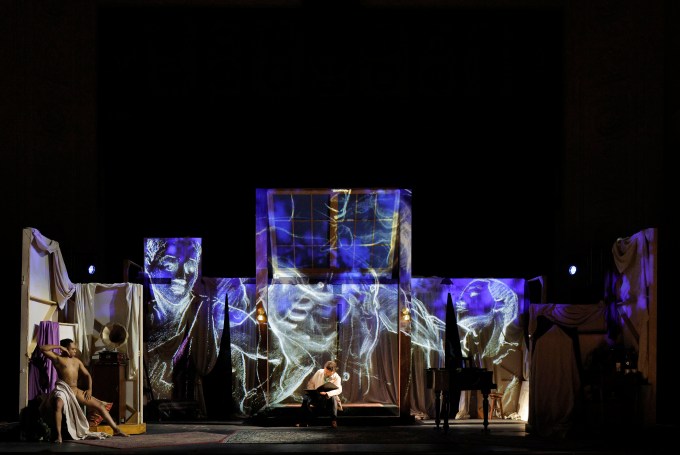
Although dominated by two-handed exchanges, especially Lili with Gerda and Lili with medical staff, Santa Fe’s production is big. Costume Designer Marco Piemontese’s124 costumes, many for the formally-dressed event participants, drive the stylish looks of art exhibits and fetes against an otherwise angular, blank backdrop with the appearance of a building from a de Chirico painting. However, Scenic Designer Allen Moyer’s portals serve to allow movable sets to slide onto stage, and the back partition opens up to display paintings on a wall or a gallery at a theater. The totality of the staging is spectacular in its beauty and diversity.
Anna Kelly (Hélène Allatini), Kyle White (Eric Allatini), Joshua Klein (Major Fernando Porta), Sylvia D’Eramo (Gerda Wegener), Lucia Lucas (Lili Elbe), Josh Lovell (fiancé Claude Lejeune).
Another enhancement is the broad, brooding projections of Greg Emetaz against the dull canvas of the set, always fuzzy and provocative, and often carrying the anchor theme throughout the opera, that of Orpheus and Euridice. This ancient myth speaks both to change, the transition in Lili’s life, and to her never looking back, as Orpheus was commanded not to. The ambiguity of Lili’s very persona is even represented by the shifts in characterizations, whereby Lili starts as the Orpheus figure and turns into Euridice, and the opposite for Gerda.
Lili and Gerda moved from Copenhagen to Paris whose society had more liberal views. Even so, for years, Gerda insisted that while her husband could galivant as Lili during the day but must revert to Einar after twilight. Through all of her change and trauma and belief in her own womanhood, Lili assured Gerda that one thing that would never change was her love for her. Many of the most dramatic moments of the opera concern the dynamic of the couple, which becomes most intense when Lili chooses to “reveal” against Gerda’s wishes.
Sylvia D’Eramo (Gerda Wegener), Anna Kelly (Hélène Allatini), Kyle White (Eric Allatini), Lucia Lucas (Lili Elbe as Ainar Wegener).
As in the Swiss premiere, Lili is portrayed by Lucia Lucas, and in effect, the role was written for her, even though that presents a problem. While most female transgenders develop a lighter voice than in their pre-transition life, Lucas remains a bona fide heldenbaritone, with the full range and masculine timbre of the most common male voice plus some extra notes at the low end encroaching on a bass’s domain. Her voice possesses commanding range and power throughout without a hint of vocal uncertainty. Yet, one of her signature arias “I shall take my life,” is very much about the uncertainty and instability in the life she leads
Lucas is even believed to be the only known transgender to sing a major male role with a recognized company, as she sang Don Giovanni with Tulsa Opera. Her deep, sinewy voice when in her female mode may seem incongruous to the listener, but the bigger issue is finding other transgender performers (which is a goal) who can sing a role with such a low tessitura if the opera has legs as it deserves.
Ryan Wolfe (Lili’s bother Marius Wegener), Deanna Ray Eberhart (sister Dagmar Wegener), Lindsay Ammann (Mother Wegener)
Though modern in idiom, Picker’s instrumental music is tonal and appealing with a strong representation of blaring, punctuating brass. They become particularly significant in moments of conflict, when the Conductor Roberto Kalb’s orchestra turns harsh along with the singers. The strings also bask in glory. In stylish fashion, Director James Robinson moves onto stage a string quartet which appropriately plays at a formal art exhibit.
The score offers arias and other opportunities to express vocal virtuosity, though none carry tunes that an aficionado would sing in the shower. Soprano Silvia D’Eramo, who created the role of Gerda in the world premiere, displays versatility, deftly navigating the higher register but including low end, earth-shaking dramatic power that is usually associated with mezzos. Each of the other singers contributes ably and often splendidly. The chorus offers a huge, well-balanced sound and also advances the narrative, especially with the portentous “You can never be a real woman.”
The plot twists through events concerning Lili’s family, French perfumer fiancė, doctors, and more that won’t be divulged. Notably, upon petitioning and matter of factly, Lili was declared a woman under the King’s decree in conservative Denmark a century ago. Regrettably, and to be blunt, the hate-mongering, sexist/racist Trump administration instead chooses for political advantage to vilify, oppress, and illegally disempower transgenders, a tiny population, who simply seek to get on with life like everyone else. Audience response to the opera was overwhelmingly positive, though it is impossible to disentangle praise for the artistry or the underlying content.
Lili Elbe is a powerful piece of opera that acts as a realistic yet sympathetic antidote to the unreasoned attacks on transgenders. Its music and drama make for a rewarding evening.
Surgery theater.
Lili Elbe, composed by Tobias Picker with libretto by Aryeh Lev Stollman, is produced by Santa Fe Opera and plays on its stage at 301 Opera Drive, Santa Fe, NM through August 27, 2026.
Joélle Harvey as Pamina, Josh Lovell as Tamino. All photos by Bronwen Sharp.
Although The Magic Flute can be performed with the gravity of Teutonic mythology having some comic relief, this magnificent Wolfgang Amadeus Mozart opera (technically a singspiel) with libretto by Emanuel Schikaneder can also be played as a comedy interspersed with dramatic moments. Santa Fe Opera has chosen the latter and extracts every bit of humor from the text and subtext in a production that sparkles with dazzling staging and winsome performances.
In an unusual decision, the company has chosen to offer the work in English, and though it would be unusual to highlight a translation in a review, this one from German by Jeremy Sams deserves mention. The loose translation creates the proper rhythm in concert with the music to allow for proper diction, and there is poetic rhyming as well. Kudos also to the singers, because the result is incredibly understandable sung lyrics.
Will Liverman as Papageno, Spencer Hamlin as Monostatos.
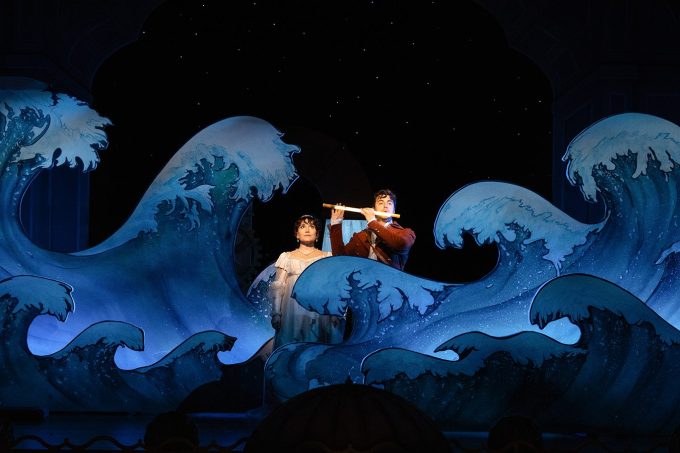
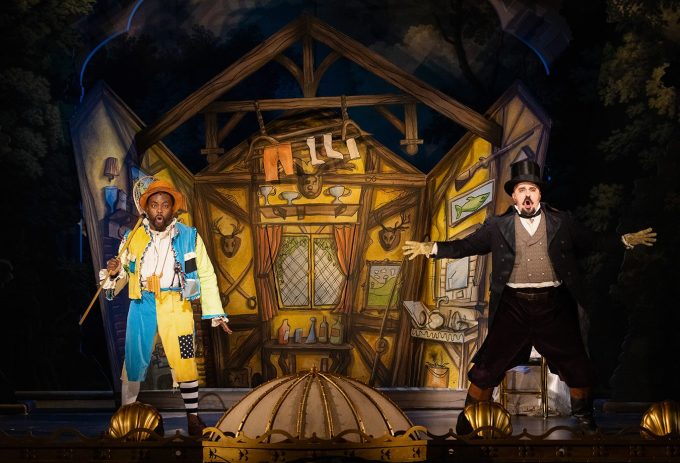
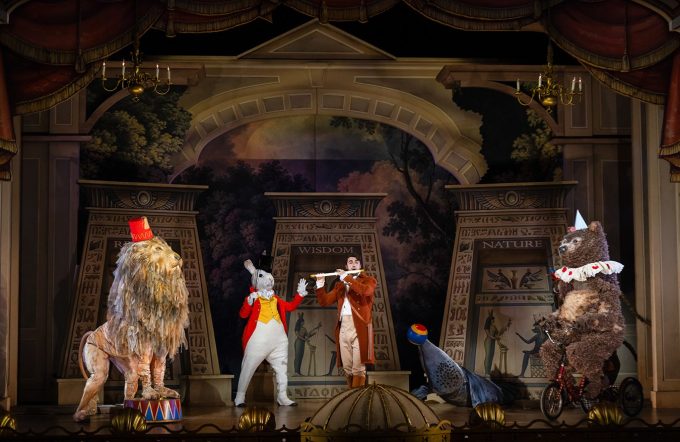
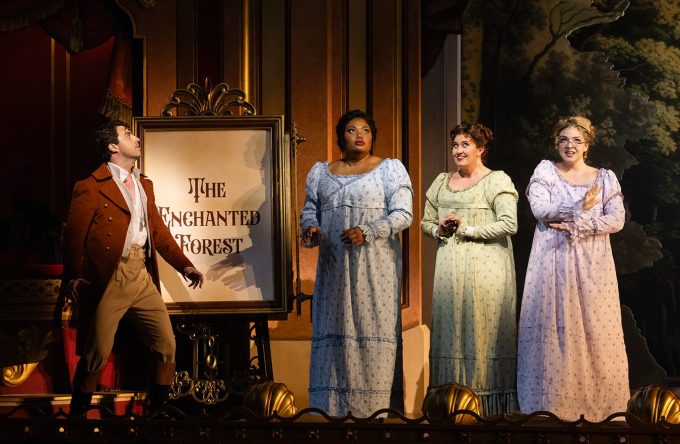
The hero’s mystical journey offers scope for elaborate visual effects. Simon Higlett’s red-dominated fixed set design also deserves early mention as it creates a perfect comic like setting for the action. The stage-within-a-stage, complete with proscenium arch and flat-panel scenery, has the look of a 19th century theater or puppet venue. Ever changing backdrops create a visual phantasmagoria. Decks of loges for kibitzers to the action flank the performing space. All of Director Christopher Luscombes’ creative designers from costuming to lighting combine to complement the look of the set.
Our hero Tamino is Josh Lovell, who looks the part and offers a strong tenor voice with a warm timbre in the upper ranges suited to the Germanic tradition. Tamino wrongly receives credit for slaying a serpent, depicted as a huge scaly, blue dragon. Together with a passel of human-sized, stuffed-animal-looking creatures appearing at other times, they are sources of amazement, charm, and laughs.
Josh Lovell as Tamino.
The serpent was actually felled by three ladies from the court of the Queen of the Night who tasks Tamino to retrieve her daughter Pamina in return for her hand. Tamino had already fallen in love with Pamina’s portrait and responded tenderly to it with the lovely aria “This vision is so wonderfully fair.” She has been abducted by her guardian Sarastro. Bright, fluid soprano Joélle Harvey delights as Pamina who will go through challenges along the way with the brave Tamino.
Accompanying the hero is the irrepressible and irresponsible Papageno, the Queen’s bird catcher. Baritone Will Liverman plays the skittish, overmatched Sancho Panza-like part, riding on his steed, an ostrich. A blessed comic, Liverman provides much of the humor in the plot with his mugging and howling. But he also has a fine voice which he shares in a lovely duet with Harvey who beautifully caresses her part.
Josh Lovell as Tamino, Jasmine Ward as First Lady, Deanna Ray Eberhart as Second Lady, Lauren Randolph as Third Lady.
Another source of humor is Monostatos (Spencer Hamlin) who repeated fails to kidnap Pamina. Monostatos has the look of a Snidley Whiplash to Pamina’s Nell from Dudley Dooright television cartoons. Like Liverman, Hamlin plays to the crowd and even engages in faux-dramatic call-and-response urging with the audience.
On reaching Sarastro’s temple, Tamino realizes that it is the Queen who is evil, not Sarastro. Indeed, and to his joy, the hero is invited to join the brotherhood that Sarastro leads and is given four tests of courage to pass. Although Sarastro’s temple is set in ancient Egypt, the trappings and social/moral themes that give the weightiness to the opera are much like that of Freemasons. Not coincidentally, both composer and librettist were members of that organization.
Tamino’s mission and transition give opportunity for the two signature arias of the opera, neither of which are his (nor is Papageno’s lilting theme on the glockenspiel). Jeni Houser is the Queen, and when she realizes that she may lose her daughter, she sings the vengeful, threatening Queen of the Night aria. This is perhaps the most widely known if not most difficult colortura soprano aria in the canon, with its leaps, arpeggios, and trills. Houser is magnificent and crystal clear in her delivery, as she is with her earlier challenging coloratura aria.
Jeni Houser as Queen of the Night.
The booming basso profundo Alexander Köpeckzi is Sarastro of the grim countenance. His famous Isis and Osiris aria, in which he asks the Gods to bless and guide Tamino and Pamina, resonates with dips to the bottom of the human vocal range.
The text of The Magic Flute is not without flaws. While it is overstuffed, the narrative is jumpy in parts as well. For instance, the tests that the couple go through to satisfy the brotherhood fly by without either good explication or execution. And on the production side, while representations like water waves are appropriately in a comic style, the fake flames are hard to recognize in an otherwise stellar staging. And throwing debris from the loges seems a bit excessive.
Josh Lovell as Tamino, Joélle Harvey as Pamina.
Some patrons will not care for the silliness of this production or may prefer that it be sung in the original German. But those who accept the production decisions will find a delightfully designed and performed realization that will seize the attention and the imagination.
The Magic Flute, composed by Wolfgang Amadeus Mozart with a libretto by Emanuel Schikaneder is produced by Santa Fe Opera and plays on its stage at 301 Opera Drive, Santa Fe, NM through August 28, 2026.
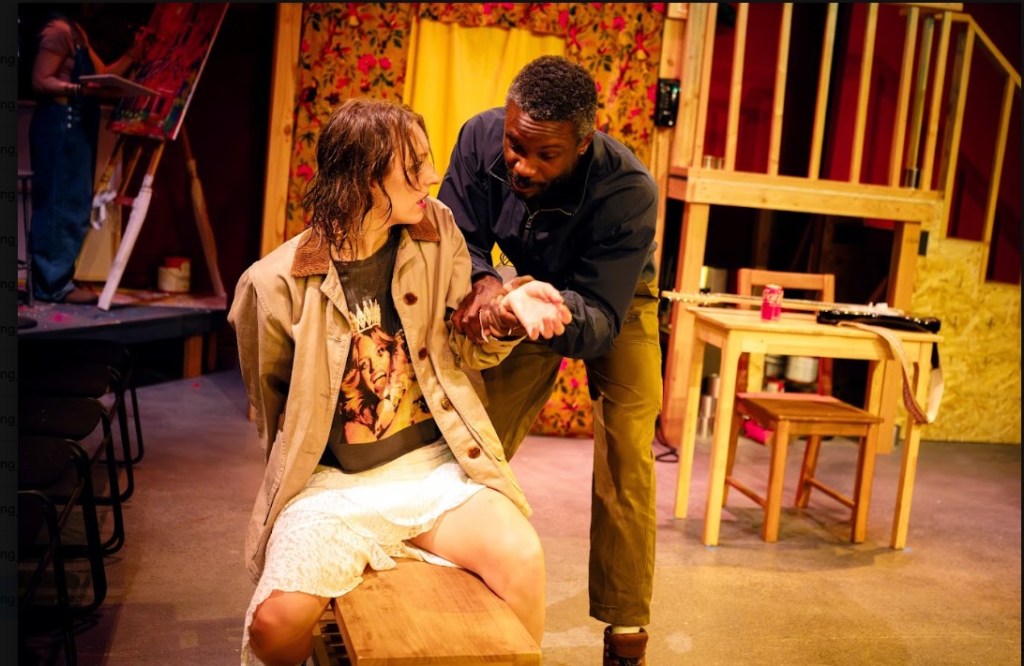
Hunter Bryant as Val, Lisa Ramirez as Lady. All photos by Ben Kranz Studio/
Tennessee Williams reigns as one of America’s greatest playwrights, penning Southern Gothic masterpieces such as A Streetcar Named Desire and Cat on a Hot Tin Roof with indelible characterizations. He also produced a number of near misses, works with elements of greatness but notably flawed. One play generally regarded as such is Orpheus Descending from 1957. While some concerns about this piece would also apply to his greatest plays, those particular to this work include the slow development of the crises and the unexplained diversions involving less important characters. But the central themes are powerful and the results more consequential than in his more popular plays.
Already renowned for the two mentioned above and several more, this was Williams’ second play written for a muse and decades long friend, Anna Magnani, whom he knew from his many years in Rome. But despite its pedigree (the Broadway opening had Cliff Robertson as the title character and Maureen Stapleton as the deceased Italian immigrant’s daughter, Lady), the play didn’t catch on. Nor did the movie, re-titled with words from the play, The Fugitive Kind, despite starring Marlon Brando and Magnani herself, who had won the Academy Award for The Rose Tattoo, the other play that Williams wrote for her. So clearly, there are obstacles to overcome.
Lizzie Isyumin as Beulah, Zolboo Namkhaidorj as Dolly.
Oakland Theater Project offers an unusual treatment of Orpheus Descending. Although I am unaware of the company’s motivation, casting a black man as the title character Val can be construed as color-blind casting, or it could offer another layer of conflict, that of race. Not only is the original text amenable to the latter interpretation (even Val’s guitar is signed by black blues legends), it does make the clashes more urgent and virulent. And several script adaptations clearly relate to making Val black.
Val’s race also adds fire to a vital incident that predates the action of the play. Lady’s father, Papa Romano, had created a vineyard and sold wine to black men at a time when it was illegal in Mississippi. A delegation of men from the town burned the family’s crops, home, and other buildings, and we can assume that they were driven by racism, not to adherence to the law. The father died trying to control the conflagration. Southern justice of the time being what it was, the case wasn’t solved, and Lady, now in an unhappy marriage with an invalid, lives in a community not knowing who all were responsible for her suffering.
Zolboo Namkhaidorj as Dolly, Hunter Bryant as Val, Susannah Martin as Vee.
Hunter Bryant is the snakeskin-jacket-wearing, guitar-playing Orpheus figure, Val. On the run from being at the wrong place in New Orleans at the wrong time, his descent is into the hell of a small racist Southern town. The married woman, Lady, who should be unreachable, is his Eurydice.
Bryant is at once charismatic and laconic, earnest and halting, with limited affect (think Marlon Brando), his character saying little more than needs to be said. He does state that he’s just turned 30 and like a snake shedding its skin, he’s leaving the old wild life behind. And though cautious understatement would be de rigeur for a black man in his situation, it doesn’t necessarily make for dramatic theater.
Natalie Pasquinelli as Carol, Hunter Bryant as Val.
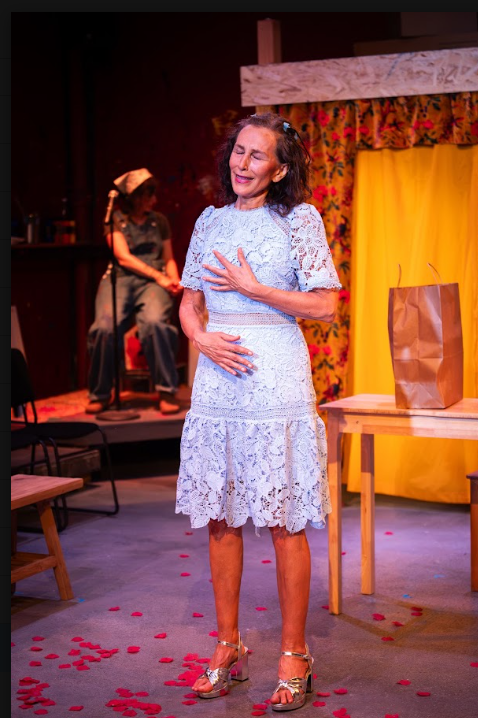
Lady is a different kind of outsider that Lisa Ramirez depicts ably and convincingly as morose and yearning for something more. Her modulated gesticulations draw from her heritage, and she animates her quieter moments with little fidgets of anticipation as she finds herself attracted to Val. Lady runs the general store for her bed-ridden husband Jabe, and her loveless marriage makes her susceptible to Val’s appeal. He’s looking for work and hiring him ensures that they will be together.
The playwright certainly knows the denizens of small Southern towns, and one of the archetypes is Carol Cutrere, the wild child from the county’s most prominent family. Played with gusto by a voluble and magnetic Natalie Pasquinelli, she is an exhibitionist with no filters and shows no restraint. Pasquinelli is absolutely frenetic throughout, though she does take time to show that she has some social consciousness and has also fallen for Val.
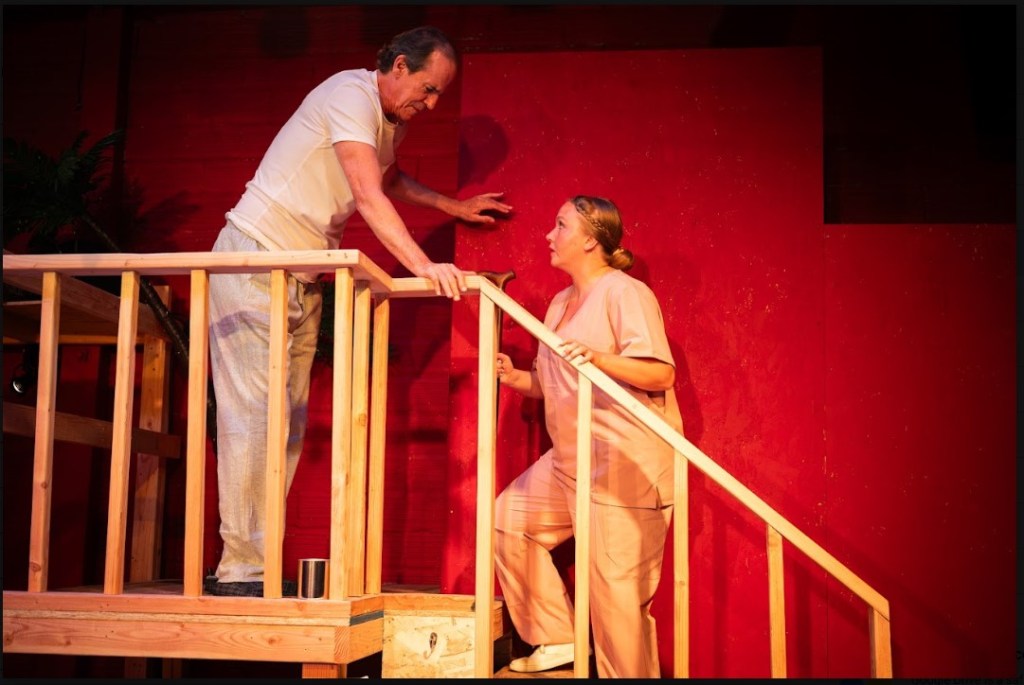
Robert Parsons as Jabe, Lizzie Izyumin as Nurse Porter.
The final major player is the talented Robert Parsons, who imbues three characters with importance, and he does it with distinction. As Jabe, thumping his cane and shaking from illness when he rarely ventures out of bed, is irascible and suspicious of Lady and Val. As the sheriff, Parsons coolly and dispassionately threatens the intruder Val to move on in a manner reserved for blacks in the South. And as David, Lady’s lover from long ago, he is contrite and apologetic.
Under Will Detlefsen’s direction, one additional conceit beyond the well-developed racial element includes speaking stage directions, in part to compensate for lacking a representational set of the general store where the action takes place. Also, when two women gossip about the goings on in the town, instead of speaking sub-rosa, they use microphones to amplify their messages. Some of the process of this device was a little clumsy on opening night, leaving some audience members a little confused, but it adds a little spice to the mix.
Lisa Ramirez as Lady.
With regard to the worth of Orpheus Descending compared to his more popular works, I completely weigh in on the positive side, especially with the racial element added. It is full of memorable characters that represent their society well. The stakes and the consequences are considerable with multiple tragic results in the end. And drawing on Greek mythology and layering in symbolism adds more dimensionality to the drama. OTP’s production decisions are a matter of taste and need to be ironed out for clarity but well worth checking out.
Orpheus Descending, written by Tennessee Williams, is produced by Oakland Theater Project and plays at Flax art + design, 1501 Martin Luther King Way, Oakland, CA through August 23, 2026.
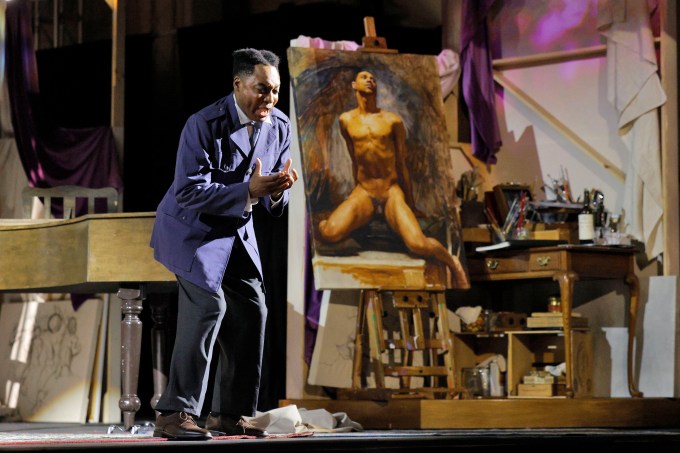
Markel Reed as Thomas McKeller, John Bellemer as John Singer Sargent. All photos by Cory Weaver.
In Greek mythology, muses were goddesses who inspired all practitioners of the various arts and some science, from poetry to astronomy. In modern parlance, muses inspire specific artists and are uniquely personal, sometimes having intimate relationships with the artist.
American Apollo tells of one such muse, Thomas McKeller, and of his patron, John Singer Sargent, the most successful classical portrait painter of his generation. Although Sargent was American, he lived in Europe as an expatriate most of his life. While residing in Boston late in the second decade of the 20th century, he used Thomas as a model, particularly to represent the bodies of gods. But as McKeller would later complain, Sargent never used his skin or his face. Thomas was black.
Markel Reed as Thomas McKeller, John Bellemer as John Singer Sargent..
To a libretto by Lila Palmer, Damien Geter has composed a portrait of the two men and the small coteries that surrounded them. Though not openly gay, homoerotic clues arise from Sargent’s letters, so the narrative imagines that the relationship between the men who worked intimately and for quite some time became romantic.
Another suggestion of a love affair derives from the fact that Sargent did paint a single portrait of McKeller that was nude and evocative, and Sargent kept it in his private collection. Alternate hypotheses could explain his not showing or selling the painting. Perhaps there was no market for such a work, or perhaps the artist’s reputation could be sullied by it. Of course, consistent with the suggested relationship is that the artist retained it as a private keepsake and remembrance.
Markel Reed as Thomas McKeller, Alexandra Armantrading as Ida Mae McDonald.
The adventuresome West Edge Opera has produced American Apollo as its third and final opera of its innovative and entertaining 2026 festival. The warm, melodic score is accompanied by a literate libretto and supported by a lead cast of powerful singers with commensurate acting skills. The result is a pleasing production that touches on continuing social issues of our time.
Geter’s score draws on many popular music idioms, resulting in one more welcomed step in the return of opera music to melodious tonalism in the post-modern era. Among non-operatic sources, the composer adds a little jazz and blues to the scenes involving only black characters. And he borrows elsewhere to the point of pastiche, even sampling in the case of John’s singing Reynaldo Hahn’s beautiful neo-Baroque chanson “A Chloris” and Thomas’s friends singing the stirring “La Marseillaise” as they enter World War I.
The warm, lush music fits comfortably in Palmer’s lyrical libretto, which wisely doesn’t try to overdo differences among characters’ race, class, and sexual orientation – the dominant themes of the story. Indeed, the librettist allows considerable ambiguity in the relationship – from speaking occasionally in coded words and uncertainty as to who initiates the intimacy to John’s departure from Boston without explanation.
Marnie Breckenridge as Isabella Stewart Gardner, John Bellemer as John Singer Sargent.
Yet, if there is an overarching weakness in the opera as a drama, it is that beyond personal anguish, the stakes are small and the climaxes not sufficiently intense. The affair is not even made public. Thus, lacking the dramatic carnage of Elektra or the civilizational gravity (and bloodbath) of Götterdämmerung, it might help if the intermediate inflections, like the deaths of two persons close to the central characters are more accented. Even the clashes between characters are understated.
Notwithstanding, the fantasy engages, and the performances are outstanding. Markel Reed as Thomas McKeller has a wonderfully earthy baritone voice, intense yet reserved, deep and well-projected. In both singing and acting, he depicts the dignity and agency of the character while conveying the quiet angst of being underprivileged and lacking opportunity for big things.
John Bellemer as John Singer Sargent shows confidence and buoyancy with his brightly vibratoed tenor. Bellemer strikes a middle ground in the relationship. Though he’s the employer and a white man of privilege, he is portrayed as largely understanding and refrains from condescension.
Markel Reed as Thomas McKeller.
The other key character is Isabella Stewart Gardener, who was not only a major patron of Sargent’s, but she founded the eponymous museum in Boston to display her bountiful world-class collection. In addition to purchasing a large number of Sargent’s paintings, she also calms the two men when clashes cause their separation. Indeed, in persuading Thomas of John’s affection, she confides, “That is why we love him. We are beautiful in his eyes.” The charming and clarion clear soprano Marnie Breckenridge is a notable addition to the plot as Gardener, and she endows the benefactress with wit and stellar voice.
The production plays on a set by the Bay Area’s ubiquitous scenic designer Nina Ball. Having a single set with fold-out sides, the framework is flexible enough to represent several different venues using a little imagination. Direction is by the versatile and uber-talented Nataki Garrett, and Oakland Symphony Music Director Kendrick Armstrong conducts with skill and conviction.
American Apollo, composed by Damien Geter with libretto by Lila Palmer, is produced by West Edge Opera and is performed at Scottish Rite Center, 1547 Lakeside Dr., Oakland, CA through August 16, 2026.
Jeremy Ohta Lee as Mark Antony, Elizabeth Carter as Cleopatra. Photo by SF Shakes.
In 1607, William Shakespeare produced the play Antony and Cleopatra based on Plutarch’s Lives. Of the Bard’s plays, it is one that comfortably falls into three categories in his catalog – history, tragedy, and romance. In no way derivative, it does build on two earlier works, although it hasn’t attained the reverence of the other two.
As a history, it is a sequel to Julius Caesar with its strongest link being Mark Antony who defeated the conspiratorial murderers of Julius Caesar. Now, Antony is the triumvir for Africa in the Second Triumvirate that rules the three parts of the Roman Empire. As a romantic tragedy, it follows in the footsteps of Romeo and Juliet in that both lovers in both plays commit suicide. In each case, one self-destruction occurs based on the false belief that the person’s lover is dead (Incidentally, spoilers don’t count in Shakespeare plays).
But not only does Antony and Cleopatra stand on its own as a solid piece of stagecraft, it offers a rarity in the Shakespeare canon, a heroine that exercises agency and even commands an empire. Yet, Shakespearean misogyny or at least condescension toward females prevails, best articulated by Antony’s General Enobarbus. Even in his admiration of Cleopatra, it is not for her accomplishments but her allure, and he otherwise dismisses women in various ways.
San Francisco Shakespeare Festival takes on this notable work and presents it at two outdoor venues in the South Bay / Peninsula as well as one in San Francisco itself. Shakespeare’s works are produced so often that many companies can’t resist tampering with the play’s packaging. In this case, Director Katja Rivera was obligated to trim the play to a run time of 90 minutes, which offers the advantages of attracting a more attention-span-challenged audience; avoids the need for an intermission; and more reliably allows completion before darkness at outdoor venues. The cost is that the narrative becomes bumpy and jumpy with frequent changes of venue and loss of continuity…..
Per agreement with Talkin’ Broadway, my complete reviews of South Bay and Peninsula theater for the remainder of the year, will appear in full on its site. Please continue at San Jose/Silicon Valley – “Antony and Cleopatra” – 8/5/26 .
Sara Couden as Goffredo, Kyle Tingzon as Rinaldo. All photos by Cory Weaver.
In 1711, as George Frederic Handel’s first Italianate opera produced for the London stage, Rinaldo fared poorly with critics of the time who weren’t prepared for it, but the more amenable audiences loved it. It went on to be wildly successful then and is now considered one of his most artistic works. That said, in part, it is a pastiche of reworked pieces that sometimes differ in style from the overall musical idiom.
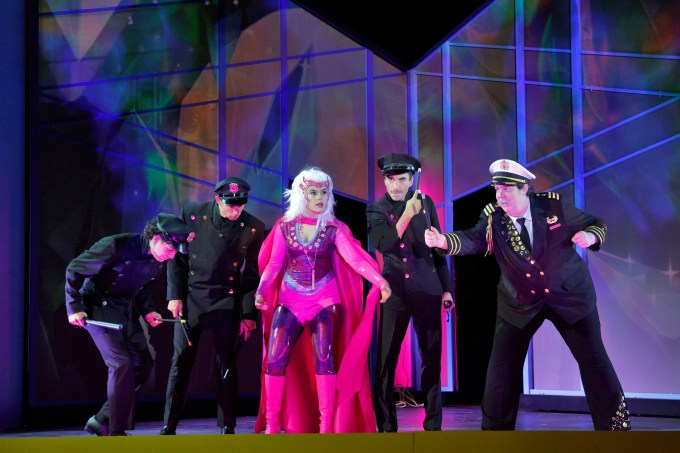
No stranger to Handel operas, West Edge General Director Mark Streshinsky wanted a new take on Rinaldo and charged Director Keturah Stickann to find the humor in the story. Since it takes place in the conflicts of the Crusades, that may seem a stretch, but at least none of the principals die. Ultimately, Stickann found parallels with American superheroes popular in comic books and films and went with it. Thus, along with both outstanding singing and orchestra conducted by Emily Senturia, the enterprising and entertaining production is full of laughs, colorful action, and modern dance movement.
Efraín Solis as Argante, Shawnette Sulker as Almirena.
Purists may object to this treatment, but if they love Handel’s music, they will still get that. A majority of the audience probably appreciates both the music and a fresh interpretation of the action. A final segment, admittedly including me, may not favor Baroque music but finds it more palatable with the diversionary depiction.
One issue with Baroque opera in general is its vocally unbalanced, typically high overall tessitura, driven by the frequent use of a castrato (now usually sung by a countertenor or mezzo-soprano) in the male lead part. In this case, smooth and mellow countertenor Kyle Tingzon is exemplary in the title role, and he gets to mug his way through the comic elements, flexing his biceps and throwing judo-type kicks.
Nikki Einfeld as Armida, dancers.
But the tessitura wasn’t yet high enough for Handel, so he specified another lead part as a trousers role, Goffredo, who is the Chief in this realization. The score calls for a contralto, and fortunately, the Bay Area is home to one of the finest of that rare breed, the robust and vibrant Sara Couden. This role calls for the high end of her range, unlike the normal expectation of a chesty vocalization. Indeed, not only are the timbre and range close to that of Rinaldo, Tingzon has also performed Goffredo.
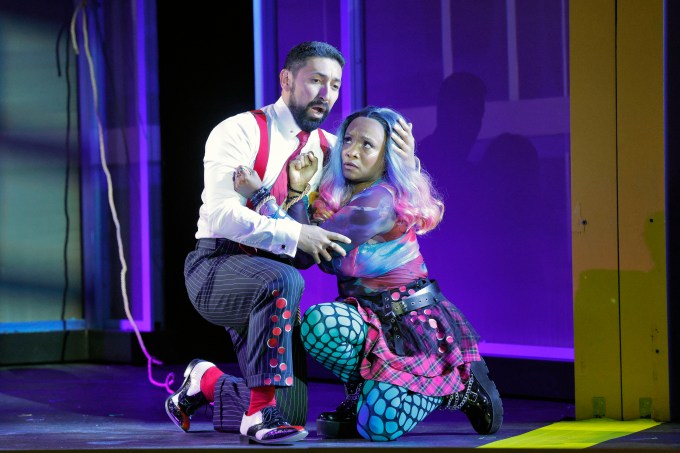
The die is cast during the opening prelude, full of Keystone Cops type pratfalls with chases, fights, and dance. The ensuing plot involves superhero Rinaldo helping Goffredo to rid the city of a crime syndicate led by Argante, played by Efraín Solis, whose warm baritone, which includes well-sung coloratura passages, is the only respite from high end voices. The two remaining key characters are talented sopranos. Shawnette Sulker is Almirena, Goffredo’s daughter who is in love with Rinaldo. Nikki Einfeld is Armida, a super villain working for and in love with Argante. However, she captures Almirena, and in the process, Argante falls for her.
Nikki Einfeld as Armida, Efraín Solis as Argante.
Kudos to all of the cast for strong singing but also for the special acting required, including many sight gags and much physical comedy. They play over-the-top for laughs to a plot indicated by the supertitles for the audience. Yet, while acting silly, they are still singing to a libretto of action from a millennium ago, replete with Saracens, chariots, and an attack on Jerusalem.
Musically, Handel is resourceful both in his use of varied instrumentation and by repurposing arias from other cantatas, oratorios, and operas. His most distinctive contributions diverge from the main musical idiom. Sulker embraces the most haltingly beautiful aria, Almirena’s “Lascia ch’io pianga” (“Let me weep”), a stately sarabande that was an instrumental in an earlier opera Almira. Also memorable is the brief “Sonata per l’arciliuto” with melody by a theorbo, an instrument of the period, and supported by plucking from the other strings in the orchestra.
Gabi Esquenazi as Siren, Sara Couden as Goffredo, dancers.
Upon reconciliation of the principals, the opera closes with a full ensemble. Its message is noble but perhaps foreboding – “Only virtue can defeat evil.”
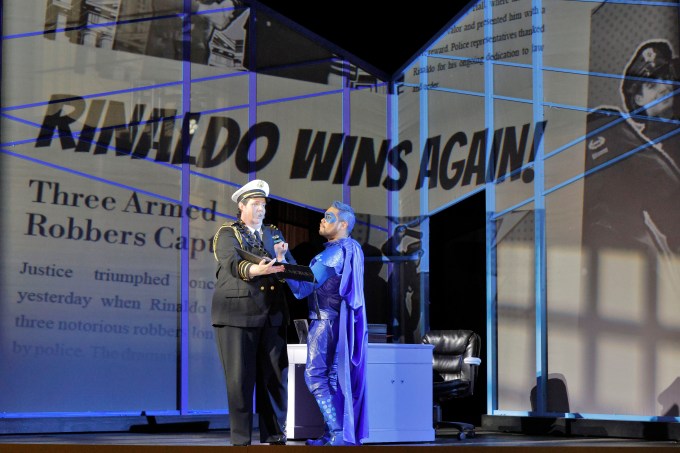
As with the company’s The Turn of the Screw, a creative contribution standout is from Projection Designer Yuki Izumihara, whose projections include the comic book use of colorful graphics splashed with words like BAM and SWOOSH to accompany fights, as well as flashes of newspapers. The other special recognition goes to Bethany Deal’s costume design particularly for the brilliantly lively outfits of the principals.
In all, Rinaldo is inventively produced and well performed, providing a superior, if eccentric, opera experience.
Projection image: Nikki Einfeld as Armida, Kyle Tingzon as Rinaldo.
Rinaldo, composed by George Frederic Handel with libretto by Giacomo Rossi drawn from Torquato Tasso’s epic poem Gerusalemme Liberata, is produced by West Edge Opera and is performed at Scottish Rite Center, 1547 Lakeside Dr., Oakland, CA through August 15, 2026.
Judith Miller as Lady Bracknell, Kyle Smith as Lane, Drew Benjamin Jones as Algernon. Photos by Evelyn Huynh.
The British Isles have long been a font of bubbly literary humor from the likes of George Bernard Shaw, Noel Coward, P. G. Wodehouse, and Alan Ayckbourn. Preceding them all, and though he penned three other socio-comedic plays that continue to amuse, Oscar Wilde’s The Importance of Being Earnest ranks not only as his most successful but is perhaps the most popular of all British theatrical comedies.
Silicon Valley Shakespeare has produced this antiestablishment drawing room comedy with amiable results, delivering its absurd notions farcically, but not over the top. Performed outdoors on a stage venue surrounded by stately redwoods, the combination of provocative culture and the grandeur of nature provide an embracing evening.
Like Algernon, whom the playwright probably identifies with, Wilde parodies hypocritical Victorian manners and exposes the truths that they hide. A pointed and poignant observation concerns bunburyism, which derives from Algernon’s fictitious friend Bunbury, whose convenient illnesses provide cover for Algernon to avoid social engagements. The hypocrisy extends to Algernon’s friend having a dual identity, in which he is Jack where he lives with his ward Cecily in the country, but Ernest when he cavorts in London………
Alex Boyer as Peter Quint, Noah Hajduk as Miles, Laura Bohn as The Governess. All photos by Cory Weaver.
From its opening strains there is no doubt that an ominous tale will follow in the opera version of The Turn of the Screw. The skittish devotees to fright will not be disappointed, and the West Edge Opera version should please aficionados.
Benjamin Britten’s chamber opera with libretto by Myfanwy Piper follows novella author Henry James’s narrative closely. Indeed, in the minds of non-opera buffs, it is a rare opera which equals or exceeds its source material in merit, although Verdi’s Otello is often cited as an exception. With elements of a Gothic novel and ghost story, it tells of an untried governess hired to care for a boy, Miles, and a girl, Flora, on a country estate. Their parents having died, they are wards of an absentee uncle. Two employees who were close to the children, the valet Peter Quint and the previous governess Miss Jessel, have also died.
As The Governess, Laura Bohn’s intensity is amplified by being on stage for the full performance, even observing action she’s not involved in. Though a lyric soprano, her voice possesses dramatic edge to convey the deep anxieties of The Governess as she descends from naïve optimism to paranoia.
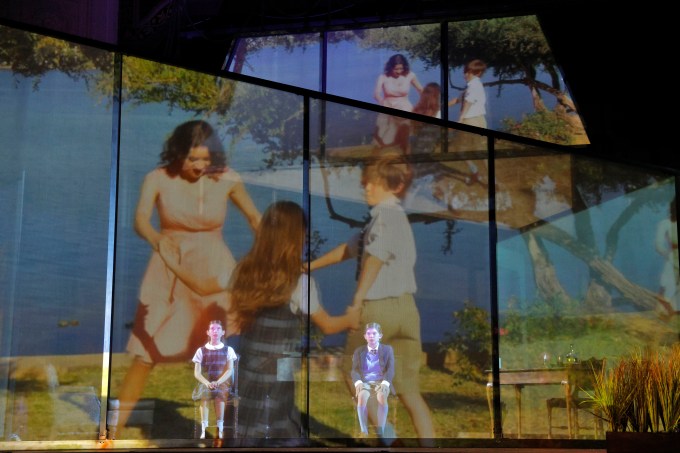
(above) Aléxa Sessler as Miss Jessel, Alex Boyer as Peter Quint, (below) Siena Conglio as Flora, James Coniglio as Miles.
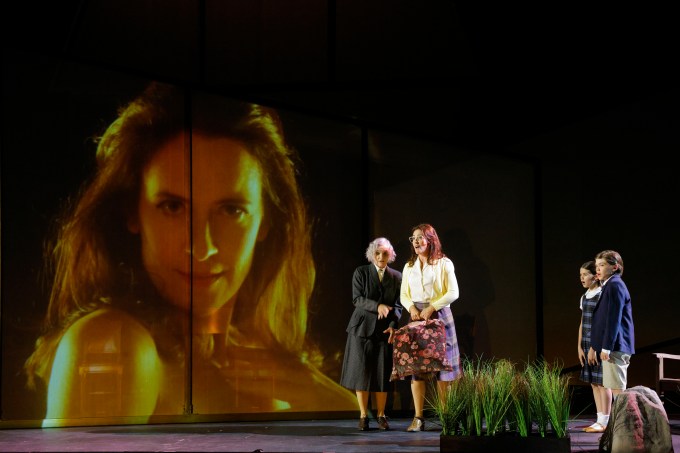
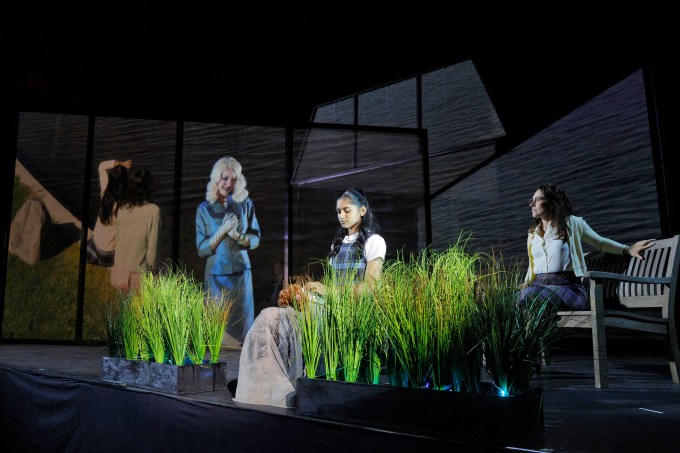
Her vague unrest (“O why, why did I come?”) solidifies having seen, or thinking that she’s seen, the deceased employees. Portrayed by powerful tenor Alex Boyer, Peter Quint is the opera’s male lead, yet his profound visual presence is through projected images. Boyer and smooth soprano Aléxa Sessler as Miss Jessel sing unseen from an upper gallery of the auditorium, with their live images projected onto scrims on the stage. A vocally and visually disemboweled state results that works perfectly to convey their otherworldliness. And particularly, the macabre close ups of Quint make even the fair-faced Boyer look menacing.
Meanwhile, the children, played by Noah Hajduk and Roya Agarwal, become more disturbing with their morbidity. Increasingly, The Governess despairs that they are under the control of Quint and Miss Jessel. Housekeeper Mrs. Grose, played by accomplished veteran soprano Erin Neff, cannot cope, as she acknowledges that she isn’t capable of competing with the bright and devious children.
Britten’s score suits the instability of the haunting story and its characters with a mix of tonal and atonal music. Jonathon Khuner’s orchestra is limited to 13 musicians, but many have solos, often imitating things in nature such as a flute sounding like a bird or a tom-tom drum like an uneasy heartbeat. The general audience will appreciate the music for its inventiveness and foreboding. Even the children singing the ditty Tom, Tom, the Piper’s Son sounds grotesque.
Aléxa Sessler as Miss Jessel, Erin Neff as Mrs. Grose, Laura Bohn as The Governess, Siena Coniglio as Flora, James Coniglio as Miles.
Musicologists will appreciate the score more intellectually. Motifs, especially the portentous 12-note “Screw” theme, which in part draws from Schoenberg’s 12-note atonal technique, appears in altered forms throughout.
The other prominent motif is “Malo,” which is Latin for “I prefer” or as sung by Miles “I would rather be.” It comes from Miles’ language lesson and becomes his theme. Except for diacritical marks, malo is a homophone for other words and has ambiguous interpretation. It expresses innocence (the movie title based on the novella is The Innocents), but it also suggests admission of guilt. Thus, Britten’s diversion from James’s novella makes the story even more ambiguous and interpretable, which many would consider a good thing. Among the ambiguities, is The Governess delusional and seeing things with her vision of the dead, or was she just told that they were dead? Are the children’s behaviors just pranks, or are they really evil?
Aléxa Sessler as Miss Jessel, Roya Agarwal as Flora, Laura Bohn as The Governess.
West Edge General Manager Mark Streshinsky directs the impressive production with its inventive use of technology. Set and Projections Designer Yuki Izumihara devises spectacularly spooky staging starting with a black-and-white projection depicting the manor. Two asymmetrical layers of scrims front and rear display most of the projections, creating a space where much of the action takes place. While it could be characterized in many ways, it seems like a prison where this isolated party of four living souls is trapped.
In eerie contrast to the live proceedings, recorded moving images of Quint and the children enjoying activities like tossing balls and playing piano are often projected which have the feel of home movies. Is this to say that superficial representations of how we live can often be misleading?
Cast.
The Turn of the Screw, composed by Benjamin Britten with libretto by Myfanwy Piper and based on the novella of the same name by Henry James, is produced by West Edge Opera and plays at Scottish Rite Center, 1547 Lakeside Drive, Oakland, CA through August 15, 2026.