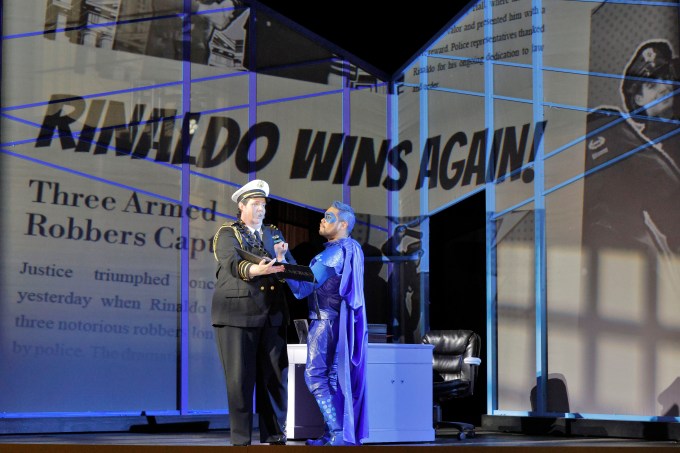
In 1711, as George Frederic Handel’s first Italianate opera produced for the London stage, Rinaldo fared poorly with critics of the time who weren’t prepared for it, but the more amenable audiences loved it. It went on to be wildly successful then and is now considered one of his most artistic works. That said, in part, it is a pastiche of reworked pieces that sometimes differ in style from the overall musical idiom.
No stranger to Handel operas, West Edge General Director Mark Streshinsky wanted a new take on Rinaldo and charged Director Keturah Stickann to find the humor in the story. Since it takes place in the conflicts of the Crusades, that may seem a stretch, but at least none of the principals die. Ultimately, Stickann found parallels with American superheroes popular in comic books and films and went with it. Thus, along with both outstanding singing and orchestra conducted by Emily Senturia, the enterprising and entertaining production is full of laughs, colorful action, and modern dance movement.
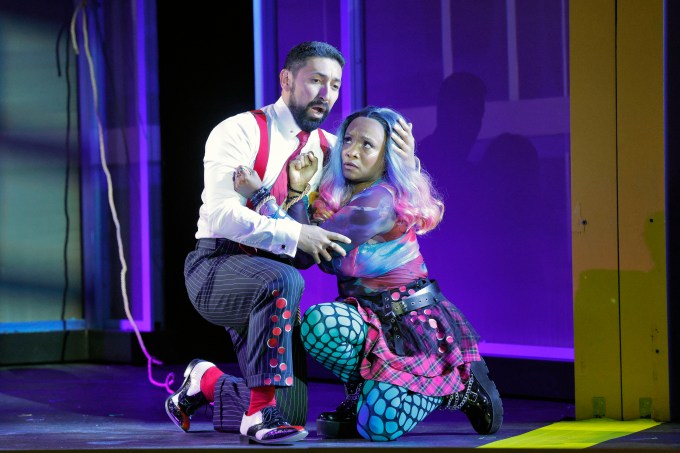
Purists may object to this treatment, but if they love Handel’s music, they will still get that. A majority of the audience probably appreciates both the music and a fresh interpretation of the action. A final segment, admittedly including me, may not favor Baroque music but finds it more palatable with the diversionary depiction.
One issue with Baroque opera in general is its vocally unbalanced, typically high overall tessitura, driven by the frequent use of a castrato (now usually sung by a countertenor or mezzo-soprano) in the male lead part. In this case, smooth and mellow countertenor Kyle Tingzon is exemplary in the title role, and he gets to mug his way through the comic elements, flexing his biceps and throwing judo-type kicks.

But the tessitura wasn’t yet high enough for Handel, so he specified another lead part as a trousers role, Goffredo, who is the Chief in this realization. The score calls for a contralto, and fortunately, the Bay Area is home to one of the finest of that rare breed, the robust and vibrant Sara Couden. This role calls for the high end of her range, unlike the normal expectation of a chesty vocalization. Indeed, not only are the timbre and range close to that of Rinaldo, Tingzon has also performed Goffredo.
The die is cast during the opening prelude, full of Keystone Cops type pratfalls with chases, fights, and dance. The ensuing plot involves superhero Rinaldo helping Goffredo to rid the city of a crime syndicate led by Argante, played by Efraín Solis, whose warm baritone, which includes well-sung coloratura passages, is the only respite from high end voices. The two remaining key characters are talented sopranos. Shawnette Sulker is Almirena, Goffredo’s daughter who is in love with Rinaldo. Nikki Einfeld is Armida, a super villain working for and in love with Argante. However, she captures Almirena, and in the process, Argante falls for her.

Kudos to all of the cast for strong singing but also for the special acting required, including many sight gags and much physical comedy. They play over-the-top for laughs to a plot indicated by the supertitles for the audience. Yet, while acting silly, they are still singing to a libretto of action from a millennium ago, replete with Saracens, chariots, and an attack on Jerusalem.
Musically, Handel is resourceful both in his use of varied instrumentation and by repurposing arias from other cantatas, oratorios, and operas. His most distinctive contributions diverge from the main musical idiom. Sulker embraces the most haltingly beautiful aria, Almirena’s “Lascia ch’io pianga” (“Let me weep”), a stately sarabande that was an instrumental in an earlier opera Almira. Also memorable is the brief “Sonata per l’arciliuto” with melody by a theorbo, an instrument of the period, and supported by plucking from the other strings in the orchestra.
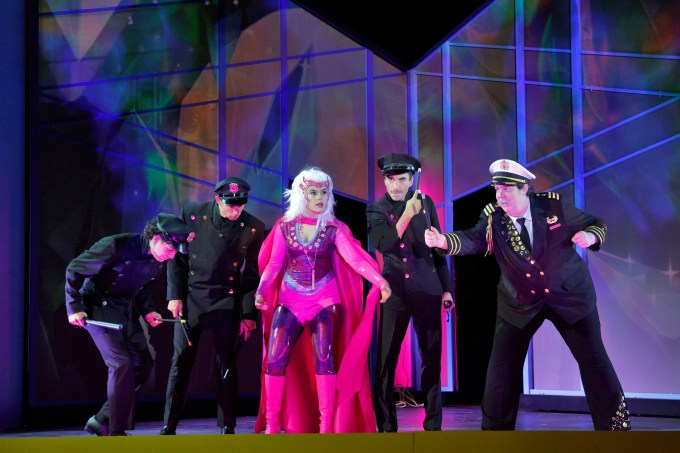
Upon reconciliation of the principals, the opera closes with a full ensemble. Its message is noble but perhaps foreboding – “Only virtue can defeat evil.”
As with the company’s The Turn of the Screw, a creative contribution standout is from Projection Designer Yuki Izumihara, whose projections include the comic book use of colorful graphics splashed with words like BAM and SWOOSH to accompany fights, as well as flashes of newspapers. The other special recognition goes to Bethany Deal’s costume design particularly for the brilliantly lively outfits of the principals.
In all, Rinaldo is inventively produced and well performed, providing a superior, if eccentric, opera experience.

Rinaldo, composed by George Frederic Handel with libretto by Giacomo Rossi drawn from Torquato Tasso’s epic poem Gerusalemme Liberata, is produced by West Edge Opera and is performed at Scottish Rite Center, 1547 Lakeside Dr., Oakland, CA through August 15, 2026.

