For those of you who desperately need to get onto other things (?!), I’ll give my verdict first before discussing the interesting aspects of this opera. Yes, Suor Angelica is among the greatest one-act operas in the canon, and Livermore Valley Opera has crafted a sterling production that reveals its numerous assets.
Giacomo Puccini hatched the idea of composing three one-act operas to be performed in specified order in one evening. While the first, the brooding and violent Il Tabarro, was already formed, Puccini enlisted librettist Giovacchino Forzano to write this one, as well as what became the breakout hit, the sparkling comic opera Gianni Schicchi. However, the three operas lack a common thread or compelling reason to be performed together. What’s more, they present such divergent casting and staging demands that only the biggest opera companies can do them justice in a single program, and then, with what artistic purpose? What was Puccini thinking?
Il Trittico (“The Triptych”), as they are known, premiered at the Metropolitan Opera in 1918. From the outset, many American critics disparaged Suor Angelica. Since the three operas demanded commitment to a long evening, many productions soon after dropped this most criticized one, and the stain has somewhat followed this brilliant vignette of life in the convent.
However, these early reviews deserve their own criticism. Note that predominantly non-Catholic societies, starting with the U.S., may have balked at an opera about nuns. Also, while this opera has an all-female cast, all critics of the era were male and accustomed to male domination in all contexts. Perhaps if the critics had set their testosterone and religious beliefs aside, they could have accepted Suor Angelica as a bright beam of devotion, morality, redemption, and tradition, but that notion seemed to be beyond their grasp.
Puccini composed four war-horse operas, among the most performed world-wide, each having successions of one popular set piece after another. Suor Angelica lacks that level of familiarity, but the music throughout is typical of its composer’s – rich, lush, and melodic. Moreover, it does have as its touchstone the stunningly beautiful and achingly heart-rending aria “Senza Mamma” (“Without Mother”). Ann Toomey is Angelica, and the soprano’s “Senza Mamma” exhibits every painful shred of deep emotion, vocal range, and chilling power demanded by this stellar and haunting aria.
The opera’s libretto breaks down into discrete segments, with the music adeptly responding to prevailing topics and emotions, whether prayers, recreation, or discussion of nuptials. One of the most distinctive is when Angelica is asked by the Badessa (Abbess) and in front of the other nuns to declare what she misses. She lies and says “nothing.” This produces a musical chatter of gossip, as the sisters know that she yearns to hear from her guardian who hasn’t communicated in seven years.
Angelica came from a distinguished family and was forced into the convent by her guardian, the Zia Principessa (Princess Aunt), as punishment for having a child out of wedlock. Of course, this practice seems alien and irrelevant to our society today where nearly half of children are now born outside of marriage.
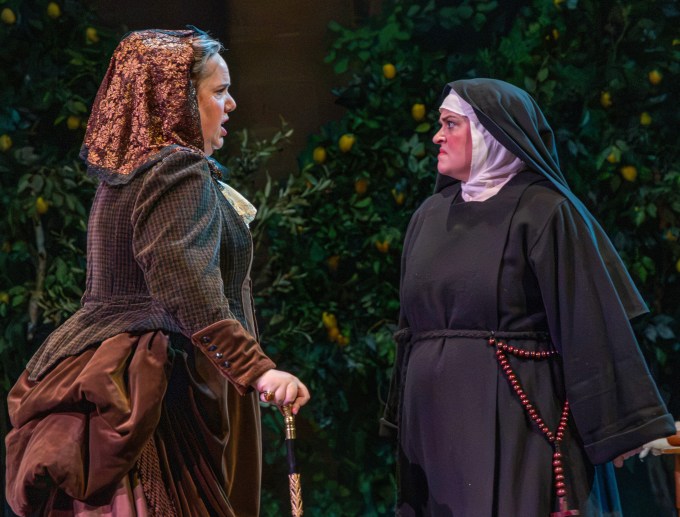
The central event which is telegraphed by the tragic Angelica’s lie is a visit from the Principessa. Angelica has long subjugated her wants to those of the convent but is now asked to make another, permanent sacrifice. The Principessa is an exceptionally well-crafted role that could not be more suited to contralto Sara Couden. In a few short minutes, Couden captures the imperious, self-serving Principessa, disrupting what little peace Angelica possesses. Couden’s potent, deep throttle voice resonates to the rafters and drips with authority in a vivid and highly memorable performance.
Stage Director Annalisa Winberg leads the artistic contributions, and though Puccini was noted as providing copious stage directions, Winberg does come up with some interesting interpretations outside of the libretto. One particular blocking sequence involves the Principessa whose dominance over Angelica is clearly displayed as she backs her niece across the stage.
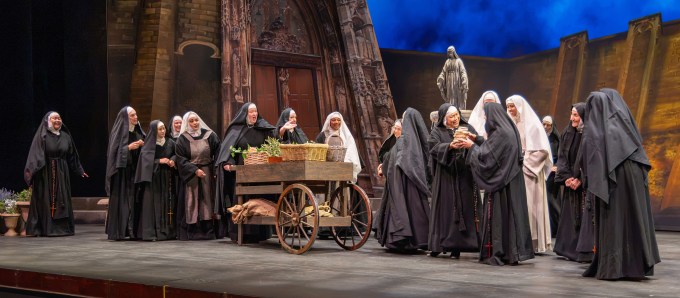
The action plays out in the convent courtyard, beautifully conceived by Set and Video Designer Jean-François Revon. A nice touch in the scenic design is above the convent walls where projected ominous clouds move irresistibly and portentously toward the courtyard.
Apart from the central crisis, the composer and librettist also manage to introduce several other nuns from the sisterhood engaging in daily life. Despite brief exposures and the constancy and shrouding of the habits they wear, they are rendered as having distinct personalities. The high tessitura from the absence of male voices and the consistency of black-and-white religious garb, with the exception of the Principessa, might seem monotonous, but in this 60 minutes makes it more riveting.
Some of the voices under the nuns’ veils are quite good. But at this performance, there were multiple instances of faint vocal projection until the visitation, including from Toomey, who perhaps was saving her voice for the later fireworks which she navigated so well. Music Director Alexander Katsman leads the orchestra, which performs admirably in this one as it should, being one of Katsman’s favorite operas.
I would be remiss not to mention the sad and unexpected passing of Livermore Valley Opera’s longtime Artistic Director Erie Mills. To add to her notable career as an international opera star, she was instrumental in making LVO into a highly-respected regional opera company. Erie was responsible for organizing the 2026-7 season’s productions, and her choices to give exposure to two fine but less performed Puccini operas is greatly appreciated – La Fanciulla del West, to be performed in February-March being the other. Erie will be sadly missed.
Suor Angelica, composed by Giacomo Puccini with libretto by Giovacchino Forzano is produced by Livermore Valley Opera and plays at Bankhead Theater, 2400 First Street, Livermore, CA through October 11, 2026.

