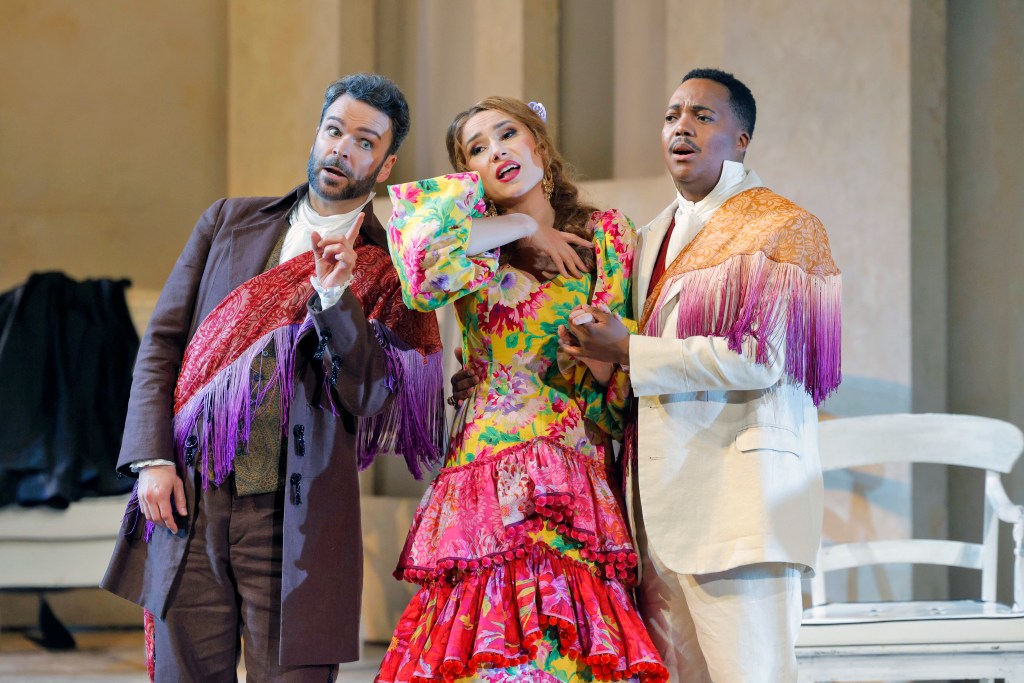
By 1816, opera buffa had about a century under its belt. Composer Gioachino Rossini had something new in mind, to lift the comic level of the action from the subtle to raucous. His vehicle was The Barber of Seville, based on French playwright Pierre Beaumarchais’ play of the same name, and in effect, a prequel to Mozart’s opera The Marriage of Figaro. These two works not only remain in the repertory after more than two centuries, but both are perennially in the top ten of operas performed worldwide.
Along with other music, Rossini produced 39 operas and retired wealthy at the age of 37. A highly gifted composer who made an art form of reprising and stitching together bits of scores from previous use, he hit his zenith at 24-years-of-age with The Barber of Seville. Its music, written in a mere 13 days, is bright and melodic and its characters well drawn and memorable. And for those who appreciate bel canto, it offers every element of expression of beautiful singing.
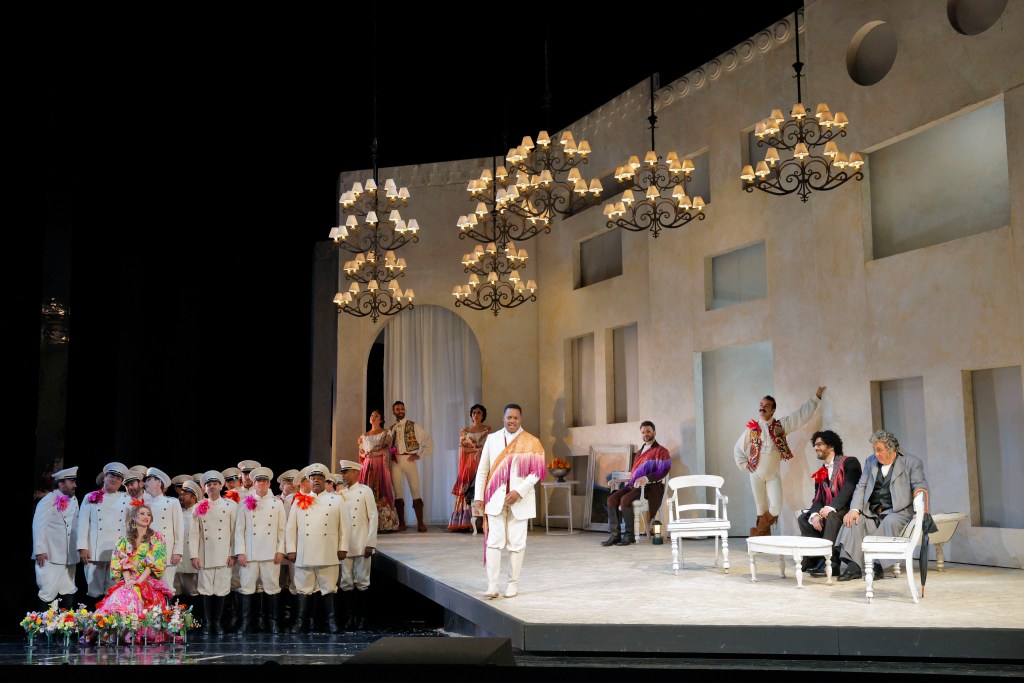
Unsurprisingly given its popularity, in the 101 years since San Francisco Opera first performed The Barber of Seville, the current offering is its 29th production. And what a production! The one versatile “building” in Llorenç Corbella’s set rests on a slanted ramp and takes on various looks with changes in enhancements and lighting. The ramp even serves as a comic mouth when a passel of military men crawl out from underneath it or when a bodyless long arm extends a guitar to Figaro. And the closing is spectacular with accentuated colors added to the neutral look preceding and with the addition of projections and even a stunning 1971 Morgan Plus 8 Convertible as a conveyance for the wedded couple.
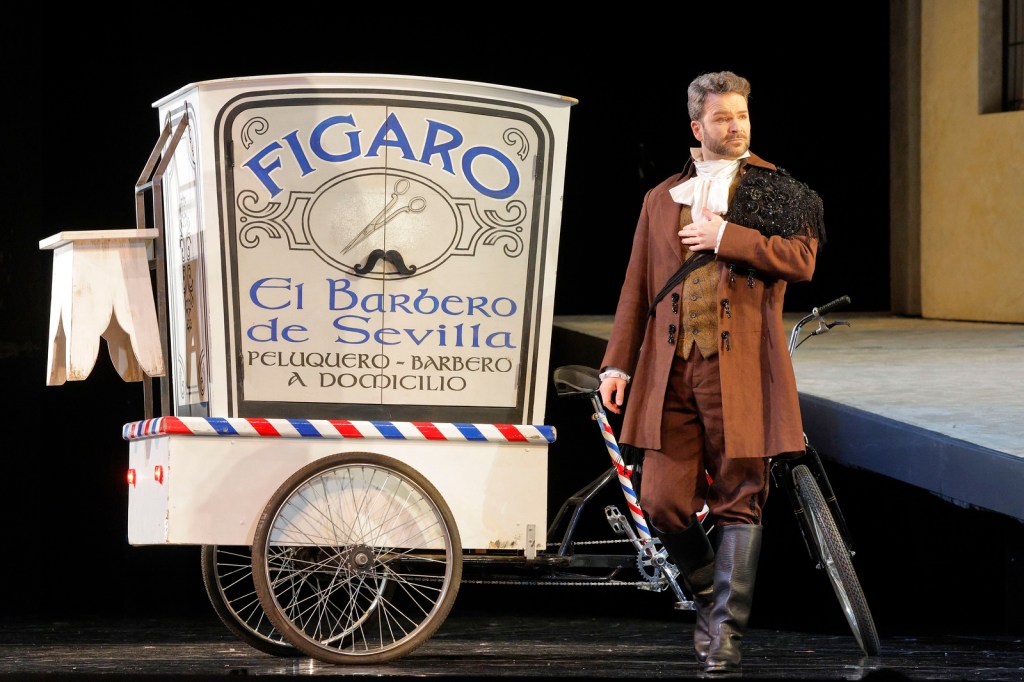
Of course, the magic begins with the music and the comedy, which integrate wonderfully. Highlights from the score start early on when explosive music introduces Figaro in the person of baritone Joshua Hopkins who delivers a fine rapid-patter rendering of “Largo al factotum,” (“Make way for the handyman”), Figaro’s signature aria that even watchers of cartoons know. Unlike most title characters, however, Figaro becomes a facilitator, who nonetheless takes credit for all of the good that happens. The remaining showcases are for other performers or shared with them.
The central plot issue is that Dr. Bartolo is guardian to Rosina, whom he wishes to marry – but quick. Rosina falls for Count Almaviva, who wants her love to be genuine and not based on his position. Thus, he engages in the disguise of a student, Lindoro, to attract her affection. Mezzo-soprano Maria Kataeva is Rosina, and her showstopper is “Una voce poco fa” (“A voice from the past”), both beautiful and bombastic, in which she at once claims to be docile but gives allegiance to Lindoro and vows to be a viper if impeded. Kataeva embraces the highly challenging coloratura aria with flourishes, replete with dramatic shifts in dynamics and thrilling runs.
Levy Sekgapane portrays Count Almaviva and his various guises. His roles demand tremendous coloratura skills, and the high tenor with glimmering timbre answers the bell with the same breadth and precision of trills and ornamentation as provided by the distaff part.
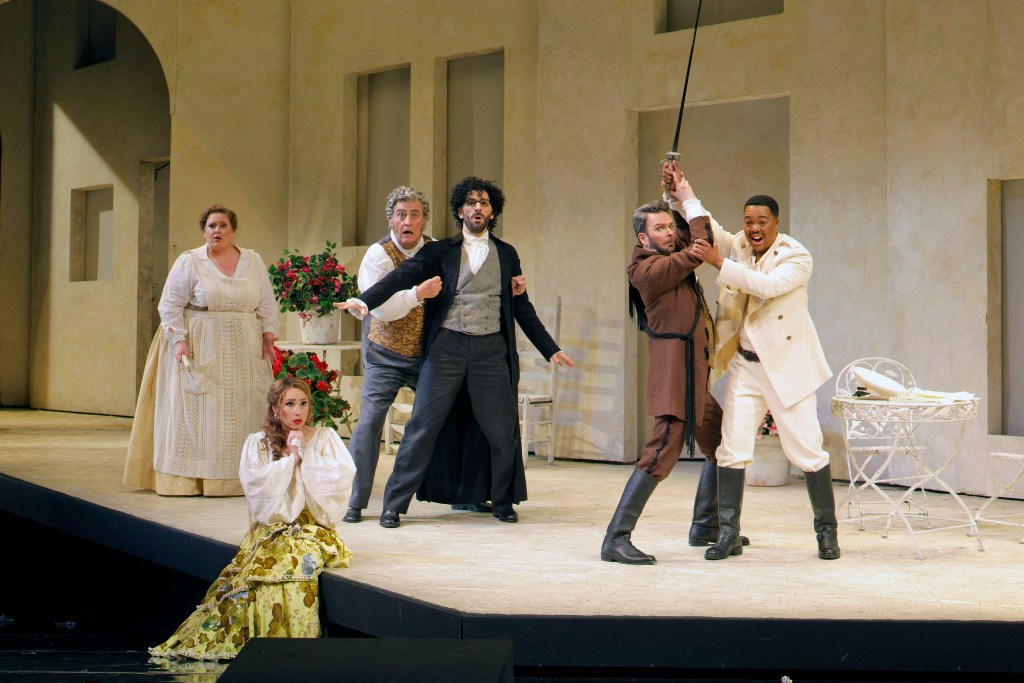
Almaviva does face treachery in his quest however. Bartolo’s accomplice Don Basilio suggests that a little slander will go a long way to discredit Almaviva in his mock-serious “La colunnia” (“Slander”). Riccardo Fassi delivers the ominous but humorous message with precision, but the effect would be stronger if the voice were more powerful. The final aria of the opera, Almaviva’s “Cessa di più resistere” (“Stop resisting”), is pure embellishment for overachievers with a soaring tessitura, but Sekgapane conquers it with grace.
The other key player, is Dr. Bartolo, played by veteran Renato Girolami who sets the standard of comic brilliance in the production, with matching warm vocal quality in his mid-and-upper ranges. Perhaps opening was an off night for him, but he lost considerable volume in the bottom of his range and in some of the rapid patter.
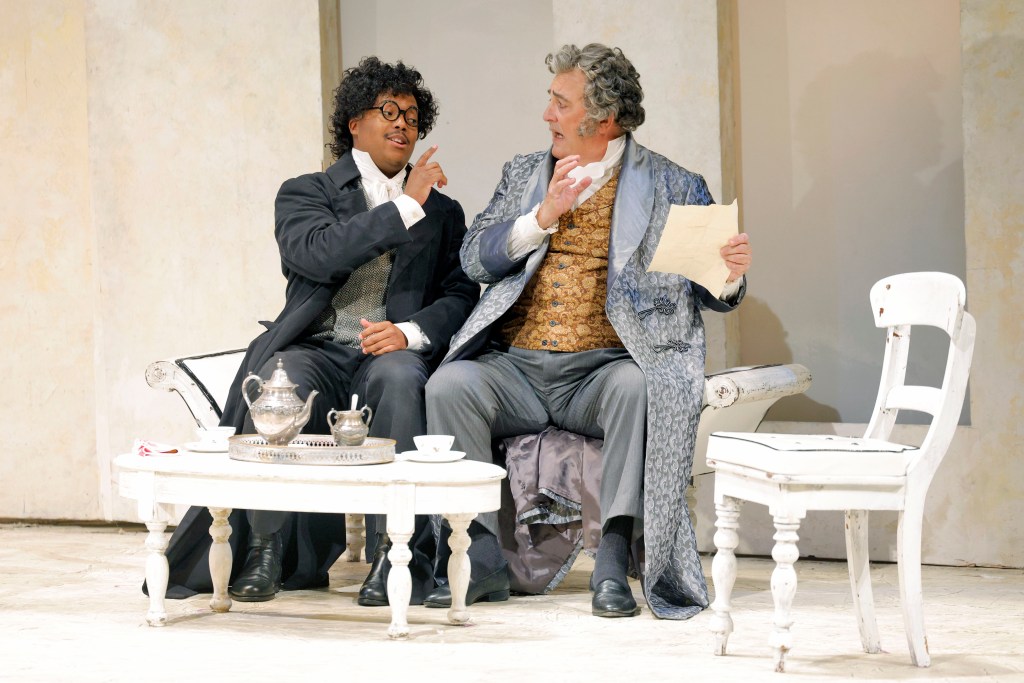
Of course, a lot happens between individual highlights, and the opera is full of ensemble moments, especially the multi-staged Act 1 conclusion. Generous use of chorus and dancers creates a lively atmosphere, and the snippets of flamenco, so strongly associated with Seville, are welcomed.
One criticism is that like so many operas from previous eras, a lot of filler seems designed to make for a longer evening that patrons particularly appreciated back then. That would apply to Almaviva’s last aria as well as Berta, the housekeeper’s. Notwithstanding, a couple of comments on Berta. Local legend Catherine Cook will perform the role going forward, meaning that she has played it for every SF Opera production since 1996. Her illness at opening allowed Adler Fellow Mary Hoskins to stand in and display her considerable talent.
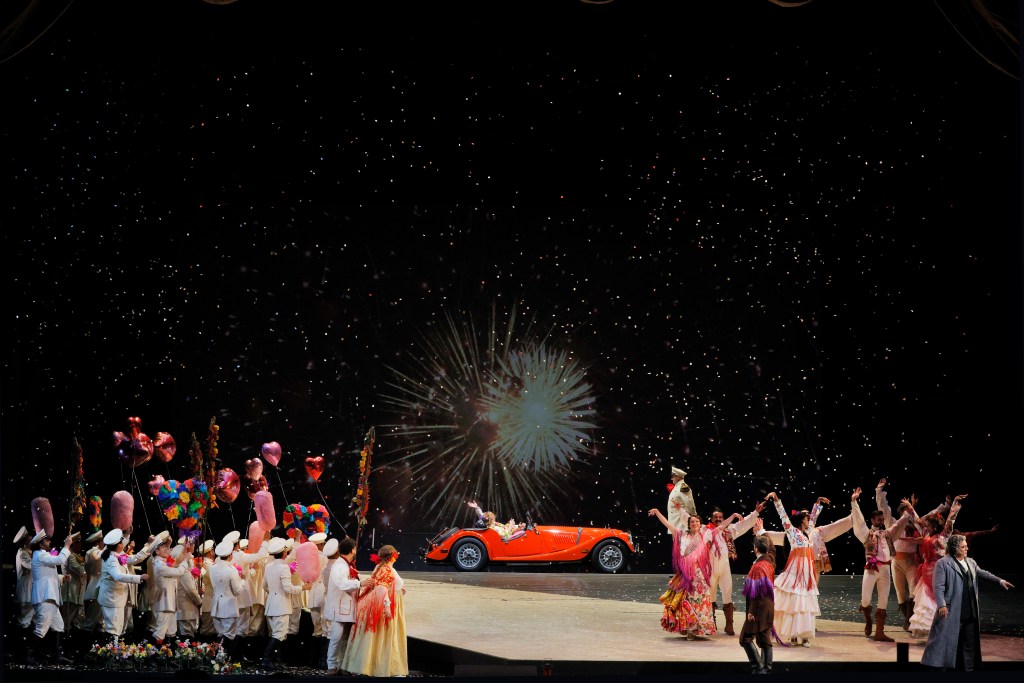
In all, the Emilio Sagi directed production hits all the right notes and makes for a rewarding evening.
The Barber of Seville, composed by Gioachino Rossini with libretto by Cesare Sterbini and based on Pierre-Augustin Beaumarchais’ play of the same name, is produced by San Francisco Opera and plays at War Memorial Opera House, 301 Van Ness Avenue, San Francisco, CA through June 21, 2026.
 cordellreportsdotcom