Although its origins rest in ancient times, the notion of “innocent until proven guilty,” with the additional caveat “beyond a reasonable doubt,” has been the cornerstone of American jurisprudence since 1895. In conjunction with jury verdicts in criminal proceedings that must be unanimous, it provides protection from official abuse that separates enlightened democracies from oppressive authoritarianism.
Sadly, this protection does not extend beyond criminal trials. “He said, she said” civil suits seem to rest on the relative credibility of the complainants. Major league sports associations are quick to suspend players without recourse who are simply accused of illegal or unsavory activity, with the argument that the presumed behavior unpunished sullies the reputation of the league. And, of course, employers and other organizations often penalize individuals on the basis of questionable evidence and with perhaps no due process allowed for the defendant.
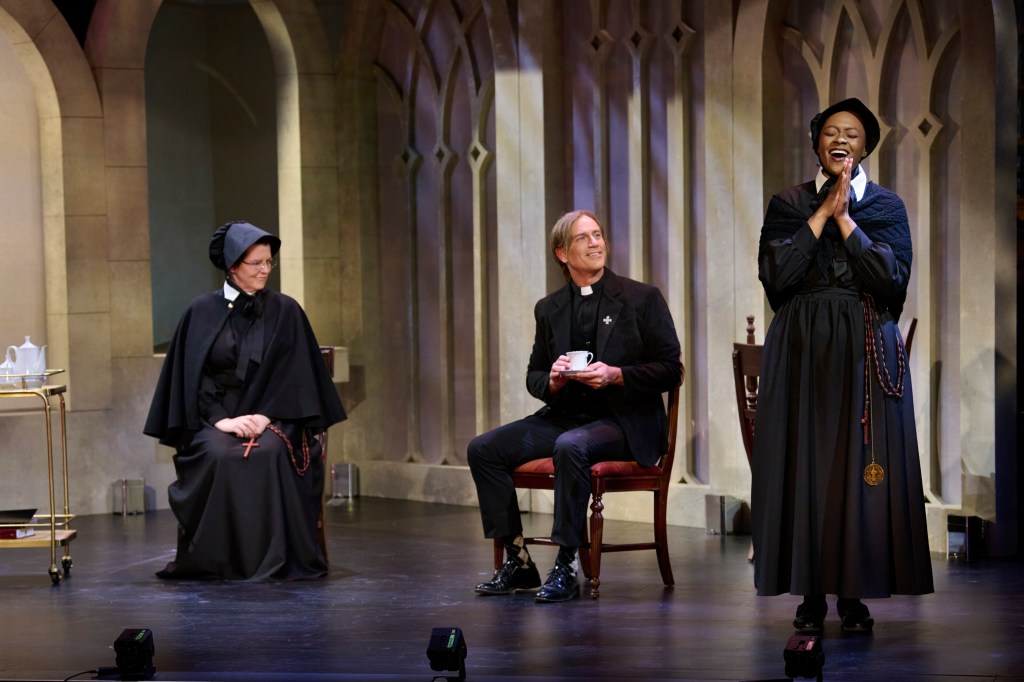
Playwright John Patrick Shanley’s Doubt: A Parable won the 2005 Pulitzer Prize as well as the Tony Award for Best Play. Composer Douglas J. Cuomo, along with the playwright as librettist, premiered the opera Doubt in 2013. Now, the always innovative Opera Parallèle has premiered a new version with chamber orchestration.
Not only does this version retain the riveting drama and humanity of previous realizations, but the smaller orchestra suits the intimate nature of the drama, with a cast of four mostly confined to a single setting. The vocal score is in the modern idiom, but reasonably listenable, while the mellifluous orchestral music in support is very pleasant with warm strings, occasional heralding from brass and winds, and versatile percussion. In an agreeable nod to an instrumentalist, the lead violist twice stood apart from the orchestra for solos.
The story is simple but gripping. At a Catholic school in the Bronx in 1964, School Principal Sister Aloysius suspects that the Parish Priest Father Flynn has sexually abused Donald, a 12-year-old boy student. Being of inflexible attitudes and values, she dislikes the priest because he uses a ballpoint pen (!) and keeps his fingernails too long. Driven by unreasoned certitude, she seeks to destroy Flynn by any means. And though she is a stickler for rules, she breaks them when they serve her purpose.
While whatever outcome will most affect Father Flynn, the narrative is really a character study of Sister Aloysius and a metaphor for larger society. In a sense, she was of her time, when the Catholic Church expected lockstep adherence to its principles, but she represents the excesses of the “true believer,” like the thoughtless followers of charismatic leaders in the political world whose beliefs are guided by what they want rather than by facts. Her practices are so extreme as to be fanatical and of the sort, whether in despotic religion or tyrannical politics, that breed adverse reaction and rejection.
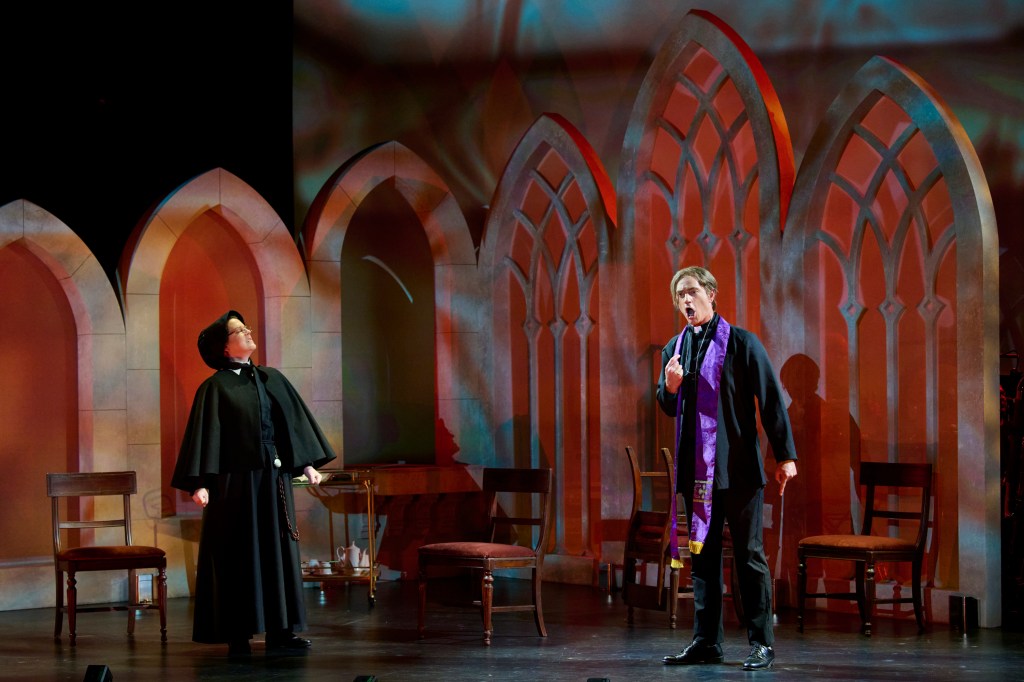
Rhoslyn Jones is a lockcinch fit for Sister Aloysius. In look, posture, and gesticulation, she conveys the imperiousness of her character and her disdain for others, especially Father Flynn. Though Jones has a resumé that includes lyric roles, her singing here is accurate but harsh in the style of a dramatic soprano, as suits her character.
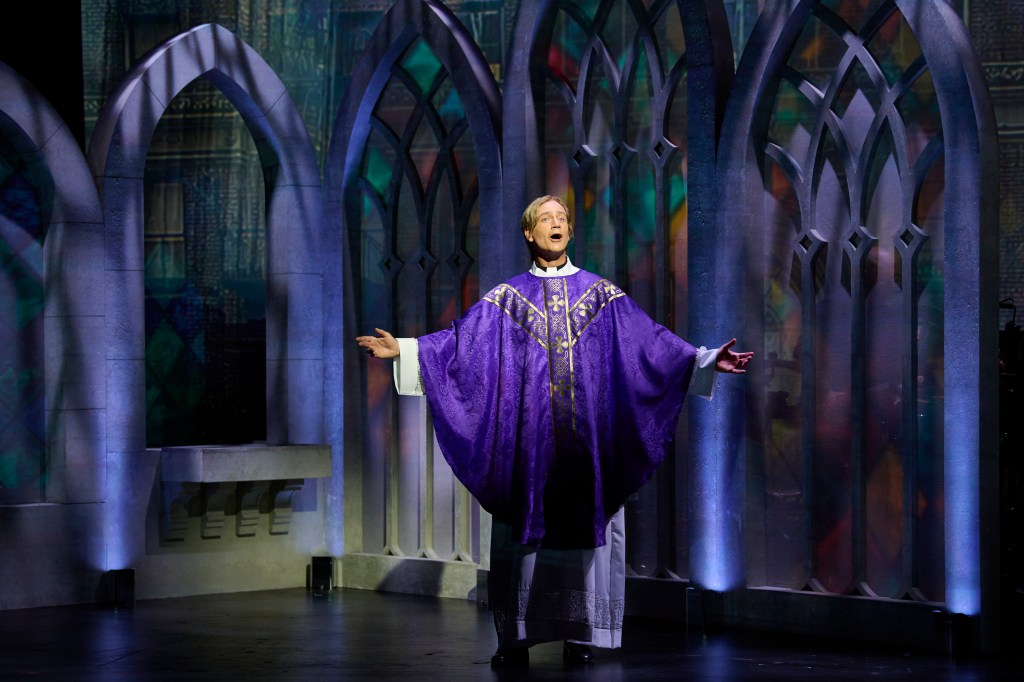
Her nemesis, Father Flynn, is portrayed by Matthew Worth who originated the role in the Minnesota Opera premiere with full orchestration, so he clearly excels in it. With a warm but full-bodied baritone that fills the hall and easy-going mannerisms, he is credible as a sympathetic priest who would be liked and trusted by young people. He even relates to the audience by breaking the fourth wall and delivering a sermon as if it were his flock
But the questions remain. Did he give altar wine to Donald? Did he have or attempt to have sexual contact with him? Because Donald is a lonely black boy in an Irish and Italian community school, Sister Aloysius’s antenna are particularly sensitive that Father Flynn’s sympathy may lead to inappropriate contact. And Worth’s expressions of Father Flynn’s ambiguities heighten the drama.
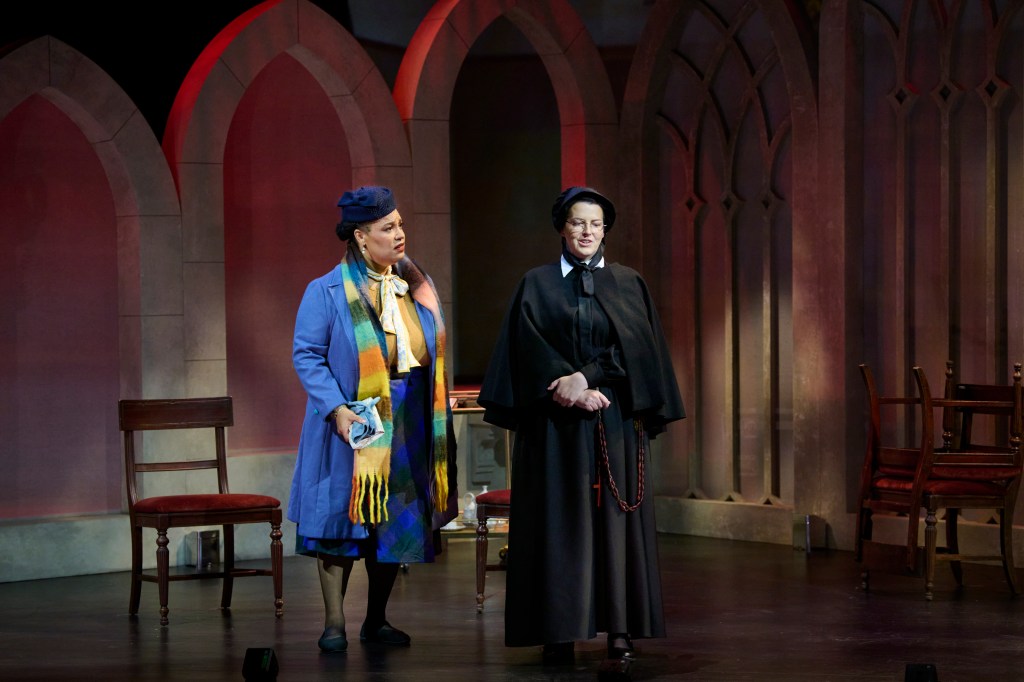
The other two performers delight as well. Naomi Steele, as school teacher Sister James, is sweet in affect and voice. Her observation which led to Sister Aloysius’s suspicions will be something she regrets, but as the latter is her boss, she feels trapped. Deborah Nansteel is a bit of a surprise as Donald’s mother, Mrs. Miller, because while the role is important, it is small – a single meeting with Sister Aloysius. But Nansteel’s vocal power commands the attention as does her acting. While sharing private matters with the principal, she expresses concern that Donald graduate middle school and move on to public high school. Dubious about her motivations, Mrs. Miller is quite candid in questioning whether the principal is on her son’s side.
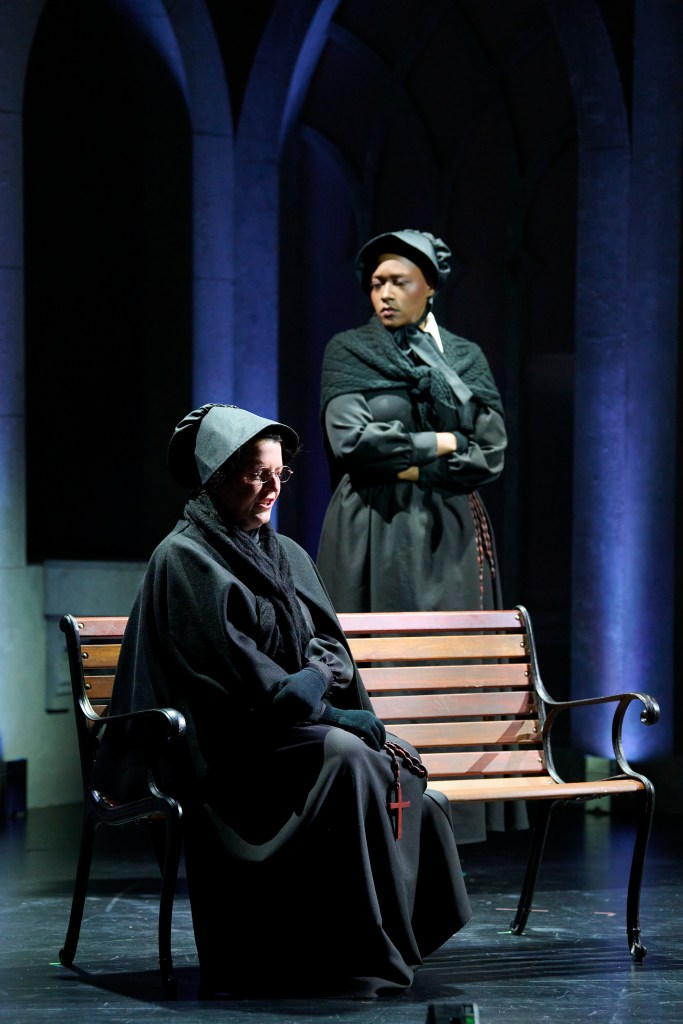
Doubt played at the renovated Presidio Theatre, a beautiful space and part of the transition of the military post to private use. However, the performance area is on the small side, and having the orchestra on stage intrudes on the set, with the result creating the sense of a dressed concert version of an opera. Some compensation comes from extensive use of projections that even extend to the side walls to enhance the look.
As expected, Conductor Nicole Paiement on the musical side, and Director Brian Staufenbiel on the staging side, combine to produce a wonderful operatic experience.
Doubt, an opera composed by Douglas J. Cuomo with libretto by John Patrick Shanley, was a world premiere chamber orchestration produced by Opera Parallèle, and performed at Presidio Theatre, 99 Moraga Avenue, San Francisco, CA through May 31, 2026.

