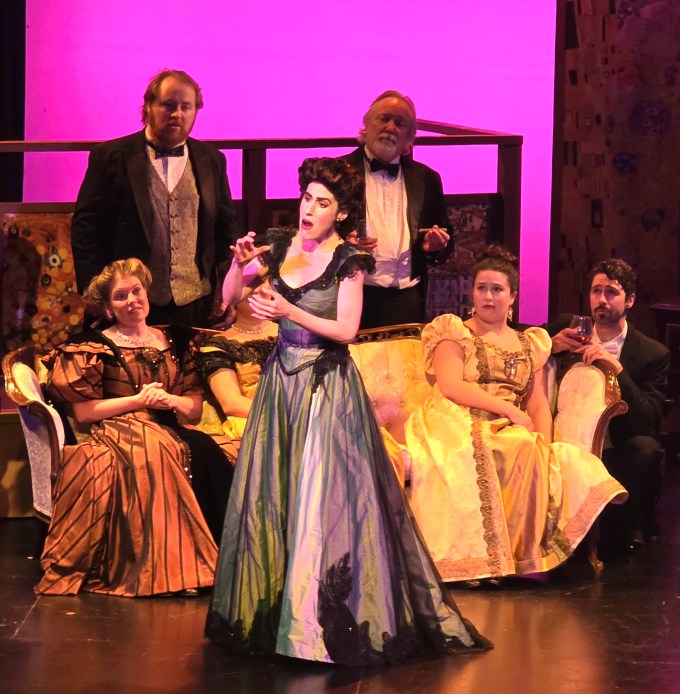
Giacomo Puccini was perhaps opera’s greatest master of melody. Chronologically following his three wildly popular pieces (La Boheme, Madama Butterfly, and Tosca), the less frequently performed La Rondine (“The Swallow”), displays a maturity of his craft and combines some unique elements.
Since La Rondine was commissioned in Vienna as an Austrian-styled operetta, it contains light musical idioms as well as the integration of ballroom dance rhythms as tropes that make it special in his canon. Some aficionados consider this opera to be superior to Puccini’s more familiar ones, and Pocket Opera General Director Nicolas A. Garcia even identifies it as his favorite opera altogether. The company takes on this special work and endows it with a strong cadre of voices and a lush if compact production that make for wonderful entertainment.
The plotline could be characterized as La Traviata Light, as it concerns a courtesan who shares a loving relationship with a man whose family is not likely to support marriage. But, unlike Violetta in the Verdi opera, in this one, the central character Magda does not die.
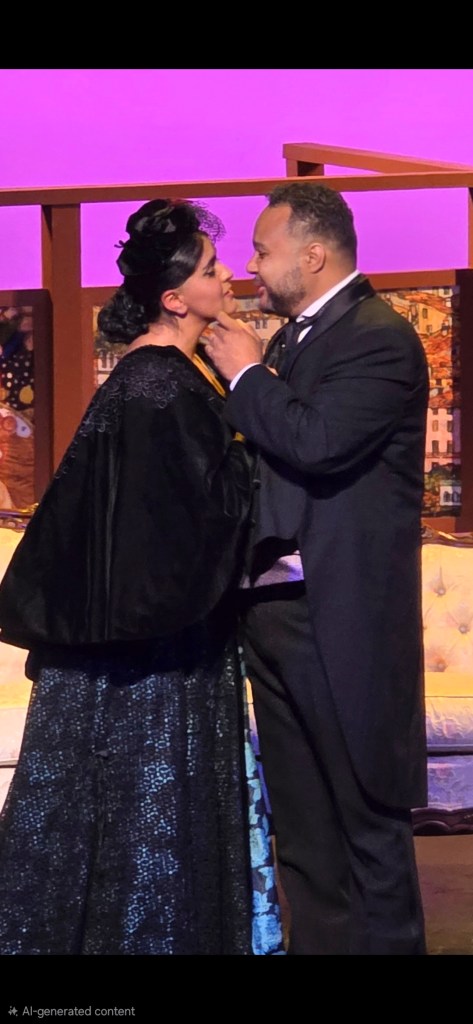
Contextually, La Rondine holds an unusual place within Puccini’s operatic output. The maestro composed eight full-length operas. Dismissing the unsuccessful first produced, Edgar, which the composer deemed unredeemable, the remaining seven all have females as title characters. All but two are tragedies, with at least a key female principal dying. Tongue-in-cheek, some aficionados will say that if the heroine doesn’t die, it’s a comic opera. In this case, the narrative is legitimately comic in great part, relieving the weightiness that comes with many operas.
Structurally, while his previous operas had traditional pauses after arias and ensembles for applause, this one is through-composed, which in the case of many composers implies little in the way of memorable set pieces. But, after all, this is still Puccini.
So what is La Rondine really about? In the case of both female leads, they will have the opportunity and even the taste of greener grass, a new life that each has aspired to. But there are obstacles, known and unknown, and the question remains whether they can succeed and at what price. Will either fly away, or does the swallow return to its home?
The most satisfying, hauntingly beautiful melody and recurring leitmotif that most embodies La Rondine is about a character who doesn’t exist in the opera. Magda is a Parisian courtesan who holds lively soirees. One of her regulars is the poet Prunier (performed by the talented, bright-voiced tenor Alex Taite) who begins to tell the story of his creation, Doretta who has forgone wealth for true love. Magda, who will face this quandary herself, picks up on the tale as if it were her own and completes it with the magnificent “Chi il Bel Sogno di Doretta,” (“Doretta’s Dream”). Michelle Allie Drever is Magda, and she absolutely owns this lilting and limpid aria with her imposing, exceedingly powerful, darkly colored soprano.
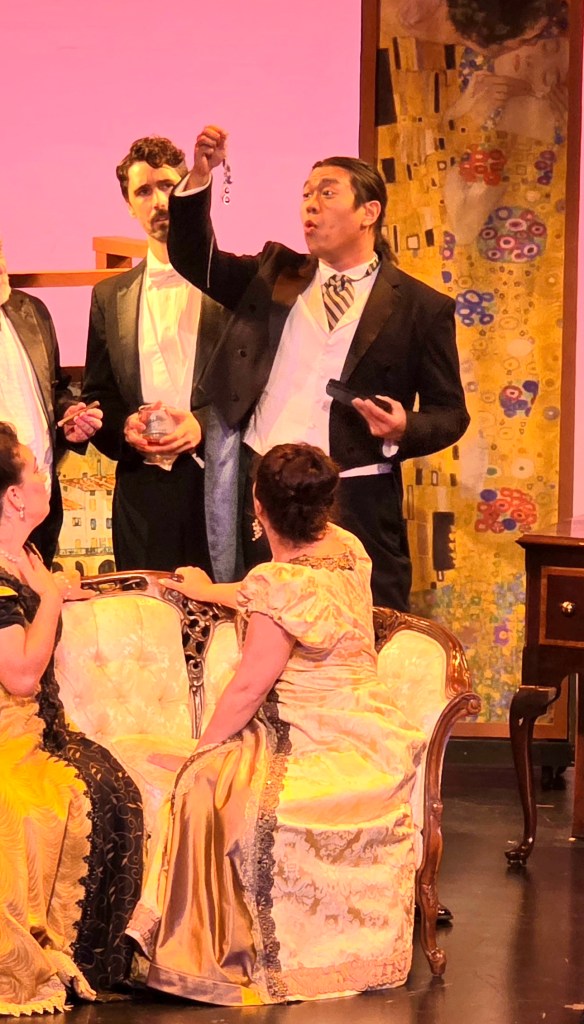
In an unusual twist, Prunier is not interested in Magda, but in her maid, Lisette. In another unusual twist, Lisette, who is played by delightfully captivating soprano Melissa Sondhi, is saucy, defiant, cigar-smoking, and even borrows Magda’s clothes, hardly the invisible servant.
When Magda crosses paths with her impossible love, Ruggero, played by tenor Maxwell Ary, at the restaurant Chez Bullier, she is disguised to the extent that Ruggero doesn’t recognize her. Yet, he falls in love with Magda again in her guise as Paulette. Prunier and Lisette have also gone to Chez Bullier, and the four will collide by accident, with the lively result being a charming quartet, “Bevo al Tuo Fresco Sorriso” (“I Drink to Your Fresh Smile”), another musical highlight.
The fifth wheel in these proceedings is Rambaldo, a wealthy banker who has been Magda’s protector and sugar daddy. Portrayed with delightful ambiguity by compelling baritone Michael Kuo, it is uncertain whether he will be there for Magna should she return to her previous life if she separates from Ruggero.
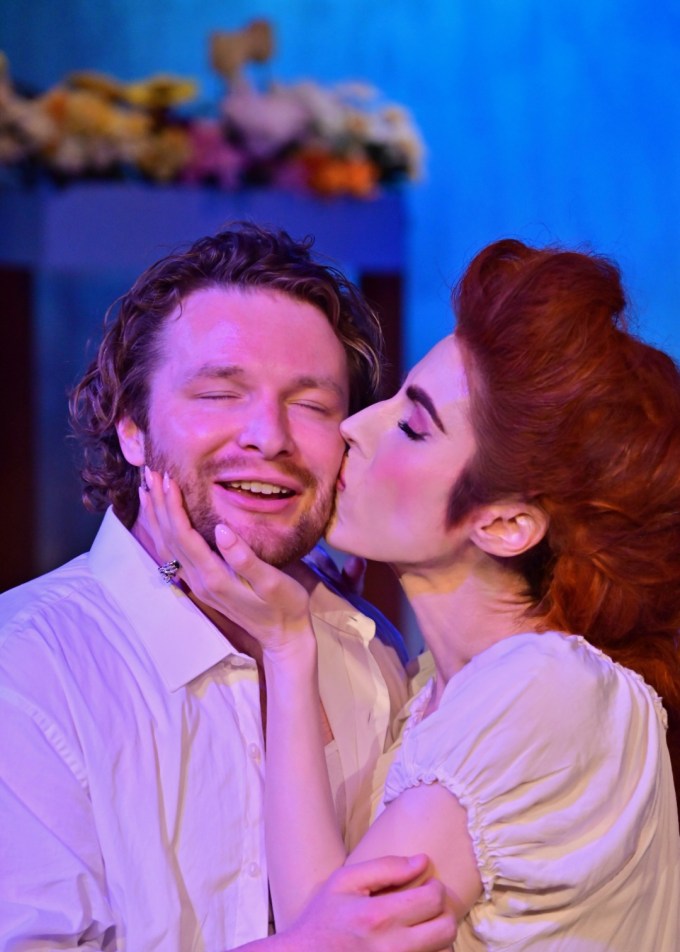
While La Rondine lacks the compendium of memorable arias and ensembles of some other Puccini operas, what it does have is warm, mellifluous music from end to end and characters that connect with the audience. And Pocket Opera always delivers more than should be expected from a company of its size – not to mention that it presently operates with the logistical disadvantage of performing each production at three very different small venues, an hour or more apart from one another.
Nonetheless, staging and costumery capture the period feel. Stage Director Elly Lichenstein creates a lively ambiance when called for, and Music Director Mary Chun leads the small but effective orchestra with conviction.
La Rondine, composed by Giacomo Puccini with libretto by Giuseppe Adami translated to English by Donald Pippin, is produced by Pocket Opera in co-production with Mercury Theater, with remaining performances at Legion of Honor, 100 34th Avenue, Lincoln Park, San Francisco, CA through July 26, 2026.

