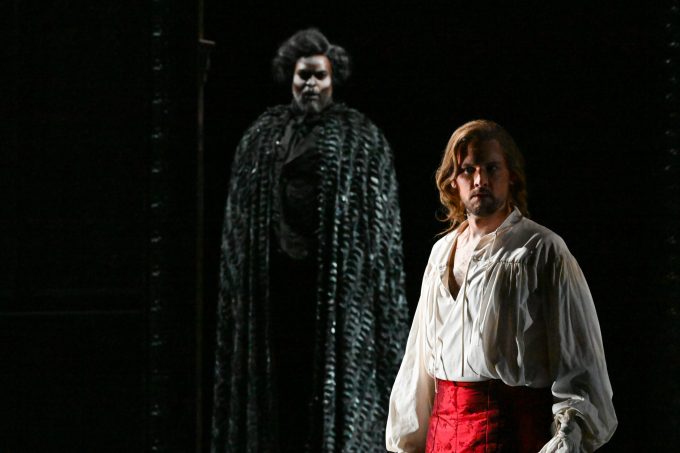
Mozart was likely the most precocious and prolific composer of all time, one of the few equally adept at opera and orchestral music. His operatic masterpiece, Don Giovanni, replete with glorious music stemmed from his fertile relationship with librettist Lorenzo da Ponte, whom he also teamed with on his classics Le Nozze di Figaro and Cosi fan tutte.
What makes Don Giovanni so unique in the whole operatic canon is its engrossing characterizations and plotline with its seamless blend of comedy, tragedy, and fantasy. Though Mozart’s name may appear above the title and is the one that virtually all sentient beings in Western civilization and elsewhere will know, da Ponte perhaps deserves greater recognition than the composer for crafting a harmonious tone with the engaging narrative and lyrics that distinguish the piece.
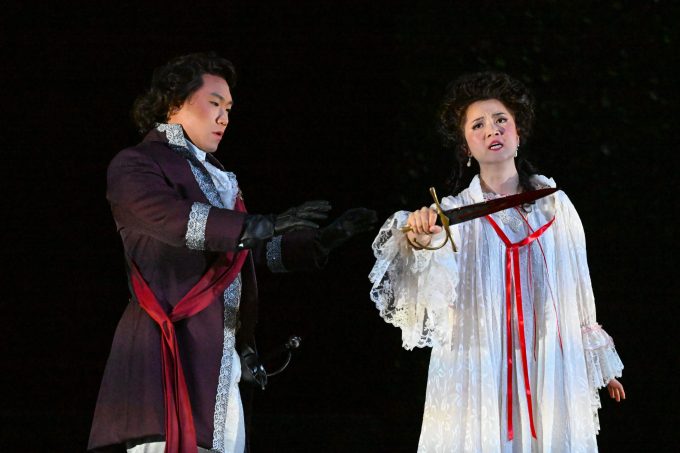
Opera San José has produced a stunning version of this wonderful opera under the able direction of Alek Shrader. The casting and performances are outstanding with a production design to match.
The story centers on a Don Juan figure who exploits his way through much of the sexually desirable female population within traveling distance. Wm. Clay Thompson portrays the title character and what a fit he offers (other than looking a little young for having such a multitude of conquests!). As if being tall and handsomely rakish weren’t enough, his warm baritone voice and convincing portrayal complete the package.
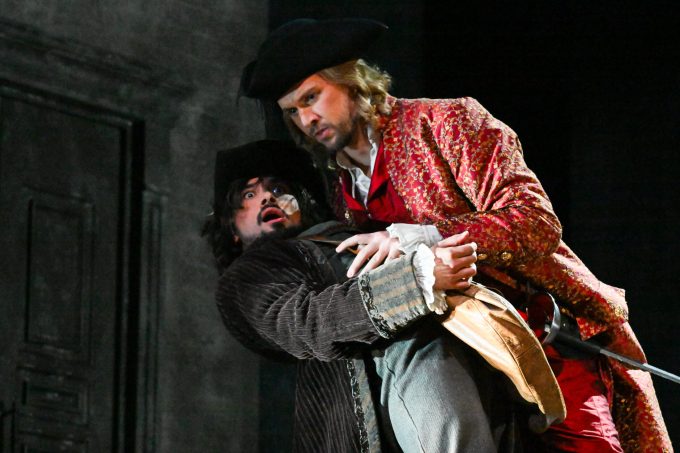
The Don’s aide-de-corruption and only known comrade is his servant/sidekick Leporello who accommodates but bridles at serving rather than being the subjugator. Bass-baritone Phillip Lopez sings with a booming voice and extracts humor with flair and precision equal to Thompson. The voices of corruptor and accomplice blend with complementarity, Thompson’s being smooth like an exquisite artisan chocolate and Lopez’s rich like a dark roast coffee. Leporello lives vicariously through his master’s triumphs, and reveals a sense of pride in them as Lopez sings with glee the notable “Madamina, il catalogo è questo,” the catalogue aria, in which the servant details his master’s thousands of sexual adventures across the map of Western Europe.
Three love interests appear, a delightful trio of talented sopranos with different vocal quality in accordance with the emotions of their characters. Each has the opportunity and does indeed shine. Yulan Piao is Donna Anna. Her father, the Commendatore who is depicted by the redoubtable Kenneth Kellogg, is slain by Giovanni in a sword fight. Because Piao’s character constantly rages with vengeance, she sets aside her superb lyric vocal style and displays a stern but controlled dramatic voice as she plots to bring Giovanni down for murdering her father and attempting to rape her.
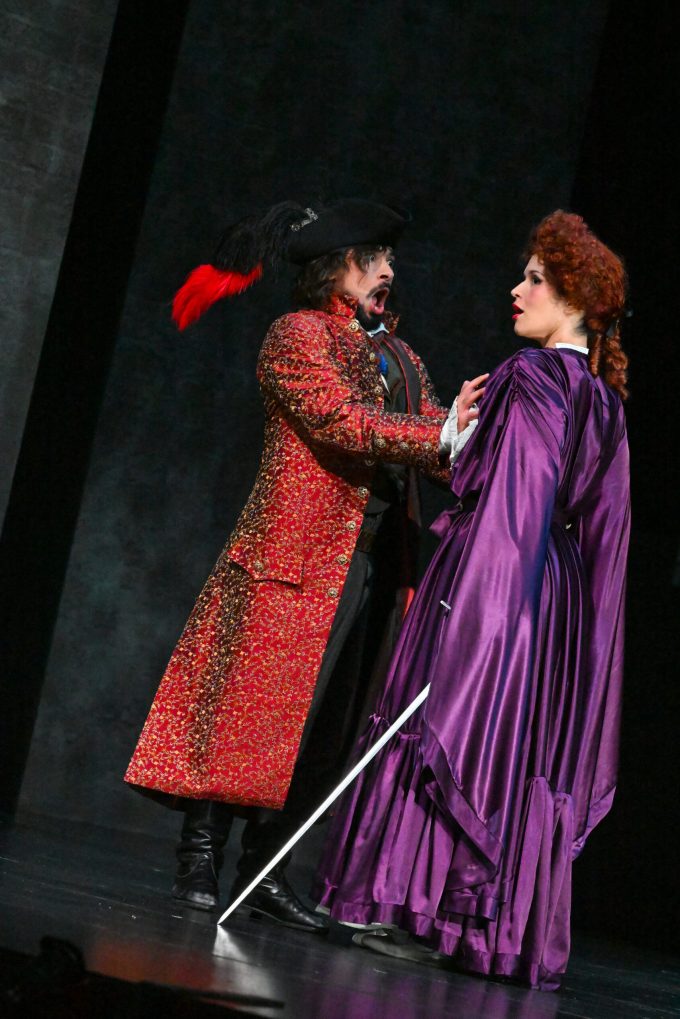
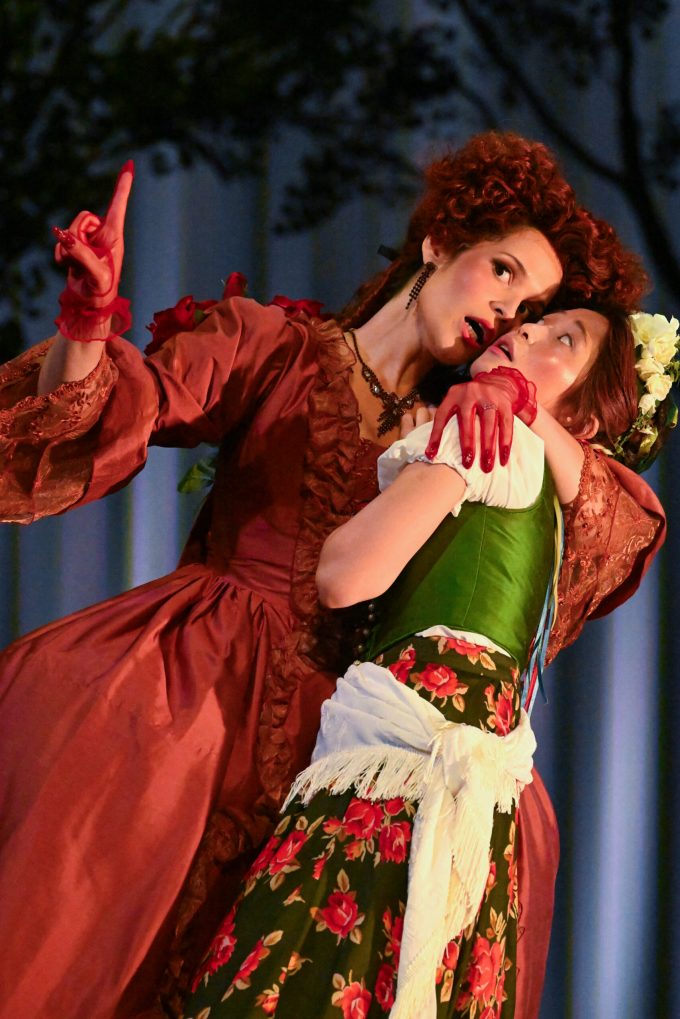
Donna Elvira represents ambiguity. She simmers rather than rampages, a sentiment that Maria Brea acts and sings with gleaming aplomb. Giovanni actually married and then abandoned Elvira, and while she would like to see him punished, she still yearns to have him for her own.
As Zerlina celebrates her pending marriage, Giovanni sweeps her away by dint of his suave style and social status. The peasant girl is played by Nicole Koh, who possesses a beautiful lyric voice. While the whole cast enliven their characters with good acting coming mostly from facial expression, Koh is a full-body actor who is a joy to watch as her saucy character frets and fidgets. She and Thompson also shine in the opera’s most famous music, the charming seduction duet, “Là ci darem la mano.”
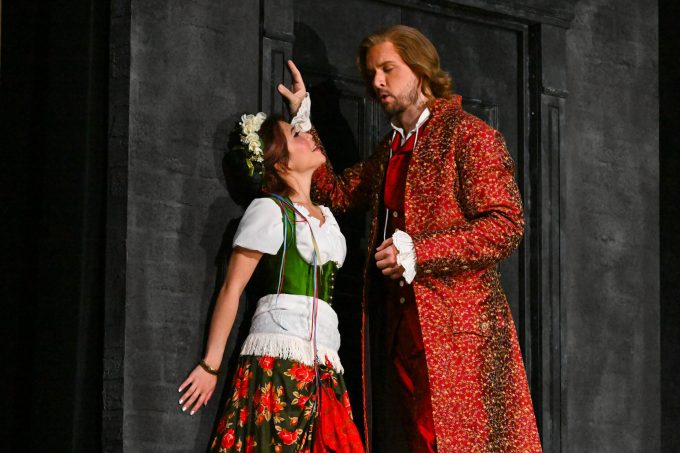
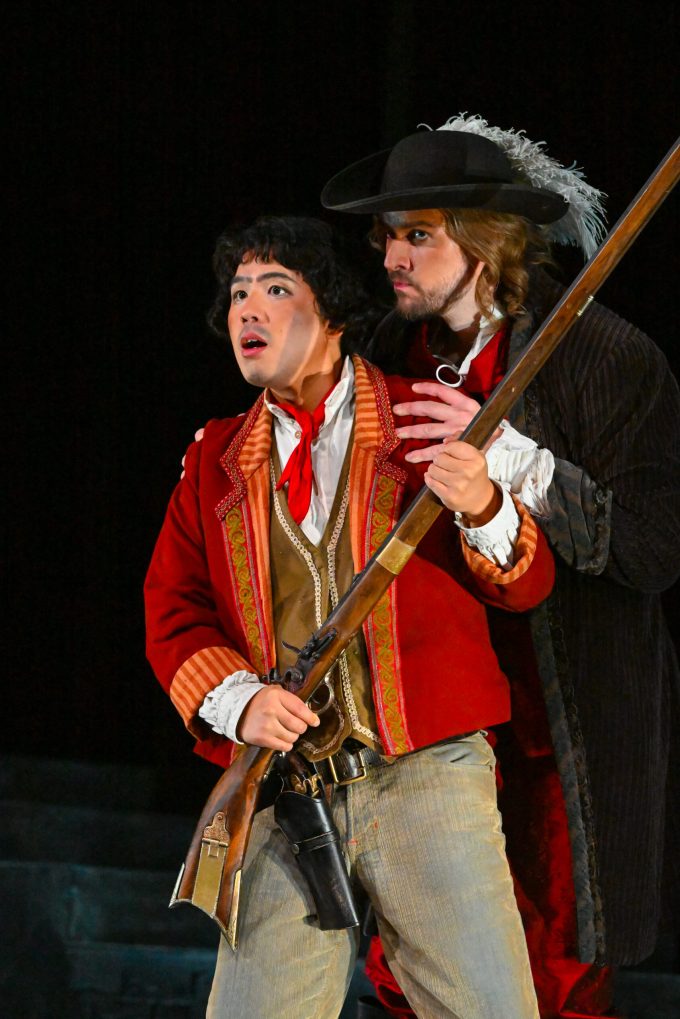
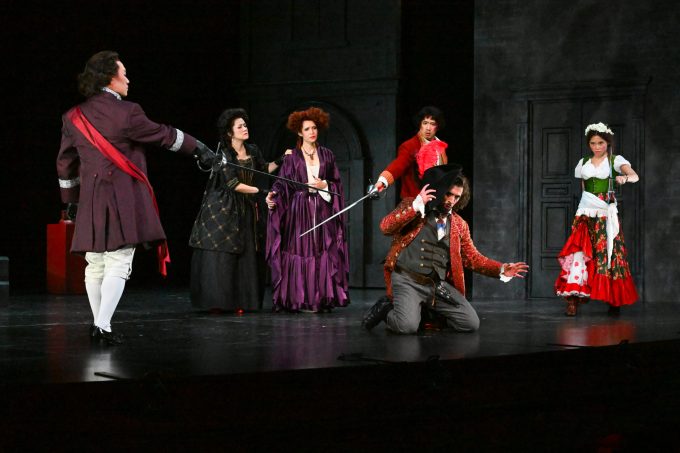
Ultimately, the three women ally to bring down the deflowering brigand with the help of male friends. Anna’s intended, Don Ottavio, sung in the style of a polished Italian tenor by Jonghyun Park, and Masetto, Zerlina’s fiancé, sung by big-voiced bass-baritone Joseph Park join in the posse.
The action plays against a somber stage of hushed color and simple lines that lacks sparkle except during the party scene, yet it serves as a muted canvas for the vividly clad players who visually pop as a result of contrast lighting. The overall visual effect is in keeping with the artistry of chiaroscuro, reflecting the contrasts of light and shadow as well as comedy and tragedy, and with the cinematic genre of film noir by ensnaring innocents in a life-altering web. All of this is musically driven from the pit by Maestro Joseph Marcheso and his fine orchestra.
So what is Don Giovanni really about? Clearly the Don possesses surfeits of narcissism and hormones, but does he really understand the damage that others suffer because of him or does he simply not care? He is certainly dismissive of the value of the Commendatore’s life, which he took, and gladly deflects blame for his own actions on the hapless Leporello. Does he not see his victims as human beings? Does he feel that social and legal rules are for others but not for him? These days, it’s hard not to see art through the prism of today’s political environment, and it is especially salient when today’s driver is a fellow named Don.
In a sense what is more chilling than the derangement of one powerful individual is that of his/her followers. Particularly poignant is the evasive Leporello’s comment upon Don Giovanni’s death that he hopes that his next master is nicer. This is a fascist follower’s self-permission to exempt himself from blame for the offenses committed, even though they have been enabled by the follower. This flabby justification is just the premise that totalitarians rely on to control and abuse a population. It will be interesting to see what direction spineless congresspeople who have lockstep supported The Don will do when he is gone.
At over three hours run time, the opera is a bit taxing. Fortunately, the music enthralls from the dark and jarring salvo at curtain up to the death of the Don. Actually, the death is a false ending, and action goes on, but at least with more Mozart music. Occasionally, artists seem underpowered, not from vocal weakness but from underestimating the acoustics of the space. Notwithstanding minor issues, Don Giovanni entertains and provokes at the highest level.
Don Giovanni, composed by Wolfgang Amadeus Mozart with libretto by Lorenzo da Ponte, is produced by Opera San José and plays at California Theater, 345 South First Street, San Jose, CA through September 27, 2026.

