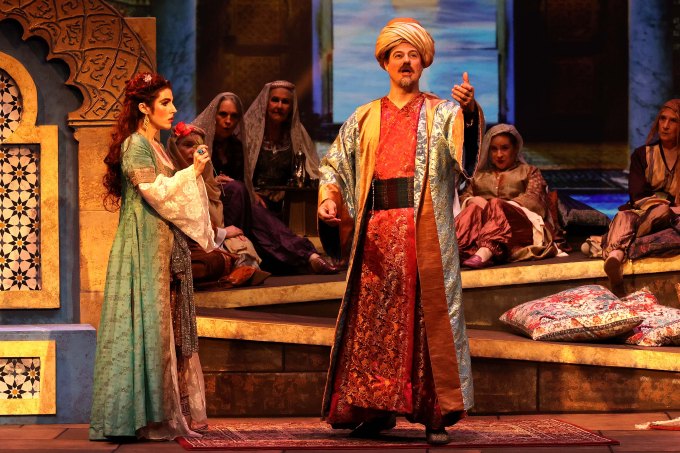
Other than Idomeneo, Abduction from the Seraglio (Die Entführung aus dem Serail) is Mozart’s earliest composed “opera” that remains in the repertoire. However, it is really a classic singspiel with a considerable amount of dialog. A vital role, the Pasha Selim, is even a completely spoken role, though performed by the accomplished bass Kirk Eichelberger. As many deficiencies as bedevil this piece, it works on its own terms, as an engaging narrative with beautiful and challenging music. West Bay Opera has produced a captivating version of the work.
The opera largely concerns the clash of European and Middle Eastern values. Three Europeans who were captured by pirates have been sold to the Turkish Pasha Selim, whose factotum Osmin, actually the chaperone of the Pasha’s harem, often acts as his gatekeeper. Belmonte, the Spanish fiancé of Konstanze, one of the captives, arrives in search of her. Belmonte engages with the ill-tempered Osmin, who provides resistance rather than assistance.
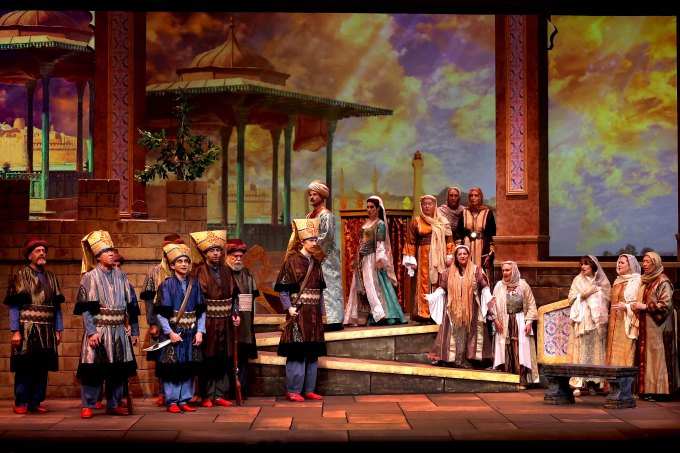
Osmin is stereotyped as a Muslim who holds Europeans in low opinion and treats them accordingly. Conversely, the libretto depicts the Pasha kindly, as he refrains from forcing himself on Konstanze, even though he is greatly attracted to her and could simply command that she accept his advances. The action of course centers on the efforts to free the prisoners from the grasp of Pasha, and ends with some interesting, if improbable, twists. Note that the composer and librettist’s (Gottlieb Stephanie) deference to the Pasha flies in the face of Austrian antipathy toward Turks as the Ottomans had twice sieged Vienna, most recently a century before the opera.
Abduction opens with a lively and familiar overture that foretells some of the themes that follow. In addition to traditional Baroque music, Mozart also introduces some Turkish musical idioms that enrich the score.
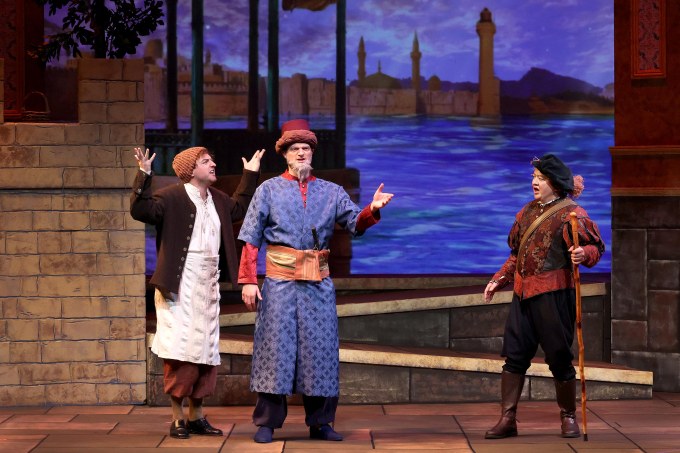
The young composer did present challenges for lead principals, which each surmounts. Michelle Allie Drever is a wonderful Konstanze. Drever displays a penetrating and mellifluous voice. Her Act 1 reflective aria “Ach ich liebte, war so glüchlich!” (“Ah, I was in love, I was so happy”) is the apotheosis of virtuosity – full of sparkling coloratura riffs, leaps, and roller-coaster arpeggios.
Yet, her Act 2 aria “Marten aller Arten” (“Tortures of every kind”), in expectation of the degradation she faces, is considered even more difficult. Why? Not only is the aria itself a demanding eight-minute ordeal, but it comes on the heels of a lead-in eight-minute aria, testing the endurance of the soprano singing the role. Drever nails it as well. Mozart would never again demand 16 minutes of solo singing by a single artist with only a minor break.
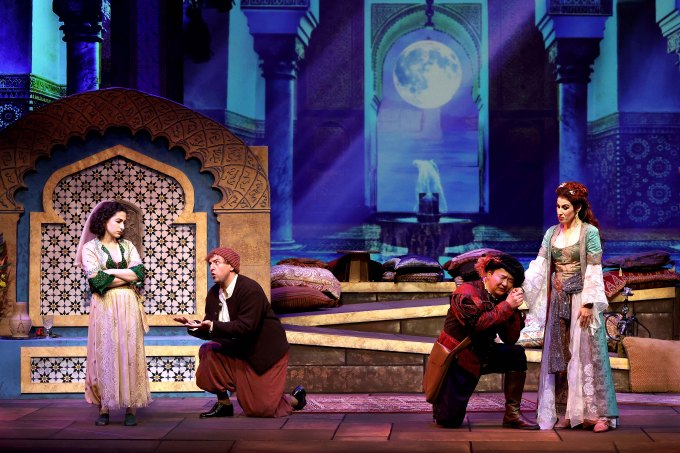
Osmin, acts as the antagonist, and Casey Germain is a fine exemplar. The bass voice must be able to sing tunefully with rich darkness in the mid and upper ranges but must also be able to plumb the depths. Osmin’s role demands the full gamut of the bass’s voice, and Germain responds. His memorable Act 3 aria when he ponders besting his enemies “Oh, wie will ich triumphieren” (“How triumphant I shall be”) descends to the basso profundo range to a low D. Like most basses, Germain loses amplitude at that level, but he is impressively true and clear.
Our hero Belmonte comes to free Konstanze along with two servants. Hak Soo Kim portrays Belmonte and delivers a warm, seemingly relaxed tenor voice. He holds the long notes with glee and excels in all of his arias, the most notable being the beautiful ode to lovers’ reunion “Wenn der Freude Tränen fliessen” (“When tears of joy flow”).

The principal cast is limited to five singing parts. The remaining two are servants Blonde (soprano Lora Bashmakian) and Pedrillo (tenor Caleb Alexander), both of whom shine in their solos. In addition to fine arias, the composer has crafted wonderful (almost obligatory at that time) act-ending ensembles with a fine trio ending Act 1 and a quartet of two loving couples ending Act 2.
While the opera and this particular production are delightful, the work is not without weaknesses, starting with its reliance on the spoken word which disrupts the flow of the piece. Another is repetition in both music and lyrics. For those familiar with the movie Amadeus, you’ll recall that Emperor Joseph II questioned Mozart whether there weren’t too many notes in this opera, to which Mozart replied that each one is needed. I would agree with the emperor.
Much of the singing takes place in the stand-and-deliver style that doesn’t integrate well with the action. Nonetheless, in Abduction we hear music that anticipates the mature Mozart in his most polished later works that would make him one of the greatest opera composers of all time.
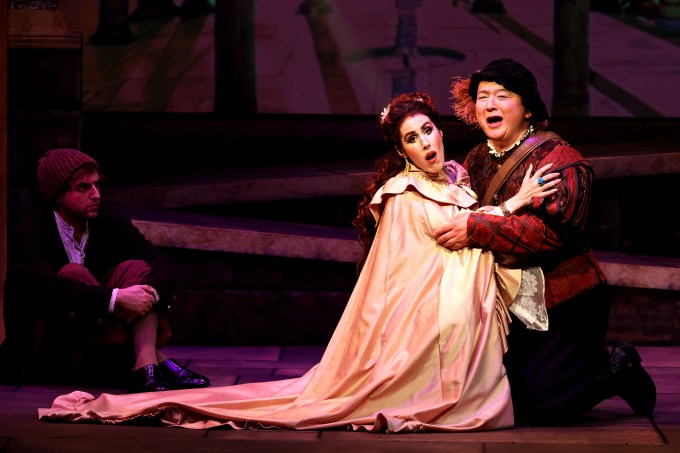
Finally, this production is visually appealing with striking costumery (Callie Floor) and set design (Peter Crompton) heavily aided by projections. As always, Maestro José Luis Moscovich conducts the orchestra with great panache.
The Abduction from the Seraglio, composed by Wolfgang Amadeus Mozart with libretto by Gottlieb Stephanie, is produced by West Bay Opera and is performed at Lucie Stern Theatre, 1305 Middlefield Road, Palo Alto, CA through October 18, 2026.

